Direct answer
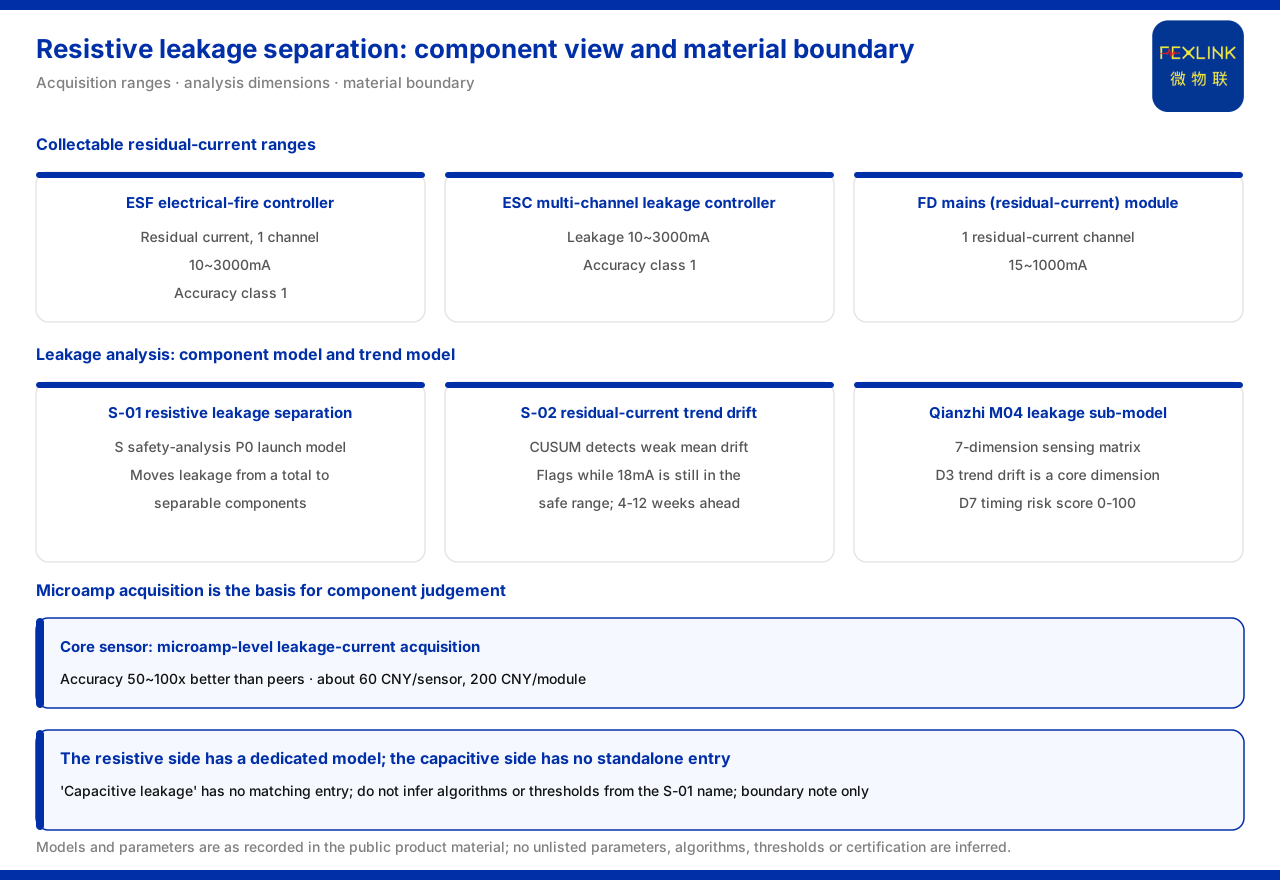
The product material does treat "resistive leakage" as an object that can be separated on its own: the S safe-analysis board of the Tianyan engine lists "resistive leakage separation" (S-01) as one of its first-release models. But the material contains no independent entry for "capacitive leakage", and no algorithm parameters or thresholds for that component. What can therefore be cited is that "the analytical dimension of distinguishing resistive and capacitive components comes from the product system"; it cannot be used to infer the algorithm, the accuracy or the threshold of the capacitive side. The distinction matters because an engineering reader who sees a separation model named after the resistive component may assume that the complementary component is equally defined, whereas the material supports only the first half of that assumption.
The sections below set out the evidence in the order in which it should be read: first the separation model that does exist, then the trend models that treat a different aspect of leakage, then the acquisition bases that make any composition judgement possible, and finally the boundary on the capacitive side.
1. The material lists resistive-leakage separation as a model
The product material records that the first-release models of the S safe-analysis board of the Tianyan engine include S-01 "resistive leakage separation". Naming resistive leakage as a separate separation model shows that the product system treats it as an analytically separable object, rather than treating leakage as an indivisible single reading. This naming moves leakage from "one aggregate" to "a decomposable composition", and it is the premise on which any component-related judgement can stand. The significance is structural: once a component is named as separable, the question "which part does the leakage consist of" becomes a legitimate one for the system to answer, and the model exists precisely to answer it.
2. The other leakage models look at trend, not composition
In the same material, S-02 "residual-current trend drift" uses the CUSUM method; it can detect a weak mean shift while the leakage is still in the safe range (e.g. 18mA) and warn 4-12 weeks in advance. The M04 sub-model of the Qianzhi engine is oriented to leakage (time-series trend), and its 7-dimensional perception matrix lists D3 trend drift as a core dimension, while D7 uses 0-100 as a time-series risk score. These models process change over time, which is a different dimension from the component split performed by S-01. Both concern leakage, but the trend model answers "is it getting worse", whereas the component model answers "which part does the leakage consist of", and the two do not replace each other. A system that only watched the trend would know that the aggregate was moving without knowing which component moved; a system that only split components would know the composition without knowing its direction of travel.
3. Product bases for acquiring residual current
A component judgement needs usable data. The bases the product material gives include: the electrical fire monitoring & control device (e.g. ESF-22110-R) provides 1 residual-current channel of 10~3000mA (accuracy class 1); the multi-channel leakage-current monitoring & control device (e.g. ESC-22310-R) has a leakage range of 10~3000mA (accuracy class 1); the mains residual-current monitoring module (e.g. FD-01011-R) provides 1 residual-current channel of 15mA~1000mA. Different products have different ranges, and a component judgement should be built on data acquired within the respective range; the closer the acquisition range is to small leakage, the more favourable it is to distinguishing the magnitude of the leakage. The range of the instrument sets the smallest difference it can resolve, so the choice of acquisition channel is not a peripheral matter but part of what makes a component-level distinction feasible at all.
4. Microamp-level acquisition is the premise for composition judgement
The product material lists the core sensor technology as microamp-level leakage-current acquisition, whose accuracy is better than comparable products by 50~100 times, at a cost of about 60 CNY per sensor and 200 CNY per module. Being able to acquire small leakage magnitudes distinctly is the premise on which the judgement "the components can be separated" holds; if small changes cannot be acquired, the split lacks an input. The composition capability and the acquisition capability therefore go together: separation cannot be discussed apart from the range. This is why the article treats the acquisition figures as part of the argument rather than as a separate topic; they describe the condition under which any separation claim is meaningful.
5. There is no independent entry for the capacitive side
A boundary must be made explicit. The product material contains no independent term "capacitive leakage"; only the S safe-analysis board names S-01 as "resistive leakage separation". The capacitive side of "looking at resistive and capacitive leakage separately" has no corresponding independent entry in the material, so the wording should be used with care when citing, and the name of S-01 must not be used to infer the algorithm or threshold of the capacitive component. This article therefore gives only a boundary note on the capacitive side and cites no parameter or algorithm for it. The asymmetry is deliberate in the exposition: the resistive model is stated positively because the material states it, while the capacitive side is stated negatively because the material does not.
Scope and limitations
First, this article explains only the existence of the resistive-leakage separation model and the material boundary; the factual boundary is limited to the product material, and no standard clause, parameter, certification or case not listed there is introduced.
Second, the product material gives no separation-algorithm parameters, accuracy or thresholds for the resistive or capacitive components; "the components can be distinguished" in this article means only that the analytical dimension exists, and does not mean the material defines a treatment method for the capacitive component.
Third, the models and parameters in this article are all as recorded in the material; this article does not infer the specifications of unlisted models from them, nor does it make performance or effect inferences.
Fourth, the actual leakage monitoring and composition-analysis scheme must be determined in conjunction with the on-site power distribution structure and acquisition conditions; this article provides no threshold setting or selection calculation.