Direct Answer
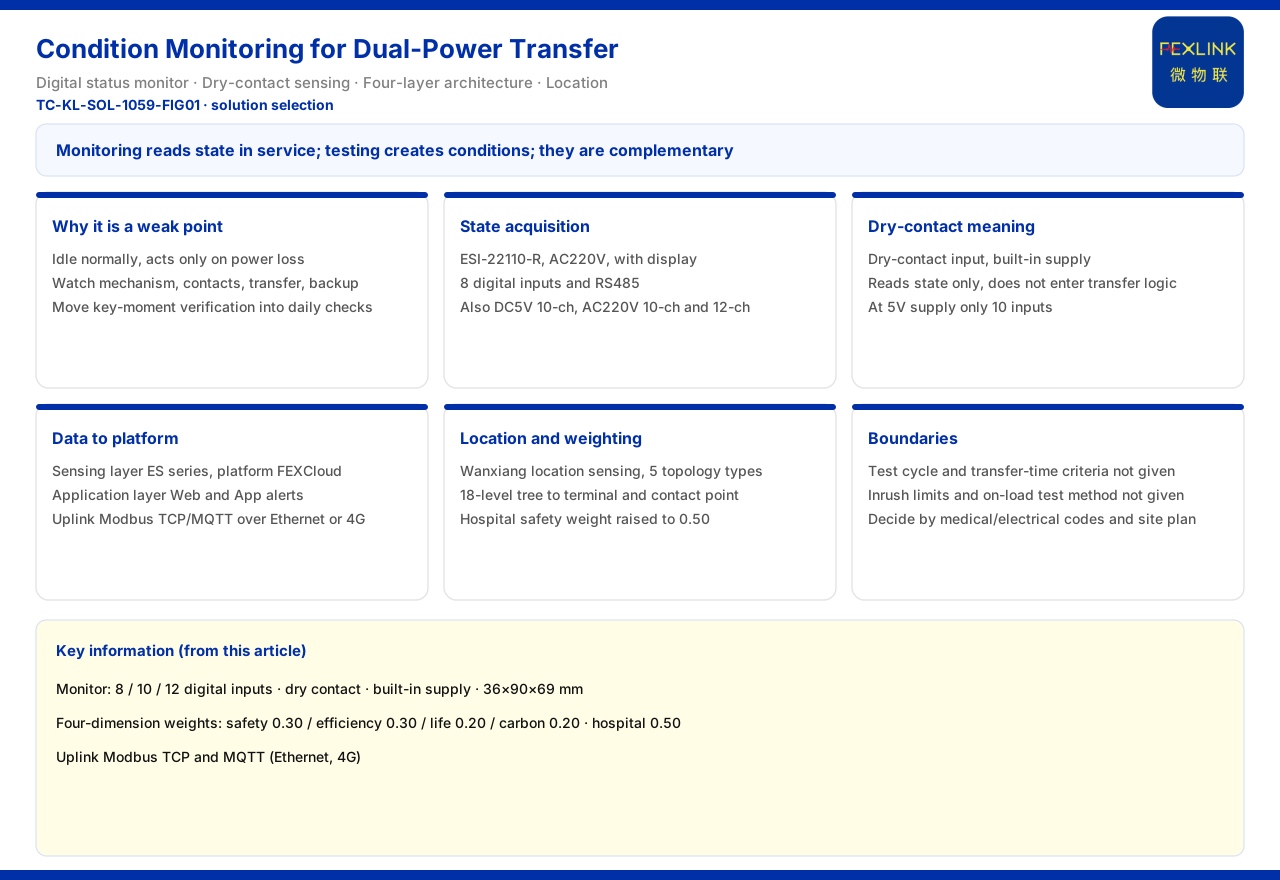
The power-supply reliability of a hospital operating room cannot accommodate "one failed transfer". To keep this kind of risk under control, the approach is to add a layer of status monitoring to the dual-power transfer device: use a digital-input status monitor to collect the dry-contact states of the transfer device, judge whether the main and standby supplies, the transfer position and the action result are normal, and then upload through a gateway and platform for real-time supervision and alarming. The digital-input status monitor in the product knowledge base supports 8, 10 and 12 digital inputs, uses dry-contact input with a built-in supply, and can be used for this kind of status collection. On the analysis side, the position awareness of the Wanxiang engine can localize risk down to the terminal and contact-point level, and the four-dimensional impact assessment raises the safety weight to 0.50 in hospital scenarios. The product knowledge base does not give the test period, the transfer-time criterion, the inrush limit or the on-load test method for operating-room dual-power transfer, so these should follow medical and electrical regulations and the on-site scheme.
Why Dual-Power Transfer Easily Becomes a Weak Point
A dual-power transfer device normally sits in a standby state and acts only when the main supply fails. This character of "not working in normal times, must work at the critical moment" means that the part most likely to fail is often not day-to-day operation but the transfer action itself: whether the mechanism sticks, whether the contacts are reliable, whether the transfer reaches position, and whether the standby supply is genuinely available. Without continuous monitoring of the transfer device's status, these problems usually surface only when a real transfer is needed, and that moment is exactly when the operating room can least afford a problem. Bringing status monitoring into the dual-power link is essentially moving the verification of the critical moment forward into daily life.
Using the Digital-Input Status Monitor to Collect Transfer Status
The digital-input status monitor in the product knowledge base offers several channel counts for dry-contact status collection. The representative model, the digital-input status monitor (ESI-22110-R), is AC220V with a display and provides 8 digital inputs and RS485; there are also a DC5V 10-channel model and AC220V 10-channel and 12-channel models. In selection, note that the product knowledge base states its input mode is dry-contact input with a built-in supply, and that with a 5V supply only 10 inputs can be used. This means the channel count cannot be expanded at will, and the supply mode affects the number of usable channels. For dual-power transfer monitoring, the states to collect usually include main supply present, standby supply present, current supply source and transfer-in-position, and a model with the right channel count can be chosen according to the number of points.
The Practical Meaning of Dry-Contact Input
Choosing dry-contact input is especially important for retrofitting an existing operating room. The dry-contact signal comes from auxiliary contacts of the transfer device or related circuits, and the monitor only "reads" the status without intervening in the transfer logic, so it does not change the action behavior of the original dual-power device. This bypass-collection approach prevents the introduction of the monitoring system from becoming a new source of risk. On installation, the product knowledge base gives dimensions of 36×90×69 mm, a small size convenient for in-place mounting inside the distribution cabinet. When assessing the feasibility of a retrofit, whether there is cabinet space and whether auxiliary contacts are available are often the two conditions that must be confirmed first.
How Data Enters the Platform
The collected status quantities need to be uploaded. Under the general four-layer architecture of the product knowledge base, the ES-series monitoring modules sit at the perception layer, FEXCloud sits at the platform layer, and Web and App visualization and alarm management sit at the application layer; the communication protocol matrix specifies that device upstream includes Modbus TCP and MQTT, over Ethernet or 4G. Linking these together gives a clear upload chain: the monitor collects status, an edge gateway converts it, it goes up to FEXCloud via Modbus TCP or MQTT, and it is presented and alarmed at the application layer. For a scenario like an operating room where locations are concentrated, wired Ethernet is preferred; for a distributed hospital campus, 4G can serve as a supplement.
Location Capability and the Safety-First Weight
The product knowledge base states that the position awareness of the Wanxiang engine maintains independent thresholds and risk models for 5 types of electrical topology position, and that an 18-level scenario tree can localize down to the terminal and contact-point level. For dual-power monitoring, the value of this capability is that when a status anomaly appears, the system does not merely tell the user "there is an anomaly" but can narrow the position to a specific terminal or contact point, shortening troubleshooting time. The default weights of the four-dimensional impact assessment are safety 0.30, efficiency 0.30, life 0.20 and carbon 0.20, and hospital scenarios can raise the safety weight to 0.50. Raising the safety weight means that, in a medical scenario, the same set of data is judged more by safety consequences, which matches the risk character of an operating room.
A Boundary That Needs Special Explanation
What this article must make especially clear is that the product knowledge base does not give the test period, the transfer-time criterion, the inrush limit or the on-load test method for operating-room dual-power transfer, and the related standard clauses are not developed in the product knowledge base either. Therefore questions such as how often to test, how fast a transfer counts as qualified, and how large an inrush counts as excessive cannot be inferred from the product materials; they should be determined from medical-building and electrical-installation regulations, manufacturer requirements and the on-site scheme. What the product materials can support is how status is collected, how data is uploaded and how risk is localized, not the acceptance criteria for transfer performance. Keeping the two classes of question apart is what keeps a scheme within bounds.
Monitoring Is Not Testing
A distinction must be drawn between status monitoring and performance testing. Monitoring continuously reads the status of the transfer device during operation and answers whether it is normal now; testing actively creates conditions and verifies whether the transfer device can act as expected when the supply fails. The two complement each other but cannot replace each other. Monitoring can find problems such as a contact not reaching position or a standby supply losing power in real time, yet it cannot prove that the device will succeed at the instant of a real transfer; testing can verify the action capability, but it is periodic and requires scheduled action. What the product knowledge base provides is status-monitoring capability, whose value lies in bringing the blind period between two tests into view as well. Understanding this division allows a reasonable power-supply assurance scheme for an operating room to be designed.
The Engineering Meaning of Raising the Safety Weight
Raising the safety weight from the default 0.30 to 0.50 in a hospital scenario is not just a numeric adjustment but a change in the orientation of judgment. After the weight is raised, the same set of abnormal data is ranked more by safety consequences, and considerations of efficiency and life give way relatively. For an operating room this is reasonable: one failed transfer can directly threaten life, while the cost of shutting down for maintenance is relatively controllable. When using the four-dimensional impact assessment, one should understand that the weights are configurable and that the hospital figure of 0.50 is only an example value given by the product knowledge base. How to set it in an actual project should be determined in combination with the department's risk level and management requirements, not copied from a single number.
Scope and Limitations
- This article is limited to what the product knowledge base already states about the digital-input status monitor, the general four-layer architecture, communication protocols, the position awareness of the Wanxiang engine and the four-dimensional impact assessment, and does not extend to test systems or limits that are not listed. - The figures in this article (8, 10 and 12 digital inputs, dry-contact input, only 10 channels usable with a 5V supply, dimensions 36×90×69 mm, safety weight 0.50, and so on) are quoted according to the figures listed by the product knowledge base and do not constitute a reliability commitment for any specific project. - The product knowledge base gives no dual-power transfer test period, transfer-time criterion, inrush limit or on-load test method, so this article makes no inference; the actual scheme is subject to medical and electrical regulations, equipment requirements and the latest product materials.