Direct Answer
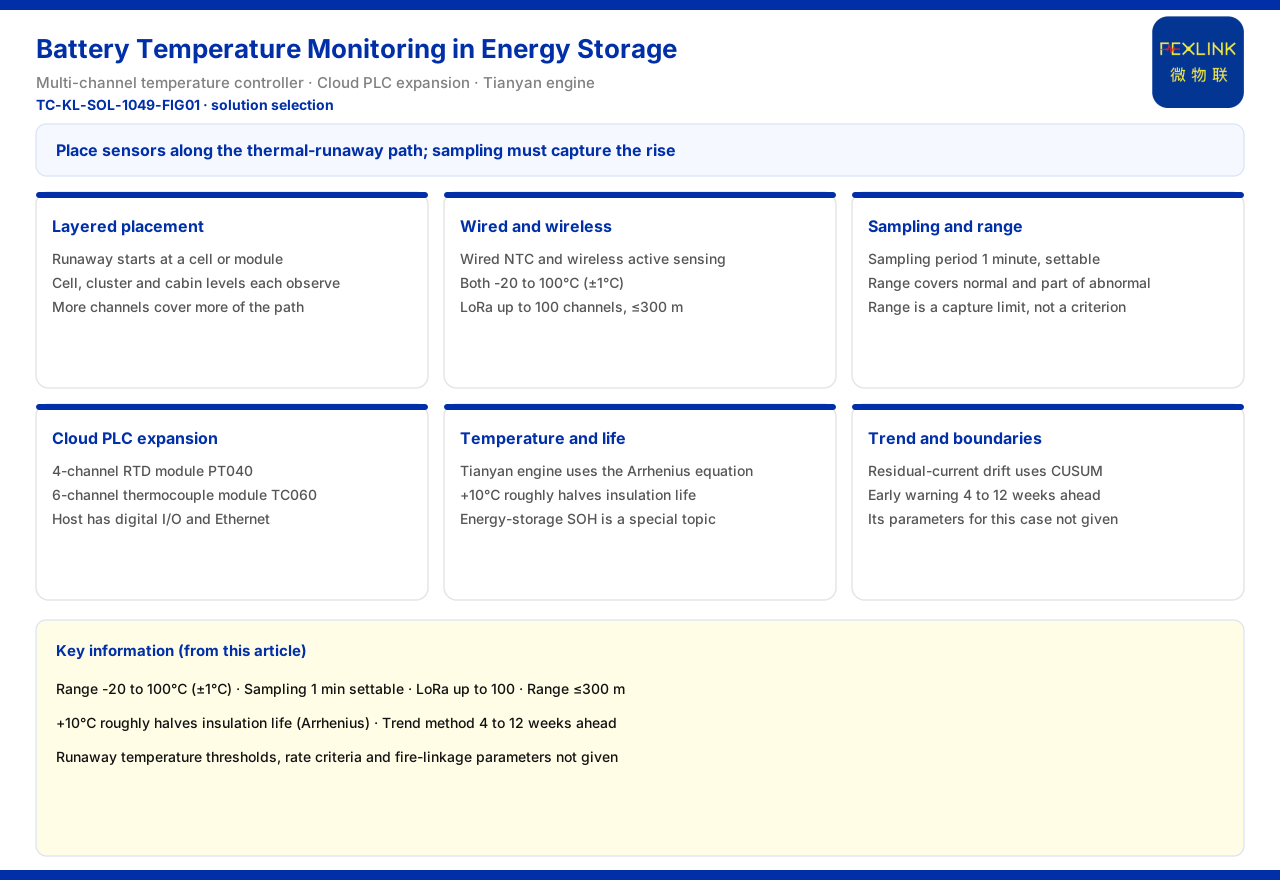
For an energy-storage station, making battery temperature monitoring meaningful does not hinge on how many temperature points are installed. It hinges on whether the points follow the propagation path of thermal runaway, whether the sampling density is enough to catch the temperature rise, and whether the temperature data is analyzed together with other electrical quantities. The product knowledge base provides two means of temperature acquisition: a multi-channel temperature intelligent controller and temperature expansion through a cloud PLC. The former supports wired NTC and wireless LoRa measurement, with a range of -20 to 100℃ (±1℃), up to 100 LoRa channels and a settable sampling period of 1 minute; the latter collects temperature through resistance-temperature-detector and thermocouple expansion channels and performs interlocking control. On the analysis side, the Tianyan engine gives a quantitative basis for temperature and life and lists energy-storage SOH as one of its special topics. The product knowledge base does not give the concrete temperature threshold, the rate-of-rise criterion, the multi-parameter joint rule or the fire-interlocking parameters for energy-storage battery thermal runaway, so these cannot be inferred from the product materials.
Why You Cannot Install Only "One" Temperature Point
Thermal runaway is not the whole battery pack heating up at the same time; it usually starts from a single cell or module and then spreads to neighbouring areas. If only a few temperature points are placed inside the battery compartment, what is measured is likely an environment-averaged temperature, which neither shows early local heating nor gives the direction of propagation. The value of temperature monitoring therefore depends first of all on layering: cell or module level, cluster level and compartment level each carry a different observation task. The multi-channel temperature intelligent controller in the product knowledge base supports 6-channel, 8-channel and even 100-channel wireless measurement, which is exactly the capacity basis for layered, dense points. The more channels there are, the better the key nodes along the propagation path can be covered.
How to Choose Between Wired and Wireless Temperature Measurement
The product knowledge base records that the multi-channel temperature intelligent controller supports both wired NTC and wireless active measurement, and the two share the same range of -20 to 100℃ (±1℃). The wired mode suits places where wiring conditions exist and points are fixed, and its stability and noise immunity are usually better; the wireless LoRa mode supports up to 100 channels and an effective distance of no more than 300 metres, suiting places where wiring is difficult or points are scattered. The trade-off in selection is whether the site allows cabling, whether points change often, and how much interference the wireless environment has. The two are not substitutes for each other, and in real projects they are often mixed by area.
The Boundary of Sampling Period and Range
The product knowledge base gives a sampling period of 1 minute, settable, which matters especially for thermal-runaway early warning: temperature rise is a process quantity, and sampling too sparsely misses the steep segment while sampling too densely inflates data volume and power use. A settable 1 minute means the rhythm can be adjusted to the battery type and risk level. On range, -20 to 100℃ covers normal operation and part of the abnormal interval; note that temperatures during thermal runaway may go well beyond this range, so the range of the measuring device is the boundary of acquisition capability and must not be used to describe the absolute temperature level of thermal runaway. This distinction must be made clear when communicating a scheme.
Temperature Expansion and Interlocking of the Cloud PLC
Besides dedicated temperature-measuring devices, the cloud PLC (CC100 and CC101) in the product knowledge base provides temperature-expansion capability. A 4-channel resistance-temperature-detector module is used for resistance-temperature-detector measurement, and a 6-channel thermocouple module is used for thermocouple measurement; the host provides digital input and output and an Ethernet interface. The point of connecting temperature expansion into the cloud PLC is that "being able to collect is not enough, it must also be able to interlock": temperature data can not only be reported but can also take part in local logic, driving relays or interlocking actions. For energy-storage scenarios, this local interlocking capability is especially valuable when communication is interrupted, because a safety action should not depend entirely on the cloud.
The Quantitative Relationship Between Temperature, Life and Risk
The product knowledge base states that the theoretical basis of the Tianyan engine includes the Arrhenius equation, whose engineering meaning is that for every rise of about 10℃, insulation life is roughly halved. This relationship explains why temperature monitoring is not only about preventing thermal runaway but is also an important input for assessing equipment life and risk. For the same temperature value, if it stays high over the long term, it keeps consuming insulation life even without immediate danger. Only by bringing temperature into trend analysis can "the heat of the moment" be read as "the risk of the long term". The product knowledge base also lists energy-storage SOH as one of the special topics of the Tianyan engine, showing that energy-storage health assessment has a corresponding model position.
The Place of Trend Methods in Early Warning
The product knowledge base records that the residual-current trend-drift method of the Tianyan engine uses CUSUM, which can detect a weak mean drift while the residual current is still within the safe range and can give warning 4 to 12 weeks in advance. Although this is a method for residual current, its idea is instructive for temperature monitoring as well: early warning often does not depend on "crossing a limit" but on "a slow yet sustained drift". For energy-storage battery temperature, only by separating the long-term trend from short-term fluctuation can a warning window be obtained before a limit is truly crossed. The product knowledge base does not give the direct application parameters of this method in energy-storage scenarios, so what is said here is the idea of the method, not a concrete rule.
Boundaries to Observe in Use
Two boundaries must be held when using a temperature-monitoring scheme. First, the product knowledge base does not give the concrete temperature threshold, the rate-of-rise criterion, the multi-parameter joint rule or the fire-interlocking parameters for energy-storage battery thermal runaway, and the related standards are not developed in the product knowledge base either, so concrete thresholds or interlocking logic cannot be inferred from them. Second, the range and sampling period of the temperature-measuring device are boundaries of acquisition capability, not a basis for judging thermal-runaway behavior. Keeping acquisition capability and judgment rules apart is the key to staying within bounds when implementing this scheme.
Why Temperature Must Be Read Together with Other Quantities
Temperature rarely explains a situation on its own. For the same temperature value, the meaning differs under different charge-discharge rates, ambient temperatures or ventilation conditions. Therefore, for energy-storage temperature monitoring to be meaningful, it should be combined with other quantities: with current, it can distinguish heating caused by load from abnormal heating; with voltage and internal resistance, it can help judge cell consistency; with residual current, it can link insulation and leakage problems. The cloud PLC in the product knowledge base has digital and analog expansion capability, which is exactly the basis for this kind of combined multi-quantity acquisition. Only by reading temperature back into the electrical and operating environment can the simple conclusion that "normal temperature means safe" be avoided.
Scope and Limitations
- This article is limited to what the product knowledge base already states about the multi-channel temperature intelligent controller, cloud PLC temperature expansion, the Arrhenius basis of the Tianyan engine, the energy-storage SOH topic and trend methods, and does not extend to thermal-runaway criteria or fire-interlocking logic that are not listed. - The figures in this article (-20 to 100℃, ±1℃, up to 100 channels, sampling period 1 minute, effective distance no more than 300 metres, and so on) are quoted according to the figures listed by the product knowledge base and do not constitute a temperature-measurement performance commitment for any specific project. - The product knowledge base gives no thermal-runaway temperature threshold, rate-of-rise criterion or fire-interlocking parameters, so this article makes no inference; the actual scheme is subject to on-site rules, fire requirements and the latest product materials.