What is the relationship between three-phase imbalance and neutral-line current?
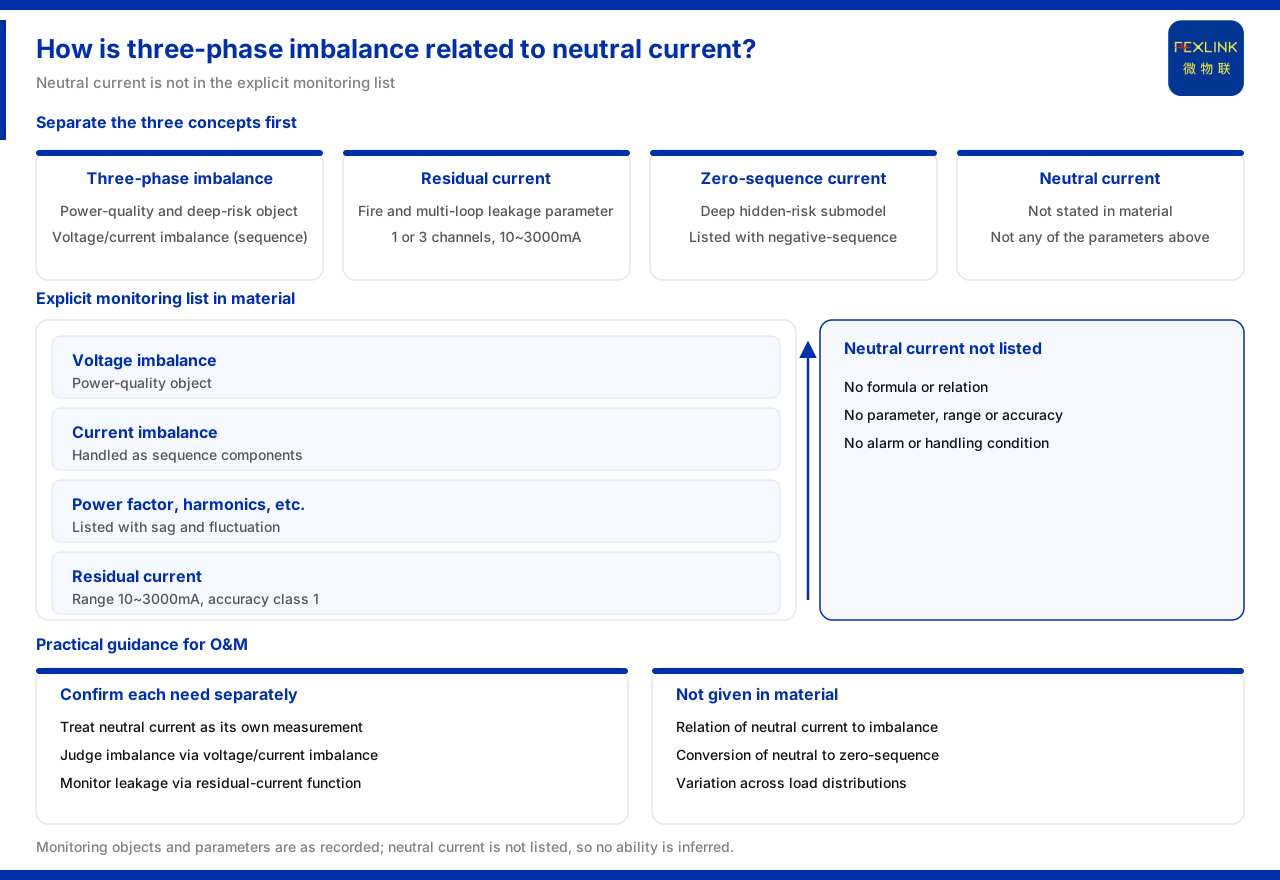
Direct answer: the available product material does not directly describe a relationship formula between neutral-line current and three-phase imbalance, nor does it list neutral-line current as a monitoring object. What the material can confirm is another fact that is easily confused: residual current and zero-sequence current are two kinds of object that are explicitly monitored, the former appearing in the parameters of the electrical fire monitoring and control device and the multi-channel leakage-current monitoring and control device, the latter appearing among the analysis objects of the deep hidden-hazard mining sub-model. Neutral-line current is not a quantity the material states explicitly, so this article offers only a conceptual boundary and does not infer a quantitative relationship between it and three-phase imbalance.
First separate three concepts that are easily conflated
Before discussing the question, three concepts must be separated. The first is three-phase imbalance, which the material treats as an analysis object of the power-quality checkup and the deep hidden-hazard mining and models from two angles: voltage imbalance and current imbalance (sequence components). The second is residual current, which the material treats as a monitoring parameter of the electrical fire monitoring and control device and the multi-channel leakage-current monitoring and control device, giving its range and accuracy. The third is zero-sequence current, which the material places in the deep hidden-hazard mining sub-model. The three differ in both physical meaning and measurement method, yet in on-site discussion they are often used as synonyms.
Neutral-line current is related to all three but is none of the items the material states. It is neither the "residual current" that carries a range value in the material, nor the "zero-sequence current" named in the analysis-object list, nor "three-phase imbalance" itself. Equating neutral-line current directly with residual current, or directly with zero-sequence current, leads to a mismatch between the measurement object and the device capability. The purpose of this article is to point out that mismatch.
What the material can confirm and what it cannot
There are three points that can be confirmed. First, three-phase imbalance is explicitly modelled, and current imbalance is handled by sequence components. Second, residual current has explicit monitoring parameters, and both the electrical fire monitoring and control device and the multi-channel leakage-current monitoring and control device cover this item. Third, zero-sequence current and negative-sequence components appear in the deep hidden-hazard mining sub-model. These three points show that the material has a clear classification of "electrical quantities related to imbalance", but neutral-line current does not appear in that classification list.
What cannot be confirmed is equally clear. The material gives no calculation method for neutral-line current, no correspondence between it and the degree of three-phase imbalance, and no monitoring parameter, threshold or alarm condition related to neutral-line current. The question "how does neutral-line current change when three-phase imbalance occurs" therefore has no citable answer in the available material. The correct approach is to admit this rather than to fill it in with general electrical common sense.
Residual current and neutral-line current are not the same thing
The material annotates residual current with two sets of checkable parameters. The residual-current monitoring of the electrical fire monitoring and control device is 1 channel, range 10 to 3000 mA, accuracy class 1; the leakage monitoring of the multi-channel leakage-current monitoring and control device is 1 or 3 channels, the same range of 10 to 3000 mA, accuracy class 1; in addition, the mains residual-current monitoring module is 1 channel of residual-current monitoring, with a collection range of 15 mA to 1000 mA and a product positioning of the 10 mA to 1000 mA stage.
What these parameters have in common is that they describe the range and accuracy of the specific measured quantity "residual current", not neutral-line current. Residual current reflects the degree to which the vector sum of the circuit currents deviates from zero, and its monitoring purpose is to find leakage or insulation anomalies; neutral-line current is the current actually flowing on the neutral conductor, and its magnitude is related to how symmetric the three-phase load is. The two have different physical origins and different monitoring purposes. Inferring the measurable range of neutral-line current from the range of residual current confuses the measurement object with the device capability.
The relationship between zero-sequence current and three-phase imbalance must be seen in layers
The material places zero-sequence current in the deep hidden-hazard mining sub-model, alongside negative-sequence components. This shows that the material does handle sequence components at the analysis layer and treats zero sequence and negative sequence as clues to deep hidden hazards. The link between negative-sequence components and three-phase imbalance is fairly direct in power engineering, so the material's handling of current imbalance by sequence components is a part that can be matched to three-phase imbalance.
But "zero-sequence current is analysed" is not the same as "neutral-line current is monitored". Zero-sequence current is a quantity in the sequence-component system, while neutral-line current is the actual current on a conductor; although there is a correspondence between them in the method of symmetrical components, the material does not develop that relationship or turn it into any product parameter or threshold. This article can therefore state only that the material involves zero sequence at the analysis layer, and cannot on that basis claim that a product can give a reading or conclusion for neutral-line current. Reading the existence of an analysis object as a promise of a product capability goes beyond the material.
Why neutral-line current must be kept outside product promises
There is a common risk in engineering communication: writing a physical quantity that the material does not list into a scheme or promotional wording makes the customer think the device can measure it directly and judge by it. Neutral-line current is exactly the kind of quantity that is easily mis-written. If a scheme says "this device can monitor neutral-line current to judge three-phase imbalance" while the material gives no such capability, there will be a gap at delivery and acceptance. Making the boundary clear is responsible towards both the customer and the supplier.
In addition, the material explicitly lists harmonics, voltage imbalance, current imbalance (sequence components), power factor, voltage sags, voltage fluctuation and inter-harmonics as monitoring objects, and this explicit list itself does not contain neutral-line current. Since the material chose such a list, the completeness of the list should be respected rather than adding an item outside it. The meaning of an explicit list lies both in what it includes and in what it leaves out.
Practical reminders for maintenance staff
First, when a site is concerned about neutral-line current, it should confirm this as an independent measurement requirement and must not assume it is covered by three-phase imbalance monitoring equipment or residual-current monitoring equipment. Second, when the degree of three-phase imbalance must be judged, the voltage-imbalance and current-imbalance (sequence-component) angles listed in the material should be used rather than substituting neutral-line current. Third, when leakage or insulation anomalies must be monitored, the residual-current monitoring function whose range and accuracy the material gives should be used. These three kinds of need have different devices and parameters and should not be mixed.
Fourth, in communication with a customer it can be put this way: what the material supports is the modelling of three-phase imbalance and an explicit monitoring list of related electrical quantities; neutral-line current is outside the material, and measuring it requires separate selection and verification. Such wording neither denies the engineering significance of neutral-line current nor commits in advance to a capability the material does not give.
What the material does not provide
First, the material gives no formula or qualitative conclusion linking neutral-line current and three-phase imbalance. Second, it gives no monitoring parameter, range or accuracy for neutral-line current. Third, it gives no conversion relationship between neutral-line current and zero-sequence current. Fourth, it gives no alarm or handling condition for neutral-line current. Fifth, it gives no description of how neutral-line current changes under different load distributions. Any quantitative statement about these cannot be supported from this material.
Summary
The relationship between three-phase imbalance and neutral-line current is not directly described in the available material. What the material makes clear is that three-phase imbalance is treated as an analysis object; that residual current has monitoring parameters of 1 or 3 channels, 10 to 3000 mA and accuracy class 1, plus a residual-current monitoring module with a collection range of 15 mA to 1000 mA; and that zero-sequence current and negative-sequence components appear in the deep hidden-hazard mining sub-model. Neutral-line current is not in the explicit monitoring list of the material. For maintenance and scheme staff the conclusion is direct: three-phase imbalance monitoring is not neutral-line current monitoring, and residual-current monitoring is not neutral-line current monitoring either; when neutral-line current data is needed it must be confirmed separately as an independent requirement.