How is three-phase imbalance treated?
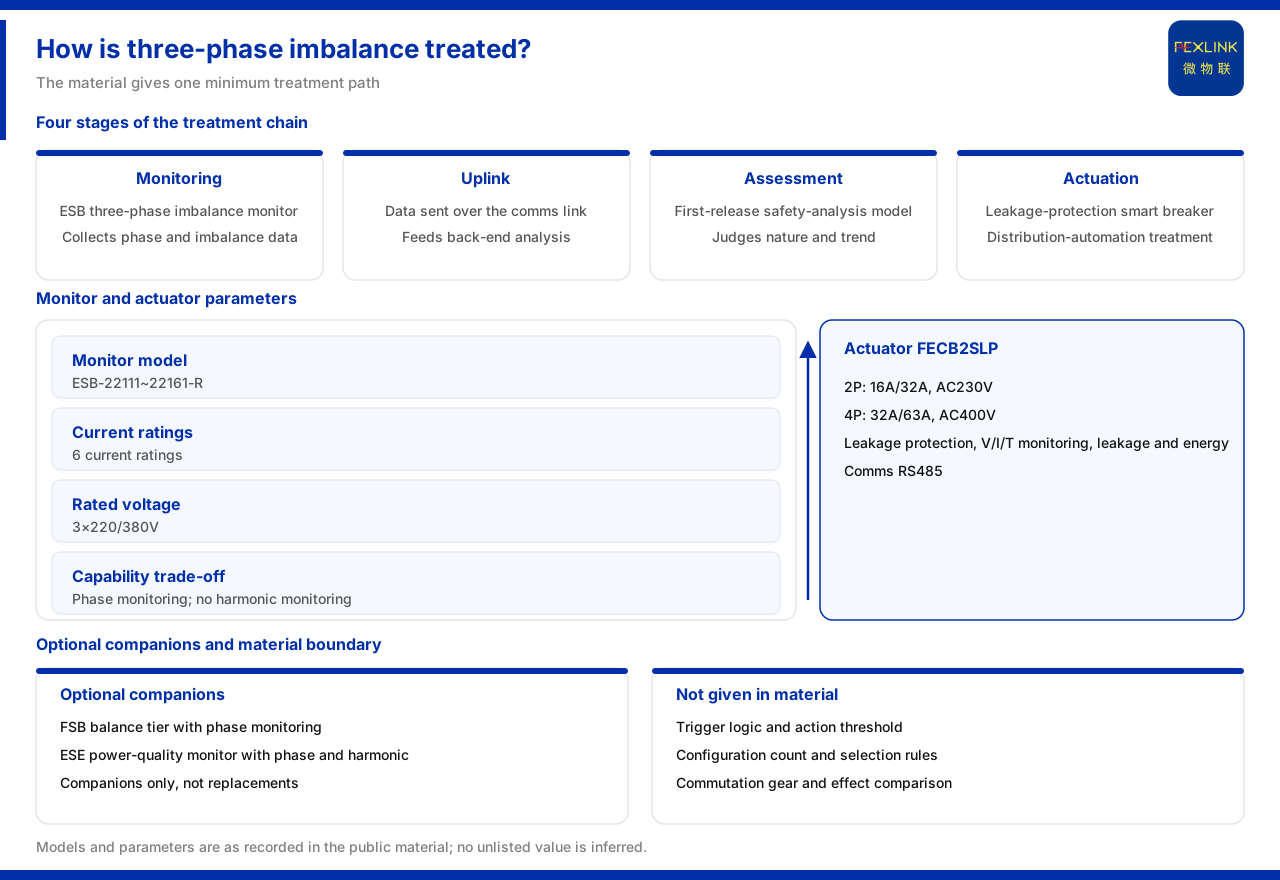
Direct answer: in its typical application scenarios and selection comparison, the available material recommends the combination of a three-phase imbalance monitor and an intelligent circuit breaker with residual-current protection (FECB2SLP-2P or FECB2SLP-4P) for distribution-automation three-phase treatment, forming a minimal treatment path of monitoring plus actuation. The monitoring end is responsible for finding the three-phase imbalance, and the actuation end for acting when needed. The material does not involve external devices such as phase-switching switches and gives neither the trigger logic nor the quantity to configure for that combination. This article can therefore deliver the selection combination the material has listed, not a complete treatment engineering scheme.
The minimal treatment combination comes from the scenario selection in the material
In the typical application scenarios and selection comparison, the material maps the scenario of distribution-automation three-phase treatment directly onto a combination of two kinds of equipment: a three-phase imbalance monitor and an intelligent circuit breaker with residual-current protection. This is the starting point of the article and the only equipment-level answer the material gives for that scenario. Its value is that it makes clear that the treatment chain needs at least two roles: one turns the imbalance into a signal that can be judged, and the other turns that judgement into an action.
It should be stated first that this recommendation answers "which combination of equipment to use", not "by what logic it acts". The material gives no interlocking rule inside the combination and no configuration difference for different circuits or capacities. Reading the recommendation as "buying these two kinds of equipment completes the treatment" goes beyond the material; reading it as "the material gives one selectable minimal path" matches the material.
The monitoring end: the three-phase imbalance monitor
The monitoring end uses a three-phase imbalance monitor. The material records that it shares the architecture of the all-parameter smart meter, has 6 current stages with the model range ESB-22111-R to ESB-22161-R, a rated voltage of 3×220/380V, an OLED display and RS485 communication; on top of the meter monitoring it adds phase monitoring and has no harmonic monitoring. For switching signals it provides 2 inputs and 1 relay output.
The meaning of this information for treatment selection can be understood in three directions. First, 6 current stages mean it can be selected according to the current level of the on-site circuit instead of covering every circuit with a single stage. Second, 3×220/380V and RS485 indicate that it faces low-voltage three-phase circuits and supports connection to a host system. Third, "adds phase monitoring, has no harmonic monitoring" is a clear capability trade-off: if the on-site goal is to identify imbalance, a phase issue, this device's position matches; if the site also needs harmonic analysis, the material gives another kind of device elsewhere, as explained in the supporting part below.
The actuation end: two models of the intelligent circuit breaker with residual-current protection
The actuation end uses an intelligent circuit breaker with residual-current protection. The material records two models: the two-pole model is 2P with a rated current of 16A or 32A and a rated voltage of AC230V; the four-pole model is 4P with a rated current of 32A or 63A and a rated voltage of AC400V. Both support residual-current protection, voltage, current and temperature monitoring, leakage monitoring and energy metering, with RS485 communication; the SLP in the model indicates a version with residual-current protection.
Putting this group of parameters together with the monitoring end gives a practical judgement: the two-pole model faces single-phase or smaller-capacity circuits, and the four-pole model faces three-phase or larger-capacity circuits. Since the main object of three-phase imbalance treatment is the three-phase circuit, the four-pole model corresponds more directly to the three-phase scenario at the parameter level, while the two-pole model may appear on other branches of the same distribution system. The material does not state which model should be fitted to a particular circuit, so only a parameter-level correspondence can be made here, not a conclusion for a project.
Why it is a monitoring-plus-actuation combination
The difficulty of three-phase imbalance treatment is that it is not an on/off switching problem but a continuous-deviation problem. Monitoring alone gives the degree and trend of the imbalance but cannot form an action; actuation equipment alone can act once a set condition is met but lacks a dedicated judgement of the imbalance. The combination given by the material separates these two things exactly: the three-phase imbalance monitor carries the sensing of the continuous quantity, and the intelligent circuit breaker with residual-current protection carries the state switching.
This division also carries another meaning: monitoring and actuation each have independent value. Even if no actuation action is connected for the moment, the monitoring end still provides phase and imbalance information; and the actuation end, even when not used for imbalance treatment, still carries residual-current protection and routine electrical-parameter monitoring. The combination is therefore not two devices built specially for one task, but two kinds of device, each with its own function, cooperating in front-end judgement. Understanding this helps explain in a scheme the necessity of each device.
Optional support: the three-phase balance controller and the power-quality monitor
The material also provides two kinds of equipment that can support three-phase imbalance monitoring and power quality. One is the multi-parameter electrical intelligent controller (three-phase balance type), which the material records as likewise including phase monitoring; the other is the power-quality monitor, which the material records as including both phase monitoring and harmonic monitoring. They sit in the same product system as the three-phase imbalance monitor and are complementary in position.
This part must be used with care. The material states clearly that they "can serve as support for three-phase imbalance monitoring and power quality", but gives no substitution relationship, combination rule or priority. What the material confirms is that they have phase or harmonic capability; it does not confirm that under some conditions they should replace the three-phase imbalance monitor. Listing them as optional support in a scheme is therefore sound, whereas writing them as a definite substitution needs additional on-site evidence.
The chain from sensing to handling
Stringing the above together, the treatment chain supported by the material is roughly four steps. First, the three-phase imbalance monitor acquires phase and imbalance information. Second, the monitoring data is sent up over the communication link and takes part in back-end analysis. Third, the relevant models in the analysis layer judge the nature and trend of the imbalance; the material lists the three-phase imbalance hazard as one of the first-release safety-analysis models at the prediction layer. Fourth, in the scenario of distribution-automation three-phase treatment, the intelligent circuit breaker with residual-current protection acts as the actuation device.
In this chain the material gives different degrees of certainty at each step: the equipment combination and parameters are clear, and the existence of the analysis model is clear, but the trigger logic, action threshold and interlocking method are blank. Drawing the chain is valuable because it makes the division of labour in a scheme immediately clear; at the same time, marking "not given by the material" at each link prevents the framework diagram from being misread as an implementation rule.
What the material does not provide
First, the material gives no trigger logic or action threshold for the combination, that is, under what imbalance condition the actuation end should act. Second, it gives no configuration quantity or selection rule for different capacities or circuits. Third, it does not involve external devices dedicated to three-phase imbalance treatment, such as phase-switching switches. Fourth, it gives no quantified before-and-after comparison of the treatment effect. Fifth, it gives no substitution or priority relationship between the optional support equipment and the monitor. When any of these appears in a scheme it should be treated as a supplement outside the material, not as a material conclusion.
Summary
Three-phase imbalance treatment is given in the available material in the form of an equipment combination: the typical scenario maps distribution-automation three-phase treatment onto the combination of a three-phase imbalance monitor and an intelligent circuit breaker with residual-current protection. The monitoring end has 6 current stages, 3×220/380V, phase monitoring and no harmonic monitoring; the actuation end has two models, 2P (16A/32A, AC230V) and 4P (32A/63A, AC400V), both supporting residual-current protection, voltage/current/temperature monitoring, leakage monitoring and energy metering, with RS485 communication. The three-phase balance controller and the power-quality monitor can serve as support. The material gives no trigger logic, configuration quantity, external devices or effect data. For maintenance staff this is a deliverable minimal path; for scheme review it should be treated as a selection basis, not as a complete treatment scheme.