Direct answer
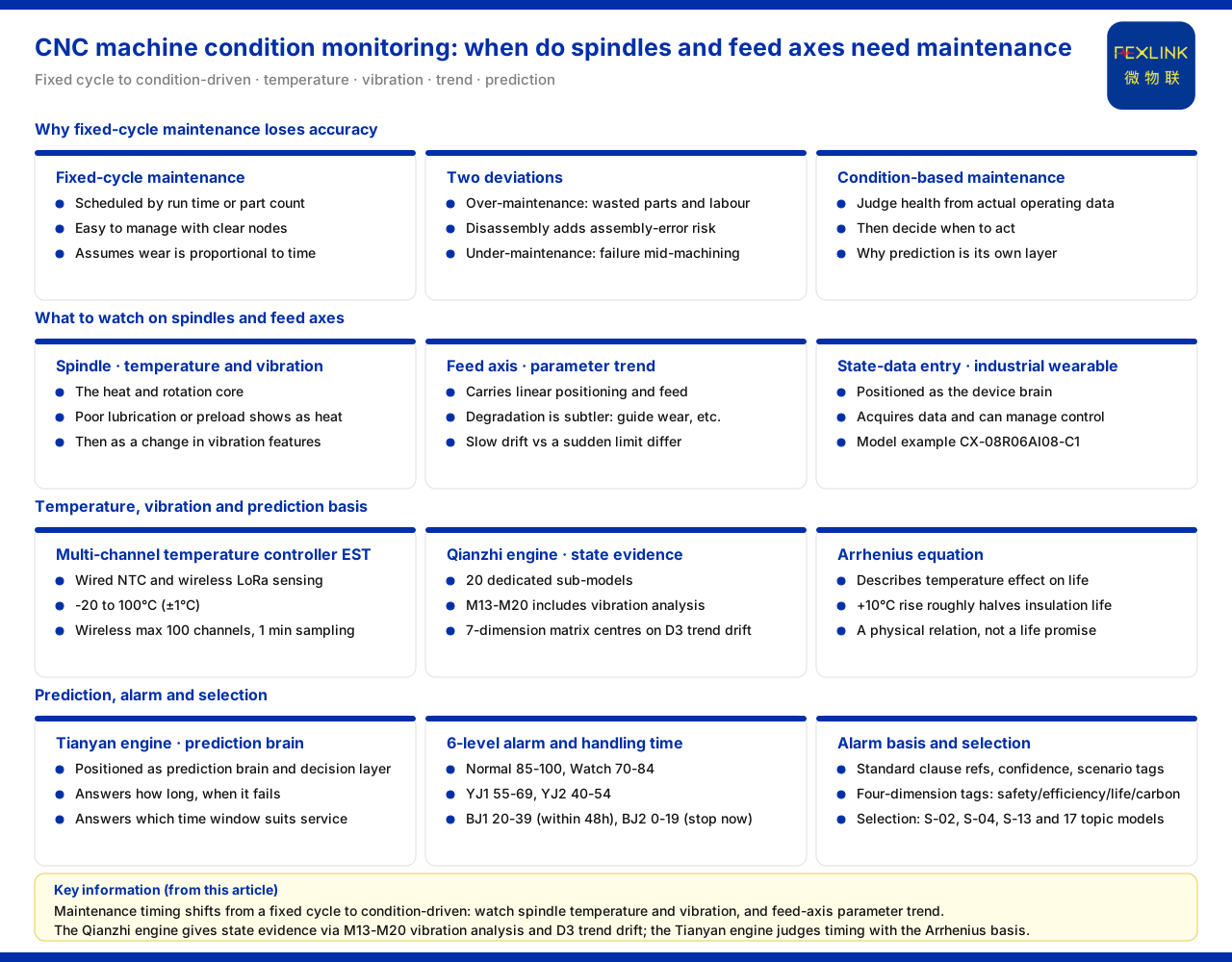
If CNC machine-tool maintenance follows only a fixed cycle, two deviations appear: the spindle and the feed axis may be in good condition, yet are shut down and dismantled because a calendar service point has arrived; or deterioration has already begun, yet the next planned service has not come, so the machine stops mid-machining. To judge maintenance timing closer to reality, spindle and feed-axis condition must become observable data, and a prediction layer must answer how much longer the equipment can last, when it will fail, and which time window suits maintenance.
In the product material this layer is the Tianyan engine, positioned as the predictive brain and decision layer. On the equipment side, condition data can be acquired by the industrial wearable (a programmable device wearable); heat-generating parts can be monitored continuously by the multi-channel temperature intelligent controller; vibration and trend signs come from the dedicated sub-models and perception matrix of the Qianzhi engine.
Why fixed-cycle maintenance loses accuracy
Maintenance is usually scheduled by running time or machined parts. That is convenient, but it assumes wear is proportional to time, while actual wear depends more on load, rotational speed, lubrication, ambient temperature and operating habits. The same plan applied to a batch of machines therefore over-serves some and under-serves others.
Over-servicing also wastes spare parts and labour, and dismantling itself introduces assembly-error risk. Under-servicing leaves the failure to occur during machining, where an unplanned stop often costs more than a planned service. To narrow both deviations, time-based maintenance must become condition-based: spindle and feed-axis operating data is used to judge health before deciding when to act. This is why the predictive brain stands alongside acquisition and control as an independent layer.
What to watch on the spindle and the feed axis
The spindle is the heat-generating, rotating core, so its condition shows up in temperature and vibration: poor bearing lubrication or abnormal preload usually appears first as a temperature rise, then as a changed vibration signature. The spindle side is therefore suited to continuously watching the temperature of heat-generating parts and the vibration trend of rotating components.
The feed axis carries linear positioning and feed motion, and its deterioration is more hidden: guideway wear, changed screw preload or rising drive load may not stop the machine at once, but leaves traces in the drift of parameters over time. For the feed axis, trend matters more than a single-point value: slow worsening and a sudden out-of-limit excursion mean different things. Overall, the spindle side leans to the instantaneous state of temperature and vibration, the feed axis side to the directional change of parameters over time.
Temperature monitoring: the multi-channel temperature intelligent controller
For heat-generating parts such as the spindle, continuous temperature monitoring is basic evidence. The product material records that the multi-channel temperature intelligent controller (EST) supports wired NTC and wireless LoRa, with a measurement range of -20 to 100 °C (±1 °C); the wireless version supports a maximum of 100 channels, a sampling period configurable at 1 minute, and an effective distance of not more than 300 m.
Mapped to a machine tool: wired NTC suits fixed points such as the spindle front bearing housing; wireless LoRa suits points inconvenient to wire or needing temporary installation; a sampling period configurable at 1 minute captures temperature change over time; 100 channels allow several points on one machine or in one workshop. Measurement range and accuracy describe the measurable span, not a judgement about a particular machine; temperature data must still be read with working conditions and a historical baseline.
Vibration and trend: state recognition by the Qianzhi engine
Vibration is important evidence of spindle and feed-axis mechanical condition. The product material records that among the 20 dedicated sub-models of the Qianzhi engine, deep hidden-hazard mining M13 to M20 includes vibration analysis, and its 7-dimensional perception matrix centres on D3 trend drift.
The two answer different questions: vibration analysis faces equipment-state anomalies and answers whether an anomaly exists; trend drift follows the direction in which a parameter changes over time and answers whether it is developing. For the spindle, a vibration signature can indicate a change in rotating components; for the feed axis, trend drift separates slow deterioration from normal fluctuation. Putting the instantaneous state and the direction of change in one perception system keeps the judgement off a single measuring point. These capabilities describe models and perception structure, not a promise to locate a specific faulty part.
How maintenance timing becomes a time window
State data is not a conclusion by itself; it must be translated into a judgement over time. The product material positions the Tianyan engine as the predictive brain and decision layer, answering how much longer this equipment can last, when it will fail, and which time window suits maintenance. It gives not a real-time value but a time judgement: remaining usable time, likely failure time, and the window suitable for maintenance.
The theoretical basis includes the Arrhenius equation, which describes the effect of temperature on life; the given formulation is that for every 10 °C rise in temperature, insulation life is roughly halved, alongside a leakage-current exponential growth pattern and a contact-resistance nonlinear growth curve. This turns spindle and feed-axis maintenance from a fixed cycle into state-driven timing: instead of stopping on a calendar day, timing is judged from the heat and operating state the equipment actually experiences. The Arrhenius equation gives a physical relationship between life and temperature, not a direct promise about a particular machine's remaining life.
How alarms give handling deadlines
When the state deviates from normal, an alarm must give an executable deadline, not just a notice. The product material records that the 6-level alarm system of the Qianzhi engine divides handling deadlines by composite score: Normal (85 to 100), Watch (70 to 84), YJ1 (55 to 69), YJ2 (40 to 54), BJ1 (20 to 39, handle within 48 h), BJ2 (0 to 19, shut down immediately); each alarm carries a standard clause citation, four-dimensional impact labels (safety, efficiency, life, carbon), a confidence level and a scenario label.
This grading makes whether to stop and how soon into orderable actions: BJ1 suits planned servicing, BJ2 points to immediate shutdown to avoid fault escalation, and the impact labels and clause citations give the order of handling more basis.
Where state data comes from: the industrial wearable
For these judgements to have data, the equipment side needs an acquisition entry point. The product material positions the industrial wearable controller (programmable device wearable) as putting a smart watch on the equipment: it acquires operating data on one side and can manage and control the equipment on the other, hence also called the device brain; its example model is the industrial wearable controller (CX-08R06AI08-C1). It is not only a passive recorder but sits between acquisition and execution, providing the equipment-side data entry point for condition monitoring.
Selection combination: equipment life prediction and predictive maintenance
According to the product-selection formulation, the equipment life prediction and predictive maintenance direction selects the S-02, S-04 and S-13 of the Tianyan engine S board with 17 thematic models; listed themes include high-voltage switchgear health, transformer life, UPS assessment, energy-storage SOH, charging-pile load forecasting and data-centre power-supply reliability. These themes face different objects; which model suits a machine tool belongs to a specific scheme design and cannot be extrapolated from the general selection, so a selection should be determined with the machine type, key components and on-site signal list.
Several boundaries that need to be stated
- The temperature controller's range, accuracy, channels, sampling period and effective distance follow the product material; a layout should be determined with the machine structure and on-site conditions. - Qianzhi engine vibration analysis and trend drift describe models and perception structure, not a promise about a faulty part or remaining life. - The Arrhenius equation and temperature-rise relationship are a theoretical basis, not a promise about a particular machine's remaining life. - Alarm grading and handling deadlines are a system formulation; actual handling should combine process and safety rules.
Scope of application and limitations
- This article is limited to the product material's existing statements on the Tianyan engine, the Qianzhi engine, the multi-channel temperature intelligent controller and the industrial wearable. - The Tianyan engine's predictive position and the Arrhenius temperature-rise formulation, the Qianzhi engine's vibration analysis and trend drift, the temperature controller's measurement parameters, the industrial wearable's position and model, and the equipment life prediction selection are all product-material formulations. - This article explains the connection from condition acquisition to maintenance-timing judgement for a CNC machine tool's spindle and feed axis; it gives no specific transformation scheme, criteria thresholds or shutdown strategy, and actual implementation should be determined with the machine, process and on-site conditions. - Other on-site conditions, installation methods and maintenance cycles are not inferred or promised here.