What harm does three-phase imbalance cause?
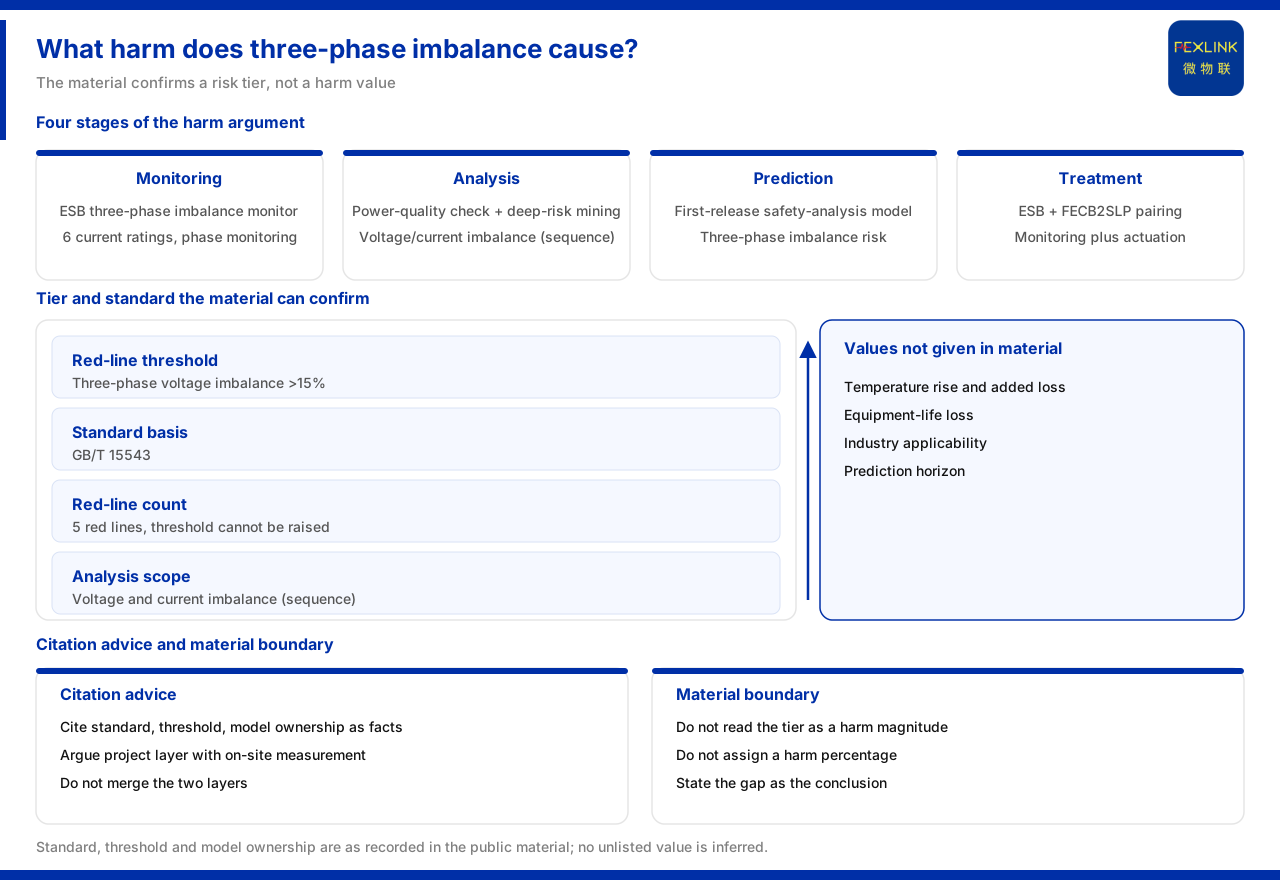
Direct answer: the available product material gives no quantified conclusion about the harm caused by three-phase imbalance. Specific values for temperature rise, additional losses and shortened equipment life all fall outside the scope of that material. What the material does confirm is the level of the problem: when three-phase voltage imbalance exceeds 15%, it is listed as a safety red line that cannot be bypassed, on the basis of the standard GB/T 15543. Three-phase imbalance is also an object of two kinds of analysis — the power-quality checkup and the deeper hidden-hazard mining — it enters the first-release model of the predictive safety analysis, and it has a dedicated monitoring-and-treatment combination in the typical selection table. This article can therefore answer how the material positions the harm of three-phase imbalance, not how large that harm is.
What the material confirms is the problem level, not a harm value
Explaining a hazard usually needs three things: the physical quantity affected, the direction of the effect, and the magnitude of the effect. The available material gives indirect evidence for the first two and no number at all for the third. It provides no quantified relationship between three-phase imbalance and temperature rise, line loss or insulation ageing, and it offers no industry-applicability conclusion and no accident case. A statement such as "three-phase imbalance increases losses by a given percentage" therefore cannot be supported from this material.
This style — giving a level but no numerical value — does not mean the material avoids the question. On the contrary, it places three-phase imbalance inside a clear handling chain: first the condition is sensed by monitoring equipment, then an analysis model judges its nature, then a predictive model gives the trend, and finally the selection table configures the equipment that acts. Whether an electrical problem matters can be judged not only by a harm value but also by whether it is treated separately in all four links of sensing, analysis, prediction and treatment. Three-phase imbalance appears in all four.
Exceeding 15% is treated as a red line that cannot be bypassed
The material explicitly lists a three-phase voltage imbalance greater than 15% as one of the safety red-line rules, and its basis is the standard GB/T 15543. The wording of the rule is "cannot be bypassed", and the material records that there are 5 such red lines in total and that no one is able to raise the threshold. Taken together, these three points form the hardest conclusion this article can cite: 15% is not a recommended value but a boundary that may not be relaxed by human decision.
For maintenance staff the meaning is this: once three-phase voltage imbalance crosses this boundary it is no longer a power-quality indicator to be merely observed, but triggers a systemic handling action. The material does not say what specifically happens after the red line is crossed, nor does it give different consequences for different degrees of exceedance. The correct way to cite it is therefore as a definite triggering condition, not as a measure of how severe the harm is.
It is counted in the power-quality checkup and in deep hidden-hazard mining
At the sensing and analysis level, the material splits three-phase imbalance into two objects and models them separately. First, the power-quality checkup sub-model covers voltage imbalance and current imbalance, where current imbalance is handled by sequence components; besides imbalance, this sub-model also covers harmonics, power factor, voltage sags, voltage fluctuation and inter-harmonics. Second, the deep hidden-hazard mining sub-model further includes zero-sequence current and negative-sequence components. Placing imbalance in two analysis layers of different depth shows that the material does not treat it as a single reading but as a group of phenomena that can be analysed from the sequence-component angle.
Restraint is needed here: the material lists these analysis objects but gives no decision thresholds, algorithm details or output conclusions for them. What can be confirmed is that three-phase imbalance is brought into the analysis; what cannot be confirmed is what hazard judgement the analysis produces. Reading "is analysed" directly as "the harm has been quantified" goes beyond the material.
On the prediction side, it enters the first-release safety-analysis model
At the prediction layer, the material records that the safety-analysis board of the Tianyan engine lists the three-phase imbalance hazard as one of its first-release models. The Tianyan engine is positioned at the prediction layer and answers what will happen in the future and when to act. That is, the material treats three-phase imbalance not only as an object needing real-time judgement but also as an object that can be trend-predicted. The significance for the hazard argument is that a phenomenon worth only after-the-fact statistics would not normally enter a first-release prediction list; entering that list means the material considers it worth intervening on in advance.
The boundary must again be kept: the material confirms only the existence and ownership of that model, and gives neither its specific algorithm nor any prediction lead time. This article therefore cannot claim that three-phase imbalance can be warned about a certain number of days ahead, because that lies outside the material.
On the treatment side, the material gives a dedicated combination
At the treatment and selection level, the material recommends, in the typical application scenarios and selection comparison, the combination of a three-phase imbalance monitor (model range ESB-22111 to ESB-22161-R) and an intelligent circuit breaker with residual-current protection (FECB2SLP) for distribution-automation three-phase treatment. This recommendation shows that in the material's system three-phase imbalance cannot only be observed but is also considered treatable by a monitoring-plus-actuation combination. The monitoring end finds the imbalance, the actuation end acts when necessary, and the two together form a minimal closed loop.
The material does not explain the trigger logic, the action threshold or the quantity to configure for that combination, nor does it involve external devices such as phase-switching switches. This article can therefore describe it only as a recommended equipment combination, and cannot decide for a specific project how many units to use, how they interlock, or what treatment effect is achieved.
Why the hazard argument still matters
Returning to the first question: if the material gives no harm value, why single out three-phase imbalance? Because it satisfies several conditions at once: it has a clear standard basis, it has a quantified red line that cannot be bypassed, it has dedicated sensing and prediction models, and it has a matching treatment combination. These four points do not amount to an answer to "how large is the harm" but to a reason "worth investing in monitoring and treatment".
For distribution-operation and power-quality engineers, this distinction directly affects how a proposal is argued. Using the red line and the model ownership as the basis for a project is traceable to the material; using "failure to treat will cause a specific loss" as the basis goes beyond the material. A sound approach is to separate the basis into two layers: the fact layer cites only the standard name, the threshold and the model ownership, while the proposal layer argues separately from on-site measured data instead of mixing the two layers together.
What the material does not provide
First, the material gives no quantified conclusion on the harm of three-phase imbalance, including but not limited to temperature rise, loss, life and failure rate. Second, it gives no applicability judgements for different industry scenarios. Third, it gives no consequence grading for different degrees of exceedance. Fourth, it gives no specific algorithm or lead time for the prediction model. Fifth, it gives no trigger logic or configuration quantity for the treatment combination. Treating any of these five as an established conclusion goes beyond the material boundary.
Summary
The harm of three-phase imbalance is presented in the available material as a problem level rather than a harm value: three-phase voltage imbalance greater than 15% is listed as one of the red lines that cannot be bypassed, on the basis of GB/T 15543, and there are 5 such red lines in total that may not be raised; it enters the object list of the power-quality checkup and the deep hidden-hazard mining, enters the first-release predictive safety-analysis model, and has a monitoring-plus-actuation combination in the selection table. The material gives no quantified harm result, no industry applicability and no prediction lead time. For maintenance staff, the sound way to cite it is as a basis for project initiation and handling, leaving the harm values to be answered by on-site measurement.