How FA and FD Work Together
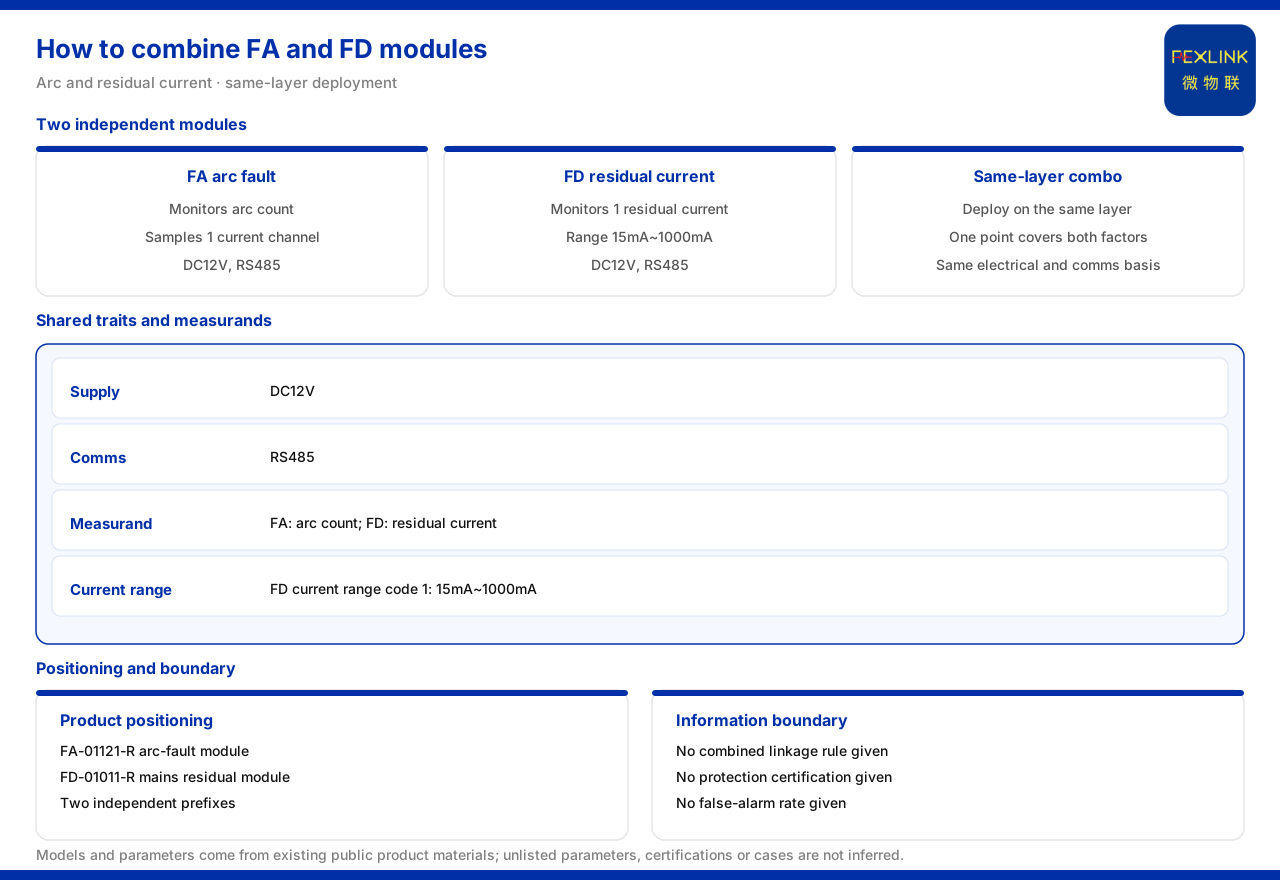
Direct answer: the FA arc-fault monitoring module and the FD mains residual-current monitoring module can be deployed at the same layer, because both use a DC12V supply and RS485 communication, and therefore have the electrical and communication basis for a same-layer combination. After combination, a single point can cover both electrical fire elements, arc count and residual current. It should be noted that the material confirms the function, supply and communication commonality of the two, but does not give the specific linkage or interlock rules after combination, nor does it give information on arc-fault protection certification or false-alarm rate.
What Each Module Monitors
The FA arc-fault monitoring module listed in the material is the FA-01121-R, whose function is to monitor arc count, with a collection object of one current channel, a DC12V supply and RS485 communication. It is concerned with whether an abnormal phenomenon such as arcing occurs on the line, and takes the arc count as readable information.
The FD mains residual-current monitoring module listed in the material is the FD-01011-R, whose function is to monitor one residual-current channel covering 15mA to 1000mA, with a DC12V supply and RS485 communication. It is concerned with the change of residual current to ground on the line, reflecting hazards such as insulation degradation.
One looks at arcs and the other at residual current, and the two target different signs of an electrical fire. Placing them in the same cabinet and at the same monitoring layer makes it possible to obtain both kinds of information at the same point, rather than scattering them into two acquisition stages that do not communicate.
Why They Suit Being Placed Together
From the material, the FA arc-fault monitoring module and the FD mains residual-current monitoring module share a commonality in supply and communication: both use a DC12V supply and RS485 communication. This commonality means they can be supplied by the same DC source and can hang on the same RS485 bus, simplifying on-site power and cabling. For a site that needs to add monitoring points in a low-voltage distribution cabinet, this commonality lowers the complexity of integration.
In the product classification of the material, FA and FD are monitoring modules with independent prefixes: the appendix lists FA as the arc-fault monitoring module and FD as the mains residual-current monitoring module. Different prefixes show that they are two independent products, while the agreement in supply and communication lets them work together. Understanding "independent products, combinable at the same layer" is the key to using the two correctly.
The FD Model Rule and Range Extension
The material also explains the FD model rule. The current-collection range code 1 corresponds to 15mA to 1000mA; besides this, FD also supports extension positions for voltage and temperature channels, meaning that beyond the basic residual-current acquisition, other acquisition content can be extended as needed. In the product outline, FD is positioned as the residual-current monitoring module, covering the 10mA to 1000mA class.
Combining the model rule with the product positioning, the FD-01011-R is the specific model in this series facing one residual-current channel. When a site needs only one residual-current channel, it can serve as the basic configuration; when more acquisition content is needed, the available configuration should be confirmed from the extension positions and later model data. The material does not give a specific model table for these extensions, so extension selection has to be checked separately.
Which Elements the Combination Covers
From the perspective of early electrical fire warning, arcs and residual current are two elements worth watching at the same time. The material confirms that FA monitors arc count and FD monitors residual current, and that when the two are combined a single point can cover both elements. Such a combination suits a distribution circuit that needs to watch for hazards such as poor contact and insulation degradation.
It is necessary to distinguish "can acquire simultaneously" from "can link automatically", which are two different things. The material confirms the acquisition functions and commonality of the two, but does not state how FA and FD link when an arc or residual current is abnormal, nor what action they trigger. The value of the combination therefore lies first in "more complete element coverage" rather than "automatically completing some control".
What Cannot Be Obtained from the Material
The material only describes the function, supply and communication of FA and FD separately; it does not give the specific linkage or interlock rules of the combination. That is, it does not state the trigger conditions or action objects after combination, nor how the data of the two modules reference each other. At the same time, the material gives no information on arc-fault protection certification and no false-alarm-rate data.
In addition, the appendix places the arc-fault monitoring module in the outsourced production category, which is production-organisation information showing that the module is completed by external support, but does not constitute a statement about its performance or certification. When citing FA in a scheme, therefore, the function and parameters listed in the material should govern, and no inference about certification or false-alarm rate should be made.
Points to Note During Deployment
In actual deployment, FA and FD can first be organised into the same cabinet along the lines of "same supply, same bus": supply them at DC12V and connect them to the same RS485 bus, then upload through a gateway or acquisition device. This uses their commonality and makes point-by-point management easier.
Second, the collection objects must be clarified. FA faces one current channel and FD faces one residual-current channel, and the circuits they connect to should be determined separately by monitoring purpose to avoid connecting to the wrong object. Finally, if the scheme needs an action triggered by these two elements, that action should be defined separately as project-level design content rather than inferred from the modules themselves.
Organising the Two Modules by Point
From the point of view of points, FA and FD each correspond to one collection object but can belong to the same monitoring point. If a distribution cabinet watches both arcs and residual current, the two modules can be installed in nearby positions, share the DC12V supply and the RS485 bus, and be accessed as one point. On the data side, that point then reports both arc count and residual current, which is convenient to view together.
If a site has several such points, FA and FD can be configured per point and then all hung on the bus. The material does not give the specific quantity to configure per point, so the quantity and position still have to be determined by the circuit structure in the cabinet.
Boundaries to Clarify
What the material confirms is the function, supply and communication of FA-01121-R; the function, range, supply and communication of FD-01011-R; the commonality of the two; the FD model rule and extension positions; that the two are independent-prefix modules; and that the arc-fault monitoring module belongs to the outsourced production category. What the material does not give is the combined linkage or interlock rules, the related certification and false-alarm rate, and the specific point quantity and installation positions. These need to be supplemented by project-level design.
Implementation Recommendations
1. First clarify the monitoring purpose: arc count, residual current, or both. 2. Using the DC12V and RS485 commonality, organise FA and FD at the same supply and bus layer. 3. Confirm the FD collection range and whether voltage and temperature extension positions are needed, per the model rule. 4. When an action is needed, design the linkage strategy separately and do not treat the modules themselves as the source of linkage logic. 5. Keep statements about certification and false-alarm rate cautious, within the scope listed by the material.
Summary
The cooperation of FA and FD rests on their shared DC12V supply and RS485 communication and on their clearly defined monitoring objects. After combination, one point can cover the two electrical fire elements of arc and residual current. What the material confirms is function and commonality; what it leaves undefined is linkage and certification. Keeping "element coverage" and "linkage strategy" apart is the boundary to hold when using these two modules.