Direct answer
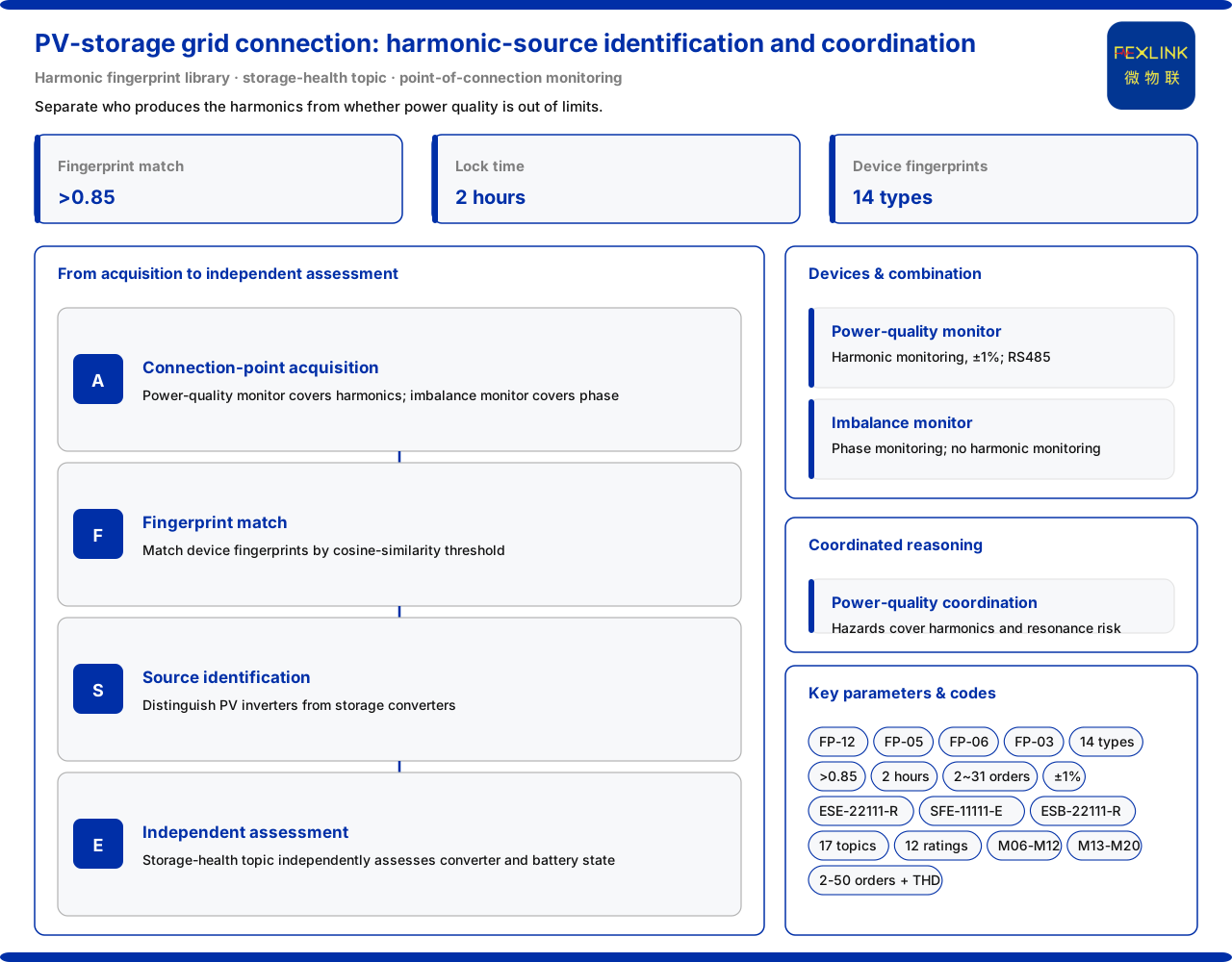
Photovoltaic-storage grid connection puts the photovoltaic inverter and the energy-storage converter on the same grid-connection point, so harmonic and power-quality problems often appear together, and "who produces the harmonics" must be judged separately from "whether power quality exceeds limits". The product knowledge base records a path from field collection to cloud evaluation: the Qianzhi engine's harmonic fingerprint library contains 14 classes of device fingerprints, matches with a cosine similarity greater than 0.85, and can lock the pollution source within 2 hours, whereas the traditional approach needs several weeks; the Tianyan engine's special topics include an energy-storage state-of-charge topic, which in a photovoltaic-storage grid-connection scenario allows independent assessment of the energy-storage converter and battery state. At field level, the ESE power-quality monitor (ESE-22111 to 22161-R) and the FSE multi-parameter electrical intelligent controller (power-quality type) respectively handle collection of grid-connection-point harmonics and power quality. This article only restates wording listed in the product knowledge base and does not infer any specific project's treatment effect.
1. Why photovoltaic-storage grid connection must separate harmonic sources
Photovoltaic inverters and energy-storage converters are both power-electronic conversion devices; once connected to the same grid-connection point, their harmonics superimpose at the common coupling point. Seeing only "harmonics exceeding limits" does not show which class of device the problem comes from. The product knowledge base's approach is to identify the source first, then judge the degree: the harmonic fingerprint library classifies different devices' harmonic features into 14 fingerprint classes, including photovoltaic inverters as well as uninterruptible power supplies, charging piles and six-pulse inverters. Separating the photovoltaic inverter's harmonics from those of energy-storage and other converters is the premise of later targeted treatment. This division means "identifying the source" and "judging power quality" are two parallel tasks, not substitutes for each other.
2. The Qianzhi engine's harmonic fingerprint library wording
The product knowledge base records that the Qianzhi engine's harmonic fingerprint library contains 14 classes of device fingerprints, covering photovoltaic inverters, uninterruptible power supplies, charging piles and six-pulse inverters. Matching uses cosine similarity with a threshold greater than 0.85; harmonic features meeting this similarity are counted into the corresponding fingerprint. It also records that the library can lock the pollution source within 2 hours, whereas the traditional approach needs several weeks. This time comparison describes the efficiency difference in the pollution-source locating step, not a promise of locating duration for any site. It should be emphasized that distinguishing photovoltaic-inverter harmonics from energy-storage and other converter sources is a direct capability of the library; whether a specific treatment meets standards is not inferred here.
3. The Tianyan engine's energy-storage-related topic
The product knowledge base records that the Tianyan engine's special topics total 17 models, including an energy-storage state-of-charge topic. The value of this topic is that, in a photovoltaic-storage grid-connection scenario, the state of the energy-storage converter and battery needs separate observation rather than being assessed mixed with the photovoltaic side. Placing the energy-storage topic with the harmonic fingerprint library under the same system shows two different concerns of the scenario: harmonic source attribution and the energy-storage device's own operating state. The product knowledge base does not expand the topic's algorithmic details in the entries on which this article is based, so this article does not further explain its modelling method.
4. Two equipment wordings for grid-connection-point power-quality collection
At field level, the product knowledge base gives two collection wordings with a division of labour.
The first is the ESE power-quality monitor (ESE-22111 to 22161-R). The product knowledge base records that it shares the architecture of the three-phase imbalance monitor and adds harmonic monitoring to phase monitoring, with a harmonic monitoring order of 2 to 31 and an accuracy of ±1%; it has 2 digital inputs and 1 relay output, with RS485 (Modbus) communication. It can therefore serve as a dedicated module for coordinated power-quality monitoring at a photovoltaic-storage grid-connection point.
The second is the FSE multi-parameter electrical intelligent controller (power-quality type), corresponding to the model range SFE-11111 to 11161-E/G. The product knowledge base records that this type adds harmonic monitoring to phase monitoring and, together with the meter type and three-phase balance type, provides 12 current specifications and 2 networking methods; the current specifications cover 3×5A, 3×100A, 3×200A, 3×400A, 3×600A and 3×1000A. Placing the two devices side by side shows that, at the grid-connection point, one may choose either a dedicated power-quality monitor or a more highly integrated multi-parameter controller.
5. The capability boundary of phase and imbalance monitoring
The product knowledge base also clearly records the capability boundary of same-architecture equipment. The ESB three-phase imbalance monitor (ESB-22111 to 22161-R) shares the architecture of the power-quality monitor, has 6 current specifications, an operating voltage of 3×220/380V, an OLED display and RS485 communication; beyond phase monitoring it does not include harmonic monitoring, and has 2 digital inputs and 1 relay output. That is, if the site's concern is three-phase imbalance and phase, the three-phase imbalance monitor suffices; if the harmonic order distribution must also be known, the power-quality monitor or the multi-parameter controller (power-quality type) is needed. Using "whether harmonic monitoring is present" as the dividing line helps select on demand without redundant configuration.
6. The power-quality special item in the selection comparison table
In its typical application scenarios and selection comparison, the product knowledge base lists the recommended product combination for "power quality/harmonic targeted governance" as the power-quality monitor and the multi-parameter controller (power-quality type), noting that the Tianyan engine harmonic analysis is used with them. This combination shows that selection does not look only at collection equipment, but includes on-site monitoring together with cloud harmonic analysis. For a photovoltaic-storage grid-connection scenario, this means the starting point of harmonic treatment is to collect the grid-connection point's power-quality data accurately, after which the Tianyan engine completes the judgement at the harmonic-analysis level.
7. The power-quality checkup and deep hazard sub-models
The product knowledge base records that the Qianzhi engine's power-quality checkup sub-models (M06 to M12) cover harmonics (2nd to 50th and total harmonic distortion), voltage imbalance, current imbalance (sequence components), power factor, voltage sags, voltage fluctuations and interharmonics; the deep hazard sub-models (M13 to M20) further include resonance risk and harmonic intermodulation. Placing the checkup sub-models with the deep hazard sub-models allows, within the same system, seeing both the "currently out-of-limits items" and the "potential risk items", serving the coordinated judgement of harmonics from the photovoltaic and energy-storage converters.
8. What to note when reading these wordings
First, the library's 2-hour locking and "traditional needs several weeks" should be understood as a comparison wording of the locating step, not a duration guarantee for any site. Second, source identification should be separated from power-quality grading: the former answers "who produces", the latter "whether limits are exceeded". Third, the device's harmonic monitoring capability should be the selection dividing line, avoiding redundant configuration where only phase and imbalance monitoring are needed. Fourth, the figures and conclusions above are the product knowledge base's wording; actual behaviour is affected by site conditions, connected devices and deployment method, and should follow the latest product materials and the specific project scheme.
Scope and limitations
First, this article only restates content listed in the product knowledge base, and its factual boundary is limited to the Qianzhi engine harmonic fingerprint library's 14 device fingerprint classes, cosine similarity greater than 0.85 and 2-hour locking wording, the Tianyan engine's 17 special topics and the energy-storage state-of-charge topic, the existing entries for the power-quality monitor, the three-phase imbalance monitor and the multi-parameter controller (power-quality type), and the existing entries for the power-quality checkup and deep hazard sub-models.
Second, 2 hours and "several weeks" are the comparison wording listed in the product knowledge base; this article does not infer its statistical method, test conditions or applicable working conditions.
Third, the harmonic monitoring order 2nd to 31st, the accuracy ±1%, and the 12 current specifications are the product knowledge base's wording; this article does not extend them into a guarantee for any scenario.
Fourth, this article does not constitute a commitment to the treatment effect or equipment selection result of any specific photovoltaic-storage grid-connection project; actual capability should follow the latest product materials and project scheme.