Direct answer
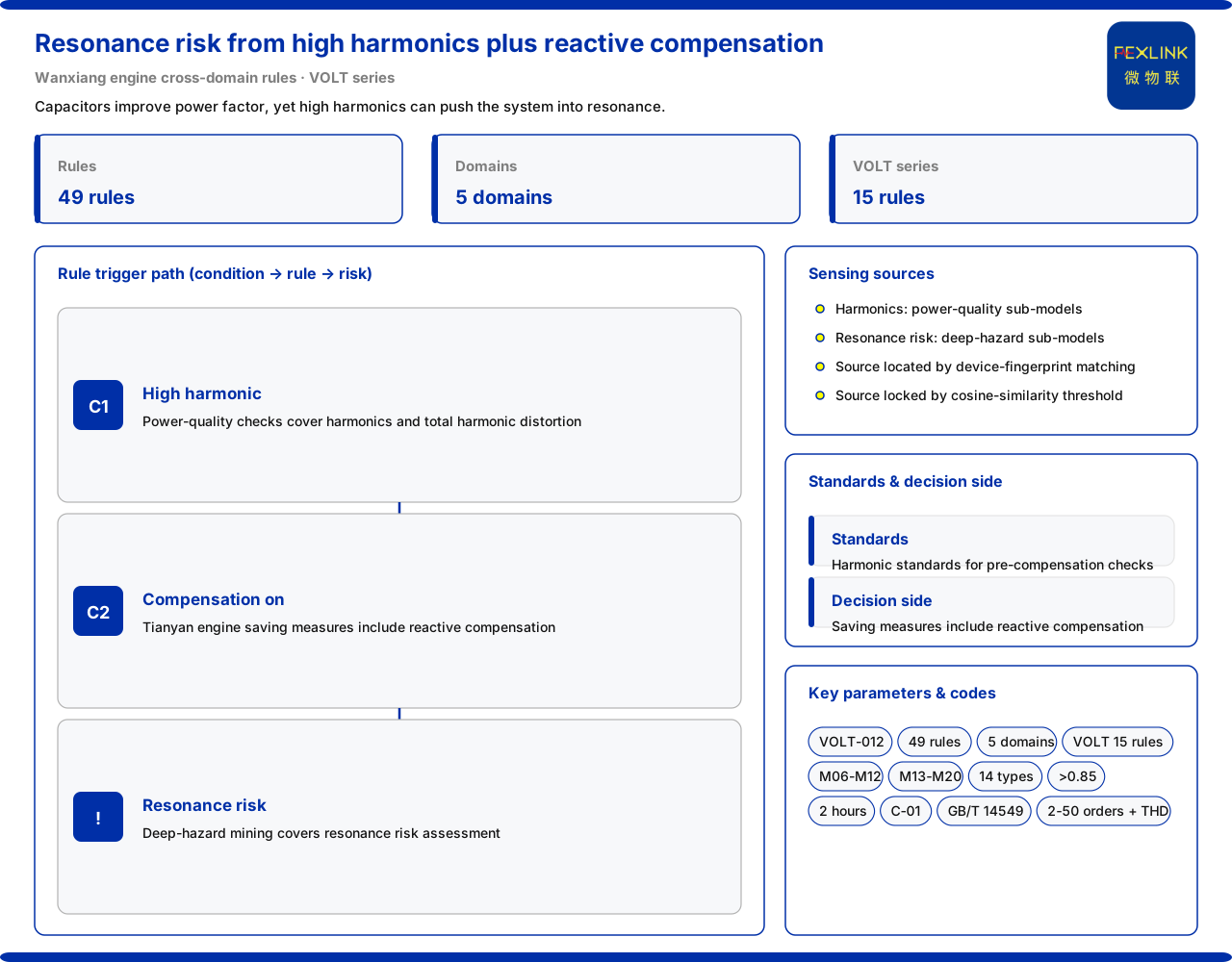
"High harmonics plus reactive-power compensation insertion leading to resonance risk" is an easily overlooked association judgement: inserting capacitors is itself meant to improve the power factor, but if harmonics are already high on site, adding reactive-power compensation may instead push the system toward resonance. The product knowledge base states that, among the VOLT-series association rules of the Wanxiang engine, the content of VOLT-012 is exactly "high harmonics plus reactive-power compensation insertion leading to resonance risk". Based on the product knowledge base, this article explains the rule's meaning, the scale of its rule system, the sensing source of resonance risk, the means of locating the pollution source, and the reactive-power compensation optimization item on the decision side; it does not infer any specific project's resonance result.
1. What one association rule says
This rule links two conditions with one consequence. The conditions are "high harmonics" and "reactive-power compensation insertion"; the consequence is "resonance risk". Its value is revealing a counter-intuitive combination: seen individually, both are routine actions, but stacked they may create a new risk. Inserting reactive-power compensation usually changes the system's impedance-frequency characteristic, while high harmonics mean that a high-frequency component of a certain band already exists; when the two meet, they may fall near a resonance point. The rule does not give a specific resonance frequency or amplification factor; it gives a judgement relationship of "be alert when these two conditions appear together".
It must be emphasized that this is an association rule, not a law of cause and effect. Its role is to flag a risky combination and trigger further analysis, not to replace on-site harmonic and impedance testing. The entry on which this article is based gives only the rule content, and does not expand its trigger weight or handling action; this article therefore does not infer how the rule participates in scoring.
2. Where the rule comes from: scale and domains
The product knowledge base states that the Wanxiang engine contains 49 cross-dimensional association rules in total, divided into 5 domains, of which the VOLT series has 15 rules and VOLT-012 belongs to that series. These give two references: 49 is the overall scale, showing association judgement covers many cross-dimensional combinations; 5 domains is the organization by dimension; 15 is the voltage-related count.
The meaning of domains is that a rule is interpreted only within its own dimension. Put back in the VOLT series, VOLT-012 discusses the interaction between harmonics and reactive-power compensation under the voltage-related dimension, which does not overlap with rules of other dimensions such as temperature or current. Understanding this structure helps avoid expanding a rule's scope without limit — a rule applies in the domain where it holds.
3. Sensing side: where harmonics and resonance risk come from
To judge whether "high harmonics" holds, the system must continuously measure harmonics. The product knowledge base states that the power-quality checkup sub-models M06 to M12 cover harmonic monitoring, covering the 2nd to 50th harmonics and including total harmonic distortion. This sub-model group is the sensing source of harmonic data: the 2nd-to-50th decomposition plus total harmonic distortion provides a quantifiable observation surface for "high harmonics".
Resonance risk itself also has a corresponding sensing position. The product knowledge base states that the deep hazard-mining sub-models M13 to M20 include "resonance risk". That is, resonance risk is not a physical quantity measured directly on site, but a class of hidden hazard inferred by the deep hazard-mining sub-models from data such as harmonics and impedance. The sensing side splits into two levels: the checkup sub-models measure the harmonics, and the hazard-mining sub-models infer whether resonance risk exists.
4. Locating side: how the harmonic fingerprint library locks the pollution source
Knowing "high harmonics" is not enough; it is also necessary to know who produces the harmonics. The product knowledge base states that the harmonic fingerprint library contains 14 classes of device fingerprints, for example a six-pulse inverter, a charging pile and a photovoltaic inverter corresponding to fingerprints FP-03, FP-06 and FP-12 respectively; the system matches with a cosine similarity greater than 0.85 and locks the pollution source within 2 hours. This wording advances harmonic treatment from "knowing there are harmonics" to "knowing whose harmonics they are".
The fingerprint library and the association rules are complementary. The association rule answers "will high harmonics plus reactive-power compensation insertion carry resonance risk"; the fingerprint library answers "which class of device the harmonics come from". In engineering, locating the source before making the compensation decision is the more reasonable order: if the pollution source is a photovoltaic inverter, the compensation scheme must be designed for its harmonic spectrum rather than simply inserting capacitors. The 14 fingerprint classes and the cosine-similarity threshold listed in the product knowledge base are the concrete wording of this judgement step.
5. Decision side: reactive-power compensation optimization
Only after locating and evaluating does the decision come. The product knowledge base states that block C (energy-saving countermeasures) of the Tianyan engine includes C-01 reactive-power compensation optimization. This provides a model-side decision basis for the action of "reactive-power compensation insertion": compensation is not that it cannot be done, but that it must be done after harmonic verification and according to the optimization item. Placing C-01 and VOLT-012 together, the relationship is clear — VOLT-012 flags the risk, C-01 provides the compensation-side optimization path.
A boundary is needed: the entry states only that block C contains a reactive-power compensation optimization item, not its algorithm, objective function or constraints; this article therefore does not infer a method for calculating compensation capacity. What can be confirmed is that the compensation decision should not bypass the front-end step of harmonic verification.
6. Standards basis
The product knowledge base states that the technical specifications of the relevant engine cover 13 main standards including GB/T 12325, GB/T 14549 and GB/T 15543, of which GB/T 14549 is the harmonic-related standard and can serve as the standards basis for harmonic verification before compensation. The role of the standard here is to turn "high harmonics" from a descriptive judgement into a comparison with a basis: whether harmonics exceed limits should follow the corresponding standard's limits, not a feel for experience.
Linking standards, sensing, association and decision gives a traceable path: use GB/T 14549 as the harmonic verification basis, use the power-quality checkup sub-models to measure the 2nd to 50th harmonics and total harmonic distortion, use the deep hazard-mining sub-models to judge resonance risk, use the harmonic fingerprint library to locate the pollution source, and use the reactive-power compensation optimization item to give the decision path — with VOLT-012 flagging the risky combination of "high harmonics plus compensation insertion" along this chain.
7. Engineering meaning
This association rule offers several prompts for field work. First, reactive-power compensation should not be treated as an isolated energy-saving action; harmonic verification should be done before switching. Second, the interaction risk between harmonics and reactive-power compensation must be continuously sensed by sub-models rather than detected once. Third, pollution-source location is a prerequisite for designing the compensation scheme, and the fingerprint library standardizes this step. Fourth, compensation optimization should follow the risk judgement; reversing the order may amplify the risk.
The value of a rule like VOLT-012 is not replacing an engineer's judgement but making an easily overlooked cross-dimensional interaction explicit: when harmonics and reactive-power compensation appear together, the system flags a combination risk rather than only checking whether a single indicator meets limits. This is the value of cross-dimensional association rules relative to single-indicator thresholds.
Scope and limitations
First, this article only restates wording listed in the product knowledge base, and its factual boundary is limited to: VOLT-012's content being "high harmonics plus reactive-power compensation insertion leading to resonance risk"; the Wanxiang engine having 49 cross-dimensional association rules in 5 domains, with 15 in the VOLT series; the power-quality checkup sub-models M06 to M12 covering harmonics (2nd to 50th and total harmonic distortion); the deep hazard-mining sub-models M13 to M20 covering resonance risk; the harmonic fingerprint library having 14 classes of device fingerprints (including the three examples of a six-pulse inverter, a charging pile and a photovoltaic inverter), cosine similarity greater than 0.85, and locking the pollution source within 2 hours; block C of the Tianyan engine containing reactive-power compensation optimization; and the technical specifications covering 13 main standards including GB/T 12325, GB/T 14549 and GB/T 15543.
Second, this article does not infer the count and content of the remaining VOLT-series rules, does not expand the domain breakdown of the 49 rules, and does not infer how the rules participate in scoring.
Third, whether harmonics exceed limits and whether resonance risk exists should follow on-site measurement and the relevant standards; the sub-models and fingerprint library listed here are the product knowledge base's wording, not a commitment to any specific project's conclusion.
Fourth, the capacity, switching mode and engineering implementation of reactive-power compensation are design judgements; this article only states that a reactive-power compensation optimization model item exists, and does not replace engineering calculation.