Direct answer
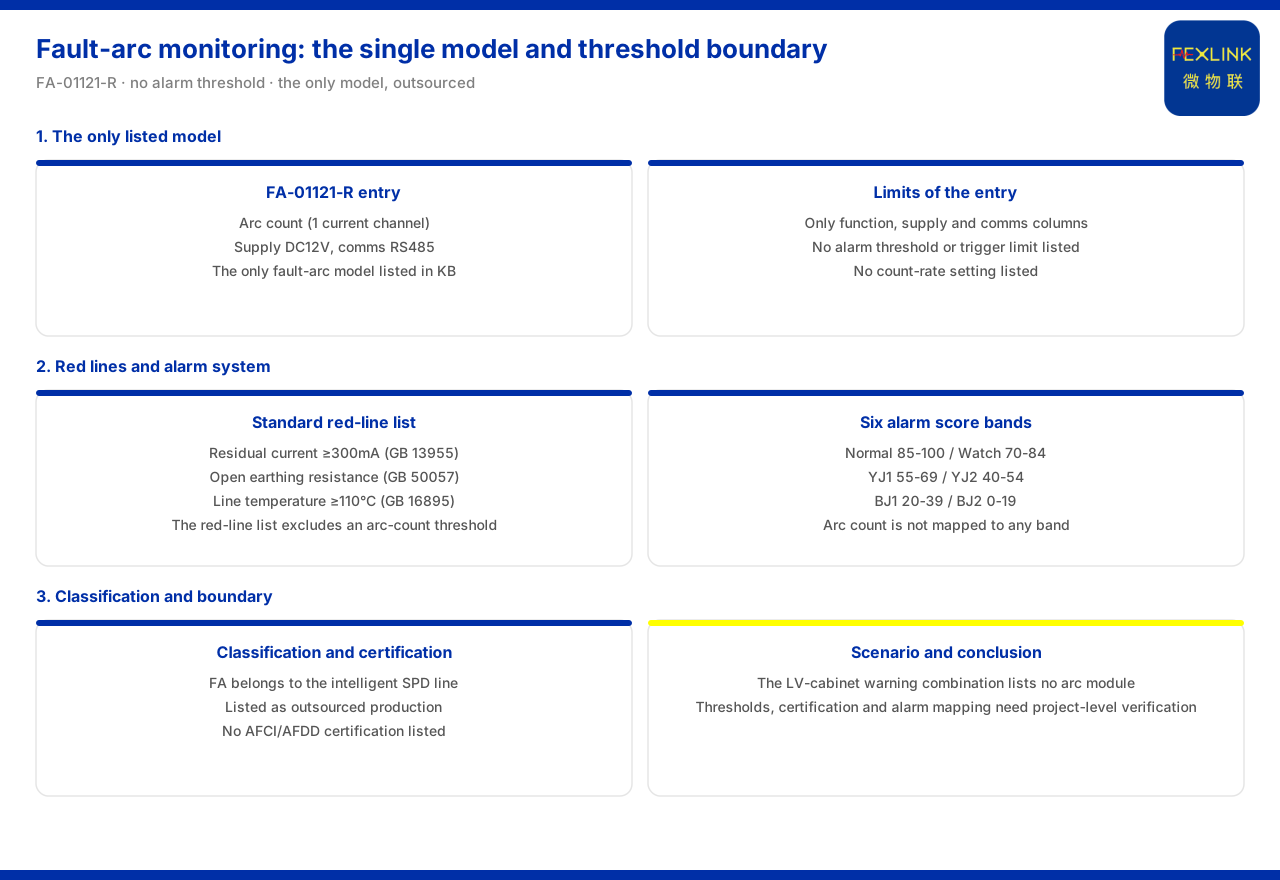
The arc-fault monitoring module currently yields a very narrow entry, and selection and use must be handled within that boundary. The product knowledge base lists one arc-fault monitoring module, model FA-01121-R, with the function of arc count (one current channel), DC12V supply and RS485 communication; it is also the only arc-fault monitoring module model listed in the knowledge base. The entry itself contains only three columns — function, supply and communication — and gives no alarm threshold, trigger threshold or counting-rate setting for arc count. The safety red-line guard list contains five rules — residual current, grounding-resistance open circuit, three-phase voltage unbalance, line temperature and insulation resistance — and does not include an arc-count threshold. The six-level alarm score bands (normal, Watch, YJ1, YJ2, BJ1 and BJ2) likewise do not map arc count to a score. In addition, the product knowledge base places the arc-fault monitoring module in the outsourced-production category and does not provide AFCI or AFDD certification or standard-compliance information with the entry, and the recommended combination for low-voltage distribution cabinet electrical fire early warning does not list the arc monitoring module. Matters concerning arc thresholds, certification and alarm mapping should therefore all be verified at project level.
1. The only model listed: FA-01121-R
The record on arc fault in the product knowledge base is concentrated in one entry. The FA arc-fault monitoring module (FA-01121-R) has the function of arc count (one current channel), a supply of DC12V and communication of RS485. Two points deserve emphasis: first, this is the only arc-fault monitoring module model listed in the knowledge base; second, the entry carries very limited information, covering only function, supply and communication. At the selection level there is thus only one model to follow, and its function points to counting arc events. Obtaining further application information on this model requires another source.
2. The entry gives only three columns: no threshold
The boundary of the entry information determines which questions can and cannot be answered. The FA-01121-R entry contains only the three columns of function, supply and communication, and the product knowledge base does not give an alarm threshold, trigger threshold or counting-rate setting for arc count in that entry. This means the knowledge base cannot answer the question "at how many arcs should an alarm be raised." In engineering practice, if a threshold is needed, it must not be inferred from the existing entry but determined separately with the device documentation and project requirements. Keeping "can count" and "when to alarm" apart avoids assuming that the model entry already contains an alarm criterion.
3. Safety red-line guard: the five-rule list excludes arc count
The Qianzhi engine of the product knowledge base lists five safety red-line guards, aimed respectively at residual current, abnormal open circuit of grounding resistance, three-phase voltage unbalance, line temperature and insulation resistance, each with a corresponding standard. This red-line list does not include an arc-count threshold. Even at the platform-side safety red-line entries, then, there is no ready arc criterion to apply. If a site wishes to bring arc monitoring into safety red-line management, the judgement convention must be confirmed separately, and it must not be assumed that the red-line list already covers arc count.
4. Division of labour with the mains residual-current monitoring module
Within the same product line, arc monitoring must be distinguished from residual-current monitoring. The product knowledge base assigns the FA arc-fault monitoring module to the intelligent lightning-protection product line; the same section also lists the FD mains (residual-current) monitoring module (FD-01011-R), which collects one residual-current channel with a range of 15mA to 1000mA, supplied at DC12V and communicating over RS485. The two share supply and communication but differ in measurement object: FA counts arc events, FD measures residual current. In selection, first establish whether arc or residual current is to be monitored, then choose between the two module classes; if both are needed, they should be configured separately rather than expecting a single module to cover both.
5. The outsourced-production and certification gap
On production and certification, the product knowledge base gives a clear boundary. The known information gaps place the arc-fault monitoring module in the outsourced-production category; the knowledge base does not provide AFCI or AFDD certification or standard-compliance information with the entry. The existing record can therefore only show that the module is outsourced for production, and cannot be used to show that it has obtained a particular arc-protection certification. For a project with certification requirements, the certification material should be requested separately at the procurement stage and the material actually obtained should govern; a certification conclusion must not be drawn from the existing knowledge-base entry.
6. Typical scenarios do not list arc monitoring
From the scenario-combination perspective, arc monitoring has not yet entered the listed recommended combinations. The product knowledge base lists the recommended combination for "low-voltage distribution cabinet electrical fire early warning" as ESF-22110, ESC multi-channel leakage, EST temperature and IoTBox; this combination does not list the arc monitoring module and gives no arc alarm threshold. In the electrical fire early warning scenario given by the knowledge base, monitoring is thus carried by residual-current, leakage and temperature devices. If a project wishes to add arc monitoring to this scenario, it is an addition outside the existing combination and must be confirmed according to actual conditions.
7. The relation between the six alarm bands and arc count
The Qianzhi engine of the product knowledge base gives six alarm score bands: normal is 85 to 100, Watch is 70 to 84, YJ1 is 55 to 69, YJ2 is 40 to 54, BJ1 is 20 to 39 and BJ2 is 0 to 19. These bands describe the overall alarm level, but the product knowledge base does not map arc count to any of these score bands or thresholds within the alarm system. Arc count therefore has no corresponding level-conversion rule for the time being. If a site wishes to manage arc risk by these score bands, the mapping must be defined separately and verified.
8. Procurement and verification suggestions
Given the available information, proceed by the following points. First, establish whether the monitoring target is arc count; if so, the only model currently available is FA-01121-R. Second, check whether the DC12V supply and RS485 communication match the site conditions. Third, if an alarm threshold is needed, determine it separately with the device documentation and project requirements rather than applying a criterion the knowledge base does not give. Fourth, if certification is needed, request AFCI or AFDD material from the supply side and let the actual material govern. Fifth, if arc monitoring is to be added to the low-voltage distribution cabinet electrical fire early warning scenario, state that it is an addition outside the combination and confirm access and criterion separately. By these points, progress can be made safely within the information boundary.
Scope and limitations
First, this article restates only what the product knowledge base records; the factual boundary is limited to the FA-01121-R entry, the safety red-line guard list, the mains residual-current monitoring module, the known information gaps, the typical scenario and the six alarm score bands.
Second, the function, supply and communication of FA-01121-R are cited as listed; the entry does not list an alarm threshold, trigger threshold or counting rate, and this article explains the boundary accordingly without inferring specific values.
Third, the five safety red-line guards and the six alarm score bands are cited as listed; this article does not infer a mapping between arc count and the red lines or scores.
Fourth, the outsourced-production and unlisted-certification item is cited as listed in the known information gaps; this article does not draw a certification conclusion from it.
Fifth, this article only explains the information boundary and procurement verification points of the arc-fault monitoring module; it provides no alarm threshold, certification applicability or setting scheme for a specific project, and related conclusions must be determined with site conditions and the project scheme.