Direct answer
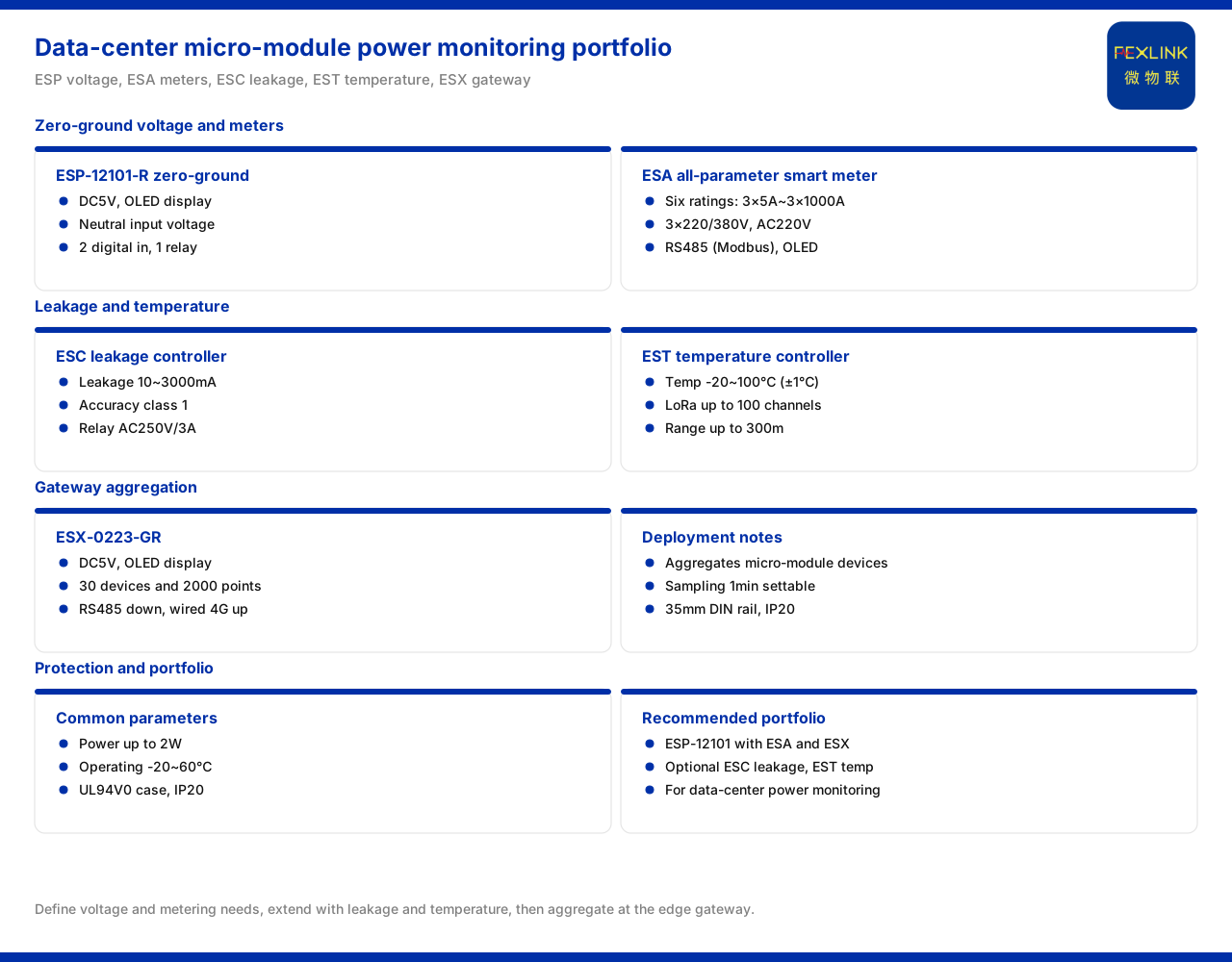
A micro-module integrated cabinet is spatially compact with constrained cabling, so monitoring has to cover metering, safety, thermal hazard and neutral-to-earth voltage within a single cabinet. According to the product knowledge base's selection comparison table, the recommended combination for data-centre neutral-to-earth voltage and power-distribution monitoring is the neutral-to-earth voltage monitor (ESP-12101-R), the all-parameter smart meter (e.g. ESA-22111-R) and the intelligent edge-computing gateway (ESX-0223-GR). On that basis, if leakage and temperature are also to be covered, the multi-channel leakage monitoring and control device (e.g. ESC-22310-R) and the multi-channel temperature controller (e.g. EST-12111-R) can be added. The minimum sufficient combination within one micro-module can therefore be summarised as four classes of monitoring — metering, leakage, temperature and neutral-to-earth voltage — aggregated and sent upward by the intelligent edge-computing gateway. This article restates only the models and parameters recorded in the product knowledge base and does not infer the channel allocation for a specific project.
1. Establishing a "minimum sufficient" principle under spatial constraints
A micro-module integrates power supply, distribution and cabinets within a limited space, leaving little room for monitoring devices and cable routing. The selection comparison table lists neutral-to-earth voltage and power-distribution monitoring as one row, corresponding to the neutral-to-earth voltage monitor, the all-parameter smart meter and the intelligent edge-computing gateway, which shows that selection for this scenario is given as a combination rather than a single device. Unpacking that row, it covers three concerns: metering reflects consumption, neutral-to-earth voltage reflects a power-quality hazard, and the gateway handles aggregation. Whether leakage and temperature are added depends on whether the micro-module needs to bring safety and thermal hazards into scope as well.
From an integrator's viewpoint, separating monitoring into the four classes of metering, safety, thermal hazard and neutral-to-earth voltage has the advantage that each class has a clear object of observation: metering answers "how much electricity was used," leakage answers "is the insulation reliable," temperature answers "is heat accumulating," and neutral-to-earth voltage answers "does power quality meet the requirement." The four do not substitute for one another and so do not duplicate points when a class is added. When space is tight, determining the classes that must be covered first and then choosing, within each class, the model that meets the accuracy and channel needs is more reliable than trimming afterwards.
2. Metering layer: all-parameter and embedded multi-function smart meters
Metering is the base of distribution monitoring. The product knowledge base records that the all-parameter smart meter has six current specifications (ESA-22111-R to ESA-22161-R, covering 3×5A to 3×1000A), all 3×220/380V, supporting meter monitoring, 2 digital inputs and 1 relay output, with the whole series supplied at AC220V, an OLED display and RS485 (Modbus) communication, and explicitly without phase or harmonic monitoring. The embedded multi-function smart meter includes ZSA-12110, ZSA-12210, ZSA-22110-R, ZSA-22240-R, ZSA-22113-R and ZSA-22243-R, all supplied at AC220V, with an OLED display and support for 1×5A or 3×5A (adjustable), and some models supporting phase, harmonics, pulse, digital input and relays. The two thus differ in current specification, phase count and whether phase and harmonics are supported; selection should weigh one against the other by circuit current and the measurements required rather than treating them as interchangeable.
It is particularly important to note that although the all-parameter smart meter is named "all-parameter," the product knowledge base explicitly records that it has no phase or harmonic monitoring; where phase or harmonics are needed, selection should turn to the embedded multi-function smart meter models that support them. Writing this difference into the selection checklist avoids mistaking the word "all-parameter" for coverage of all electrical parameters.
3. Safety layer: the multi-channel leakage monitoring and control device
If the micro-module is to bring leakage into scope, the multi-channel leakage monitoring and control device is an option. The product knowledge base records that its leakage monitoring range is 10 to 3000mA with accuracy class 1, that its relay contact capacity is AC250V/3A and DC30V/3A, and that the leakage controller includes ESC-22310-R, ESC-12111-R, ESC-12311-R, ESC-22111-R and ESC-22311-R, supplied at AC220V or DC5V, with an OLED display and RS485. The significance of putting leakage monitoring into a micro-module is to find insulation-type hazards at the distribution-unit level without waiting for a fault to appear. The choice of multi-channel model depends on the number of circuits the module needs to monitor.
4. Thermal-hazard layer: the multi-channel temperature controller
Temperature monitoring covers thermal hazards. The product knowledge base records that the wired NTC and wireless active temperature ranges of the multi-channel temperature controller are both -20 to 100 degrees Celsius (±1 degree Celsius); the wireless LoRa supports up to 100 channels, with a sampling period settable at 1 minute and an effective distance of no more than 300 metres. The general parameters are power consumption of no more than 2W, operating temperature -20 to 60 degrees Celsius, dimensions 36×110×69 millimetres, a UL94V0 enclosure, IP20 protection and 35mm DIN-rail mounting. For a spatially constrained micro-module, DIN-rail mounting and wireless temperature measurement reduce cabling needs, which is especially practical where in-cabinet routing is limited.
5. Neutral-to-earth voltage layer: the neutral-to-earth voltage monitor
Neutral-to-earth voltage is a dedicated concern of data-centre power quality. The product knowledge base records that the neutral-to-earth voltage monitor (ESP-12101-R) is supplied at DC5V, has an OLED display, measures the neutral input voltage, includes 2 digital inputs and 1 relay output, and provides RS485 communication. The selection comparison table places this model in the data-centre neutral-to-earth voltage and power-distribution combination, showing that it exists as a dedicated monitoring point in this scenario rather than being covered incidentally by a metering device. Monitoring neutral-to-earth voltage separately gives power-quality hazards an independent observation entry.
6. Aggregation layer: the intelligent edge-computing gateway
The data produced by the monitoring devices above must be aggregated and sent upward. The product knowledge base records that the intelligent edge-computing gateway (ESX-0223-GR) is supplied at DC5V, has an OLED display, provides access capability for 30 devices and 2000 data points, communicates downward over RS485 and upward over wired 4G. This parameter combination shows that it plays the aggregation role within the micro-module: gathering meters, leakage, temperature and neutral-to-earth voltage monitors downward over RS485 and sending upward over 4G. Including the gateway in the combination means that monitoring within the micro-module does not stop at local display but acquires a basis for centralised management.
In capacity accounting, the 30 devices and 2000 data points of the intelligent edge-computing gateway are the reference ceiling for the monitoring scale within a micro-module; adding up the meters, leakage, temperature and neutral-to-earth voltage monitors and comparing the total against this ceiling allows a judgement at the scheme stage as to whether the access method needs adjustment. This accounting does not change the selection of the monitoring devices themselves but affects whether the gateway suffices and how the points are organised.
7. Combination order within one cabinet
The information above can be organised into a sequence. First, select the metering device by circuit current and the measurements required: the all-parameter smart meter covers six steps from 3×5A to 3×1000A, while the embedded multi-function smart meter offers 1×5A or 3×5A (adjustable) and phase and harmonic support on some models. Second, choose the multi-channel leakage monitoring and control device as needed, with a leakage range of 10 to 3000mA. Third, choose the multi-channel temperature controller as needed, with up to 100 wireless LoRa channels. Fourth, include the neutral-to-earth voltage monitor in the data-centre power-quality scenario. Fifth, aggregate with the intelligent edge-computing gateway, whose access capability of 30 devices and 2000 data points must be accounted for together with the quantities selected above. This order separates metering, leakage, temperature, neutral-to-earth voltage and aggregation, avoiding the stacking of functionally overlapping devices in a tight space. Sixth, check the gateway's access capability of 30 devices and 2000 data points against those quantities to ensure the aggregation layer matches the front end before finalising the in-cabinet combination.
Scope and limitations
First, this article restates only what the product knowledge base records; the factual boundary is limited to the models and parameters listed for the neutral-to-earth voltage monitor, the all-parameter smart meter, the embedded multi-function smart meter, the multi-channel leakage monitoring and control device, the multi-channel temperature controller and the intelligent edge-computing gateway.
Second, this article does not infer the channel allocation, point counts or configuration conclusions of any model in a specific project.
Third, the all-parameter smart meter explicitly has no phase or harmonic monitoring; where phase or harmonics are required, another model should be chosen, and this article does not infer the monitoring scope of other series from that.
Fourth, parameters are governed by what the product knowledge base lists, and actual selection is subject to the latest product material and project requirements.