What Mistudio software is: the "device brain" of programmable logic control
In electrical automation and intelligent-retrofit projects, a controller needs a programming tool that electrical engineers can pick up quickly and that still covers complex logic. The Mistudio programmable logic control software system (compiler) is proprietary software designed for exactly this need. Its role is to turn the control intent set by an engineer into logic the device can execute, which is why it is often described as the "device brain" of the whole control scheme.
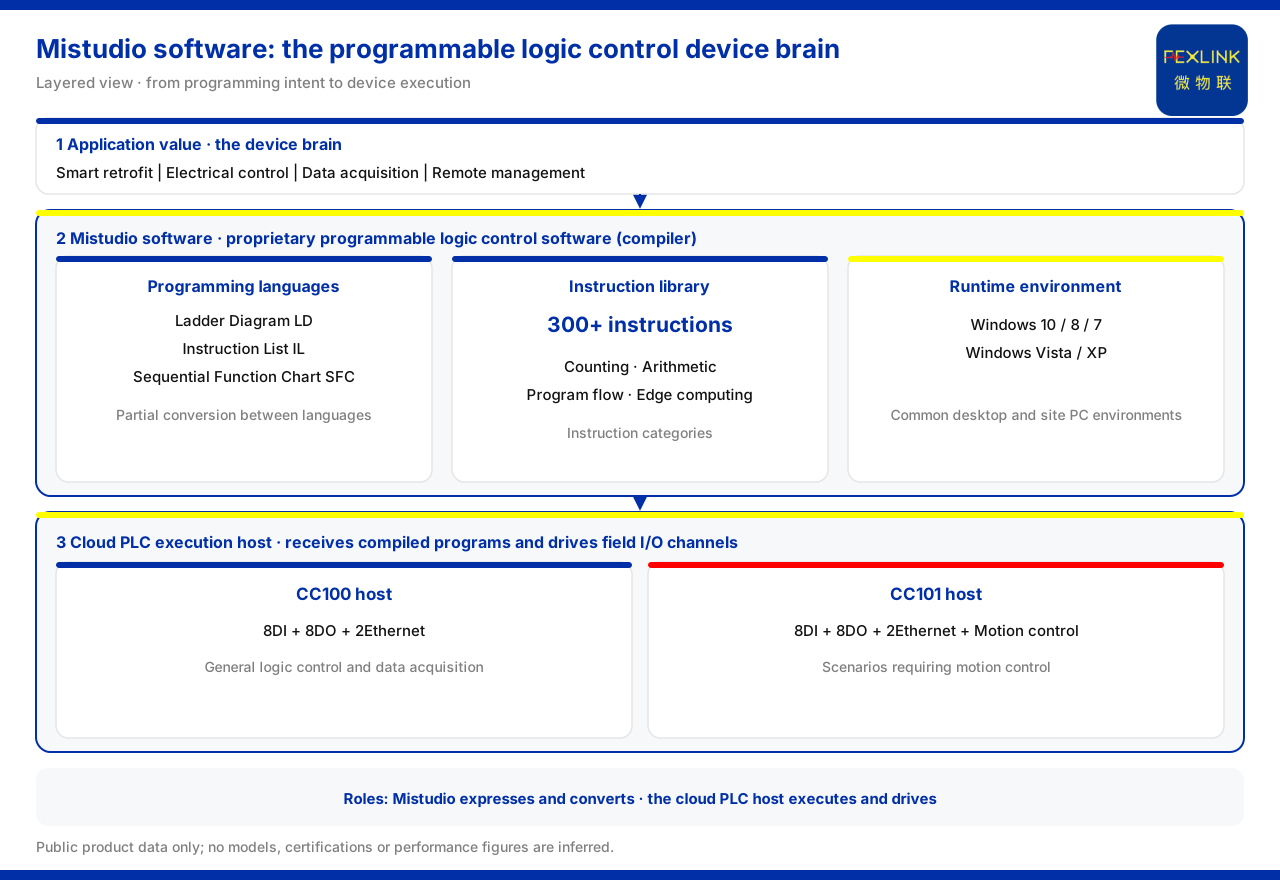
Mistudio software can be understood at three levels. First, it is a programming and compilation tool, responsible for writing control logic into a program the device can run. Second, it is an engineering language platform, letting engineers with different habits express logic in the way they already know. Third, it is the hub of the control scheme, taking design intent from above and driving field devices below. Around these three points, the sections below describe its programming languages, instruction capability, runtime environment, and how it works together with cloud PLC hosts.
Programming languages for electrical engineers
Mistudio software is designed around the real working habits of electrical engineering and supports several programming languages, including ladder diagram, instruction list and sequential function chart. The three have different strengths. Ladder diagram expresses logic graphically through contacts and coils, and is intuitive to read, so engineers who have long worked with relay control circuits can migrate to it fairly quickly. Instruction list describes a program as a sequence of instructions and suits compact logic that needs fine control. Sequential function chart is good at expressing step-by-step processes, making it easy to break a complex action into clear stages.
A more practical point is that Mistudio software supports free conversion between some of these programming languages. This means an engineer can build logic in the most convenient form during design and then switch to another representation as the project requires, without rewriting from scratch. For projects involving several engineers, this conversion capability noticeably lowers the cost of handover; for equipment that must be maintained over the long term, it also helps later staff understand an existing program from a viewpoint they know. The readability and portability of the language ultimately translate into engineering efficiency.
More than 300 instructions covering common control tasks
Programming languages answer the question of "how to write", while the instruction library decides "what can be written". Mistudio software provides more than 300 instructions, covering the common needs of electrical control and edge computing. By category, these instructions include counting, arithmetic operations, program flow control and edge-computing instructions.
Counting instructions accumulate and judge input signals, which is common in output statistics and position counting. Arithmetic instructions handle addition, subtraction, multiplication, division and comparison of values, the basis for judging between a process quantity and a setpoint. Program flow control instructions organise the execution order of a program, implementing conditional branches, loops and jumps so that logic can switch flexibly with operating conditions. Edge-computing instructions move part of the data-processing capability forward to the device side, so that the site can complete preliminary calculation and judgement locally and depend less on a higher-level system. The number and variety of instructions directly determine whether the software can cover control tasks from simple interlocking to relatively complex sequences in a concise way.
One clarification is needed: the instruction count describes the capability of the software. Which instructions are used in a specific project should still be decided by the actual control requirements and the engineering scheme.
Working with the cloud PLC host: from programming to execution
Logic written with Mistudio software must finally be executed on hardware. In a complete control scheme, that execution task falls to the cloud PLC (with expansion modules). As the execution host, the cloud PLC receives the program compiled and issued by Mistudio software, drives the field digital and analog channels, and completes the actual control of the electrical system.
The cloud PLC host models are divided to suit different needs, and all provide digital inputs and outputs together with Ethernet interfaces; one of them adds motion-control capability on that basis, for applications that must drive a motor or perform a positioning action. The table below lists the host models and their configurations for easy comparison during selection.
| Cloud PLC host model | I/O and interface configuration | Suitable direction | | --- | --- | --- | | CC100 | 8 digital inputs + 8 digital outputs + 2 Ethernet | Conventional logic control and data acquisition | | CC101 | 8 digital inputs + 8 digital outputs + 2 Ethernet + motion control | Control scenarios needing motion control |
Two cloud PLC host models, CC100 and CC101, are available. This combination of "software programming plus host execution" joins the flexibility of programming with the reliability of hardware: engineers complete logic design and verify their approach in Mistudio software, compile and deploy it to the cloud PLC host, and the host then runs continuously on site. The software handles expression and conversion, the host handles execution and driving; the division of labour is clear, and together they support the control system through the whole process from design to commissioning.
Runtime environment and engineering deployment
On the deployment side, Mistudio software can run on operating systems such as Windows 10, Windows 8, Windows 7, Windows Vista and Windows XP. These systems cover many common computer environments on engineering sites and in offices, so engineering staff can complete programming work on a fairly familiar operating system without having to change the computer platform specially for the software. For equipment manufacturers and system integrators, this means programming terminals can be arranged more flexibly at deployment, and it also leaves room for linking existing equipment with new projects.
From programming to management: the application value
Mistudio software is positioned as the "device brain", a description that points to its place in the whole scheme. Around this positioning, its application value is mainly reflected in several areas. In intelligent retrofit, it can add programmable control logic to existing equipment, giving originally fixed actions the ability to be adjusted as needed. In electrical system control, it turns relay-circuit logic into a programmable and reusable program. In data acquisition and management, it works with field acquisition channels to gather operating data for later processing. In remote management, it provides a basis for logic adjustment and operation-and-maintenance work on the device side.
These applications are not isolated from one another. Intelligent retrofit is often accompanied by a reconstruction of control logic, and the reconstructed system then produces new data, which after acquisition and management in turn supports judgement and decisions in remote management. Mistudio software sits at the start of this chain, at the definition and compilation of logic, and runs through the whole process of equipment operation.
Summary
Mistudio software is a proprietary programmable logic control software system (compiler) that supports programming languages such as ladder diagram, instruction list and sequential function chart, with free conversion between some languages. It provides more than 300 instructions covering counting, arithmetic operations, program flow control and edge computing, and runs on several Windows versions. Working with the cloud PLC host, the former is responsible for programming and compilation while the latter is responsible for field execution, together forming a complete control scheme from logic design to device driving.
During selection, it is advisable to first clarify the control object and the complexity of the action, and then judge the required instruction categories and host configuration accordingly. If motion control is involved, a cloud PLC host model with the corresponding capability should be chosen. Only by matching software capability with hardware configuration can the whole control scheme be sufficient without being wasteful.