Direct answer
The associations between harmonics, motor vibration and partial discharge fall within one and the same analytical system in the product knowledge base. The product knowledge base records that the Qianzhi engine's deep hidden-hazard mining sub-models list vibration analysis and partial-discharge detection as parallel dimensions, grouped with resonance risk and insulation state under hidden-hazard mining; at the same time the power-quality check-up sub-models provide harmonic measurement from the 2nd to the 50th order including total harmonic distortion. Harmonics provide the electrical-side features, vibration and partial discharge provide the mechanical and insulation-side features, and the two are strung together by correlation validation and cross-dimensional correlation rules, then used with the harmonic fingerprint library to locate the pollution source, ultimately supporting predictive-maintenance decisions. The product knowledge base also records the combination for equipment life prediction and predictive maintenance as the Tianyan engine's S-02, S-04 and S-13 together with 17 special-topic models, of which S-02 can warn 4 to 12 weeks ahead. The following expands item by item.
Putting harmonics into the deep hidden-hazard mining sequence
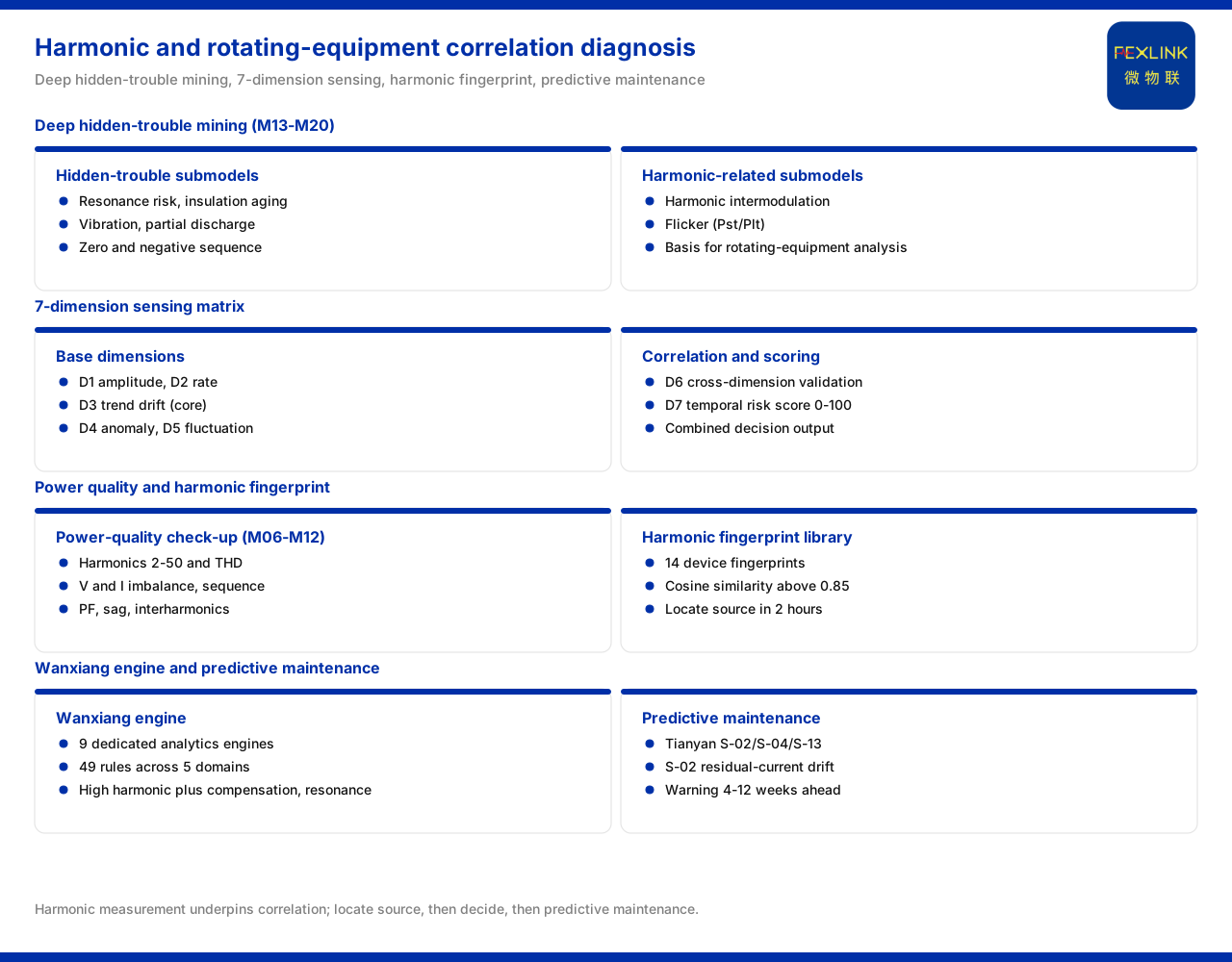
The product knowledge base records that the Qianzhi engine's deep hidden-hazard mining sub-models M13 to M20 are, in order: resonance risk, insulation state (ageing model), vibration analysis, partial-discharge detection, zero-sequence current, negative-sequence component, harmonic intermodulation, and flicker synthesis. Of these, vibration analysis is the 3rd item and partial-discharge detection the 4th.
The significance of this ordering is that vibration and partial discharge are not independent functions but hidden-hazard dimensions on a par with resonance, insulation and harmonics. For rotating equipment, vibration reflects mechanical state and partial discharge reflects insulation state; placed in the same sequence as the electrical-side harmonic intermodulation and negative-sequence component, they form a joint electrical, mechanical and insulation perspective. The reason harmonics can be associated with vibration and partial discharge is precisely that they are brought into one hidden-hazard mining system, rather than each alarming in isolation.
Qianzhi's harmonic measurement basis
To discuss associations, reliable harmonic measurement is needed first. The product knowledge base records that the Qianzhi engine's power-quality check-up sub-models M06 to M12 include harmonic monitoring, with an order range of the 2nd to the 50th order including total harmonic distortion; the same group also includes voltage unbalance, current-unbalance sequence components, power factor, voltage sag, voltage fluctuation and inter-harmonics.
Harmonic monitoring provides the measurement basis for later correlation: the 2nd-to-50th-order harmonic data outlines the frequency composition on the electrical side, while the vibration and partial-discharge features of rotating equipment often change together with particular harmonic components. Only by reading harmonics together with vibration and partial discharge is it possible to advance from "the equipment is vibrating" or "partial discharge exists" to "why it happens". This article cites the order range and the group content as they stand in the product knowledge base and does not infer the sampling method or accuracy of each harmonic order.
Seven-dimensional perception and correlation validation
The product knowledge base records that the Qianzhi engine's seven-dimensional perception matrix is D1 amplitude, D2 rate of change, D3 trend drift (core), D4 anomaly density, D5 fluctuation magnitude, D6 correlation validation, and D7 time-series risk scoring (0 to 100 composite decision). Of these, D6 correlation validation is used for cross-parameter and cross-dimensional joint assessment.
The association of harmonics with vibration and partial discharge is exactly where D6 lands: an anomaly in a single dimension may be only a disturbance, but if harmonics and vibration change in the same direction over the same period, correlation validation gives a stronger criterion. D7 then aggregates the relevant dimensions into a composite score of 0 to 100, supporting graded handling. In other words, correlation is not laying two curves side by side but taking cross-dimensional consistent change as an independent criterion into the score.
Wanxiang's correlation engine and correlation rules
The product knowledge base records that the Wanxiang engine contains 9 dedicated analysis engines, including temperature, voltage, current and harmonic correlation engines, used for correlating harmonics with other parameters. Besides the engines, the product knowledge base also records the Wanxiang engine's 49 cross-dimensional correlation rules (in 5 domains), including "high harmonics plus reactive-compensation switching points to resonance risk", "total harmonic distortion and power factor worsening together points to harmonics interfering with reactive power", and "persistent zero-sequence current points to single-phase grounding tracing".
These rules give the concrete form of correlation: harmonics, reactive power, power factor and zero-sequence current are not isolated but have identifiable combination patterns. For the association between harmonics and rotating equipment this can be understood as: if harmonic change and equipment-side features appear at the same time, they should be treated as a combined clue rather than a single-point alarm. This article restates the rule examples as they stand in the product knowledge base and does not extend to criteria outside the rules.
Harmonic fingerprint library and pollution-source location
If correlation analysis is to land on "who produces the harmonics", fingerprint capability is needed. The product knowledge base records that the harmonic fingerprint library contains 14 classes of device fingerprints, such as three-phase rectifiers, six-pulse inverters, uninterruptible power supplies, charging piles and photovoltaic inverters, matched by cosine similarity greater than 0.85, which can lock the pollution source within 2 hours, whereas the traditional approach takes weeks.
The fingerprint library and correlation diagnosis complement each other: the correlation rules answer which quantities change together, and the fingerprint library answers which class of device the change most resembles. For a harmonic source driving rotating equipment, the device class is first narrowed by fingerprint, then the state of the rotating parts confirmed with vibration and partial discharge, forming a chain from source to equipment. This article only restates the class count, matching threshold and lock-on time and does not infer the identification accuracy.
From correlation diagnosis to predictive maintenance
The product knowledge base records that the selection combination for equipment life prediction and predictive maintenance is the Tianyan engine's S-02, S-04 and S-13 together with 17 special-topic models; of these, S-02 is the residual-current trend-drift model, using cumulative-sum change-point detection, and can warn 4 to 12 weeks ahead.
Read together with the foregoing associations, the path becomes visible: harmonic measurement and correlation rules provide the features, vibration and partial discharge provide the equipment-side evidence, and the trend models then turn slow deterioration into an early warning. Predictive maintenance is therefore not the product of a single model but a decision extension after correlation diagnosis. This article cites only the model combination and the warning window and does not infer the false-alarm rate.
Utilisation sequence in monitoring
First, ensure harmonic measurement is in place, covering the 2nd to the 50th order including total harmonic distortion. Second, enable correlation validation in seven-dimensional perception and compare harmonics with vibration and partial discharge on the same time axis. Third, use the Wanxiang engine's harmonic correlation engine and cross-dimensional correlation rules to form combined clues. Fourth, match the device class with the harmonic fingerprint library to narrow the pollution-source range. Fifth, enable the predictive-maintenance combination for trend deterioration and schedule maintenance by the early-warning window.
The key to this sequence is order: ensure measurement first, then discuss correlation; narrow the pollution source first, then confirm on the equipment side; and only then enter the maintenance decision. If measurement or cleaning is skipped, the later correlation and fingerprinting both lack reliable input.
Applicability and limits
- This article is limited to the product knowledge base's existing statements on the Qianzhi engine's deep hidden-hazard mining sub-models, the seven-dimensional perception matrix, the power-quality check-up sub-models, the Wanxiang engine's correlation engines and correlation rules, the harmonic fingerprint library, and the equipment life prediction and predictive-maintenance combination. - The sub-model numbers, the seven-dimension names and the composite-score interval, the harmonic order range and the correlation-rule examples, the fingerprint class count with the similarity threshold and lock-on time are all product knowledge base conventions. - The predictive-maintenance combination and the early-warning window (4 to 12 weeks) are cited as they stand in the product knowledge base; this article does not infer their applicability to a specific device. - This article does not excerpt the clause text of the relevant standards and does not give unverified limits in the name of a standard. - This article does not constitute a commitment to the diagnostic accuracy or maintenance effect of a specific project; actual capability is subject to the latest product documentation and project scheme.