Direct answer
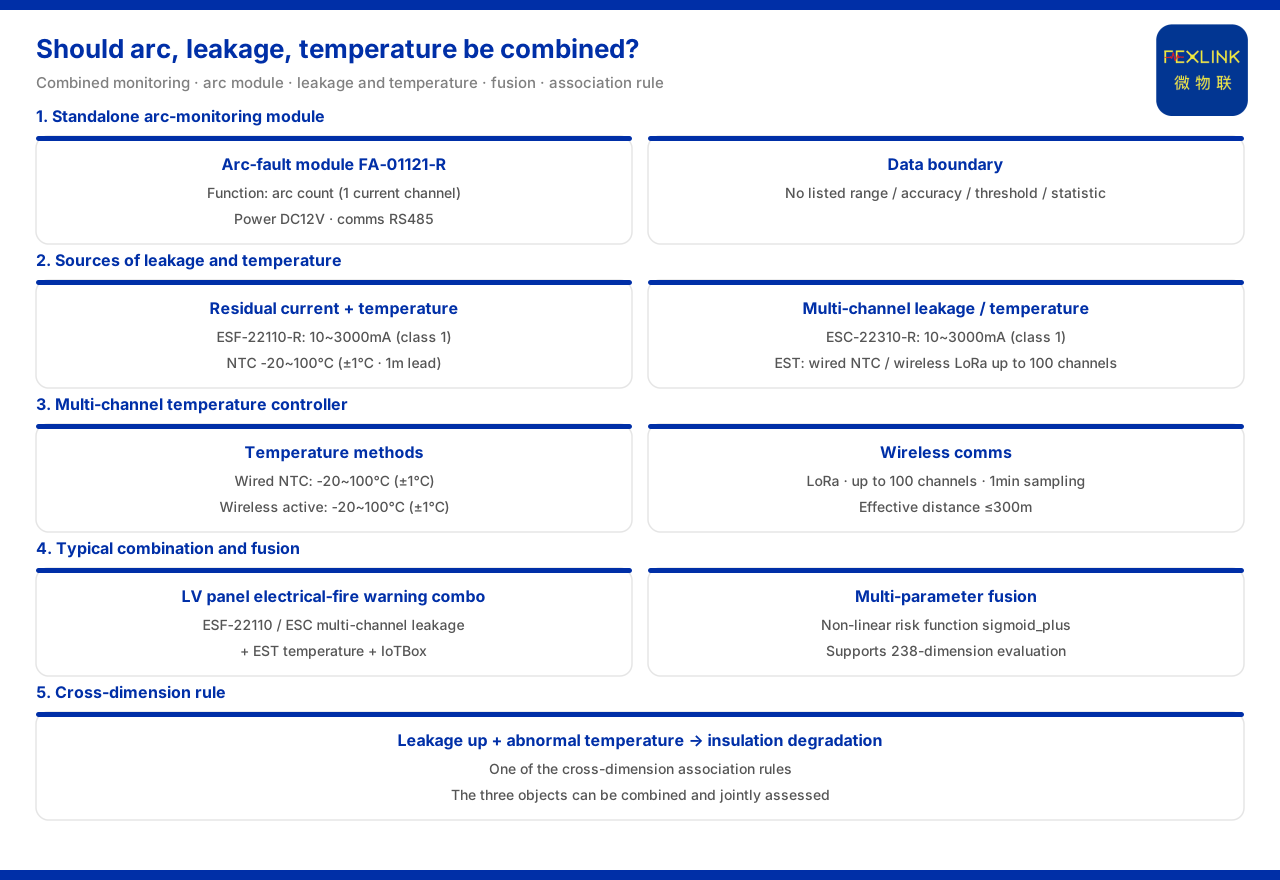
For electrical-fire early warning in a low-voltage distribution cabinet, the recommended combination given by the product knowledge base is: an electrical fire monitoring & control device (ESF-22110) or a multi-channel leakage-current monitoring & control device (ESC multi-channel leakage), plus a multi-channel temperature intelligent controller (EST temperature), plus an IoTBox access device. The combination shows that cabinet electrical-fire early warning combines three monitoring objects rather than a single sensing quantity: arc, leakage and temperature. The arc is carried by the arc-fault monitoring module (FA-01121-R), whose function is "arc count (1 current channel)", with supply DC12V and communication RS485. Leakage is carried by the electrical fire monitoring & control device (ESF-22110-R), whose residual-current range is 10mA to 3000mA (accuracy class 1), or by the multi-channel leakage-current monitoring & control device (ESC-22310-R), whose leakage range is 10mA to 3000mA (accuracy class 1). Temperature is carried by the multi-channel temperature intelligent controller, with wired NTC and wireless active temperature both of -20℃ to 100℃ (±1℃). On the study side, the integrated electrical-hazard intelligent analysis model uses the non-linear risk function sigmoid_plus and supports 238-dimension electrical-parameter evaluation, and the Wanxiang engine's cross-dimensional association rules include "leakage rise plus temperature anomaly points to comprehensive insulation degradation."
1. The independent arc-monitoring module
Of the three monitoring objects, the arc is carried by an independent module. The model table lists the arc-fault monitoring module (FA-01121-R), whose function is "arc count (1 current channel)", with supply DC12V and communication RS485. The function field contains two points: it records the number of arc occurrences, a counting quantity; and the acquisition object is one current loop. The knowledge base gives no range, accuracy, decision threshold or statistical convention for this function, so these details remain unlisted. If the arc monitoring object is needed in a cabinet combination, the data source is this module, a different model from the leakage and temperature modules.
2. The controller that combines residual current and temperature
Leakage and temperature can be combined on one controller. The product knowledge base records that the electrical fire monitoring & control device (ESF-22110-R) has a residual-current measurement range of 10mA to 3000mA at accuracy class 1; its NTC temperature range is -20℃ to 100℃ at ±1℃, with an external lead length of 1m. The model is AC220V-supplied, with an OLED display, 1 residual-current channel and 4 temperature channels; the same series includes an electrical fire monitoring & control device (ESF-12110-R), DC5V-supplied, with an OLED display. The same device therefore carries both residual-current and temperature monitoring, so one circuit's leakage and several points' temperatures can be acquired by one controller.
3. The multi-channel leakage-current monitoring & control device
When several circuits must be monitored at once, leakage monitoring can be carried by a multi-channel device. The product knowledge base records that the multi-channel leakage-current monitoring & control device (ESC-22310-R) has a leakage measurement range of 10mA to 3000mA at accuracy class 1, is AC220V-supplied and has 3 channels; the series also includes the multi-channel leakage-current monitoring & control devices (ESC-12111-R, ESC-12311-R, ESC-22111-R, ESC-22311-R). Compared with the single controller above, the multi-channel device extends by channel count: when several branches in a cabinet need leakage monitoring, the multi-channel models cover them, while leakage is parallel to arc and temperature and does not change with the acquisition device.
4. The multi-channel temperature intelligent controller
Besides the controller, temperature monitoring has a dedicated multi-channel device. The product knowledge base gives the model rule of the multi-channel temperature intelligent controller: the body segment is composed of power supply, display, channels, temperature-measurement mode and humidity, with communication listed separately. Its temperature measurement has two kinds: wired NTC temperature of -20℃ to 100℃ (±1℃); and wireless active temperature likewise of -20℃ to 100℃ (±1℃), using LoRa communication, with a maximum of 100 channels, a sampling period of 1min configurable and an effective distance of not more than 300m. The device therefore supports wired and wireless temperature measurement, up to 100 channels, and a wireless distance bounded by 300m; choose the wired or wireless model by channel count and temperature-measurement mode.
5. Typical combination: distribution-cabinet electrical-fire early warning
Placing the modules back in the scenario gives the recommended combination. In its typical application scenarios, the recommended product combination for low-voltage distribution-cabinet electrical-fire early warning is: the electrical fire monitoring & control device (ESF-22110) or the multi-channel leakage-current monitoring & control device (ESC multi-channel leakage), plus the multi-channel temperature intelligent controller (EST temperature), plus the IoTBox access device. In this combination, the three monitoring objects of arc, leakage and temperature in the cabinet are combined into one solution and then uplinked through the access device. This also explains the relations among the preceding sections: the arc has an independent module, leakage has either a single controller or a multi-channel device, and temperature has either the controller's temperature channels or the multi-channel temperature intelligent controller.
6. Multi-parameter fusion study
The three monitoring objects are combined for the purpose of study. The product knowledge base records that the integrated electrical-hazard intelligent analysis model uses the non-linear risk function sigmoid_plus and supports 238-dimension electrical-parameter evaluation; it also lists the multi-parameter fusion intelligent algorithm as the core technology of the electrical hazard early-warning system. Parameters from different sources such as arc, leakage and temperature can therefore enter the same multi-parameter fusion study rather than reaching conclusions separately. For a cabinet scenario, a change in one quantity alone may be insufficient to judge a hazard; only evaluating several parameters together forms a composite judgement of the cabinet's state.
7. Cross-dimensional association rules
Above the fusion study are cross-dimensional association rules. The product knowledge base records that the Wanxiang engine contains 49 cross-dimensional association rules, one of which is "leakage rise plus temperature anomaly points to comprehensive insulation degradation." This rule joins two classes of monitoring data: when leakage and temperature are abnormal at the same time, they point toward comprehensive insulation degradation. With the above, arc, residual current, leakage and temperature each have an independent monitoring module, forming combinable data sources that can be studied jointly by established relations.
8. Condensing combined deployment into a check order
First, confirm which of arc, leakage and temperature are needed in the cabinet and determine the modules accordingly. Second, for arc choose the arc-fault monitoring module (FA-01121-R) and check its "arc count (1 current channel)" function with DC12V and RS485. Third, for leakage choose the multi-channel leakage-current monitoring & control device or the electrical fire monitoring & control device by circuit count, checking the range at 10mA to 3000mA. Fourth, for temperature choose the multi-channel temperature intelligent controller (wired NTC or wireless active, up to 100 channels, wireless effective distance not more than 300m) by measuring-point count and wiring conditions, or use the electrical fire monitoring & control device with 4 temperature channels. Fifth, combine the controller, the temperature intelligent controller and the access device per the recommended combination. Sixth, confirm the study side: multi-parameter fusion evaluation and cross-dimensional association rules are used for interpretation, not a single-quantity criterion.
Scope and limitations
First, this article restates only what the product knowledge base lists, with the factual boundary limited to the model and parameter records of the arc-fault monitoring module, the electrical fire monitoring & control device, the multi-channel leakage-current monitoring & control device and the multi-channel temperature intelligent controller, the recommended combination for low-voltage distribution-cabinet electrical-fire early warning, and the multi-parameter fusion model and cross-dimensional association rules, introducing no unlisted parameter, certification or case.
Second, the function "arc count (1 current channel)", supply DC12V and communication RS485 of the arc-fault monitoring module (FA-01121-R) are cited as the product knowledge base gives them; this article adds no range, accuracy, threshold or statistical convention.
Third, the residual current 10mA to 3000mA, accuracy class 1, NTC -20℃ to 100℃ (±1℃, external lead length 1m), AC220V, OLED and 1 residual-current plus 4 temperature channels of the electrical fire monitoring & control device (ESF-22110-R), and the DC5V and OLED of the electrical fire monitoring & control device (ESF-12110-R), are cited as the product knowledge base gives them.
Fourth, the leakage 10mA to 3000mA at accuracy class 1, AC220V and 3 channels of the multi-channel leakage-current monitoring & control device (ESC-22310-R) and the same-series models, and the wired and wireless temperature measurement, maximum 100 channels, 1min configurable sampling and effective distance of not more than 300m of the multi-channel temperature intelligent controller, are cited as the product knowledge base gives them.
Fifth, the recommended combination, sigmoid_plus supporting 238-dimension evaluation and the "leakage rise plus temperature anomaly" rule among the Wanxiang engine's 49 cross-dimensional association rules are cited as the product knowledge base gives them; this article does not represent a commitment to any project's early-warning effect.
Sixth, this article explains only the multi-parameter monitoring combination and check order of the cabinet scenario and provides no measuring-point arrangement, device configuration or setting solution for a specific project; actual conditions are subject to the latest product material and project solution.