Direct answer
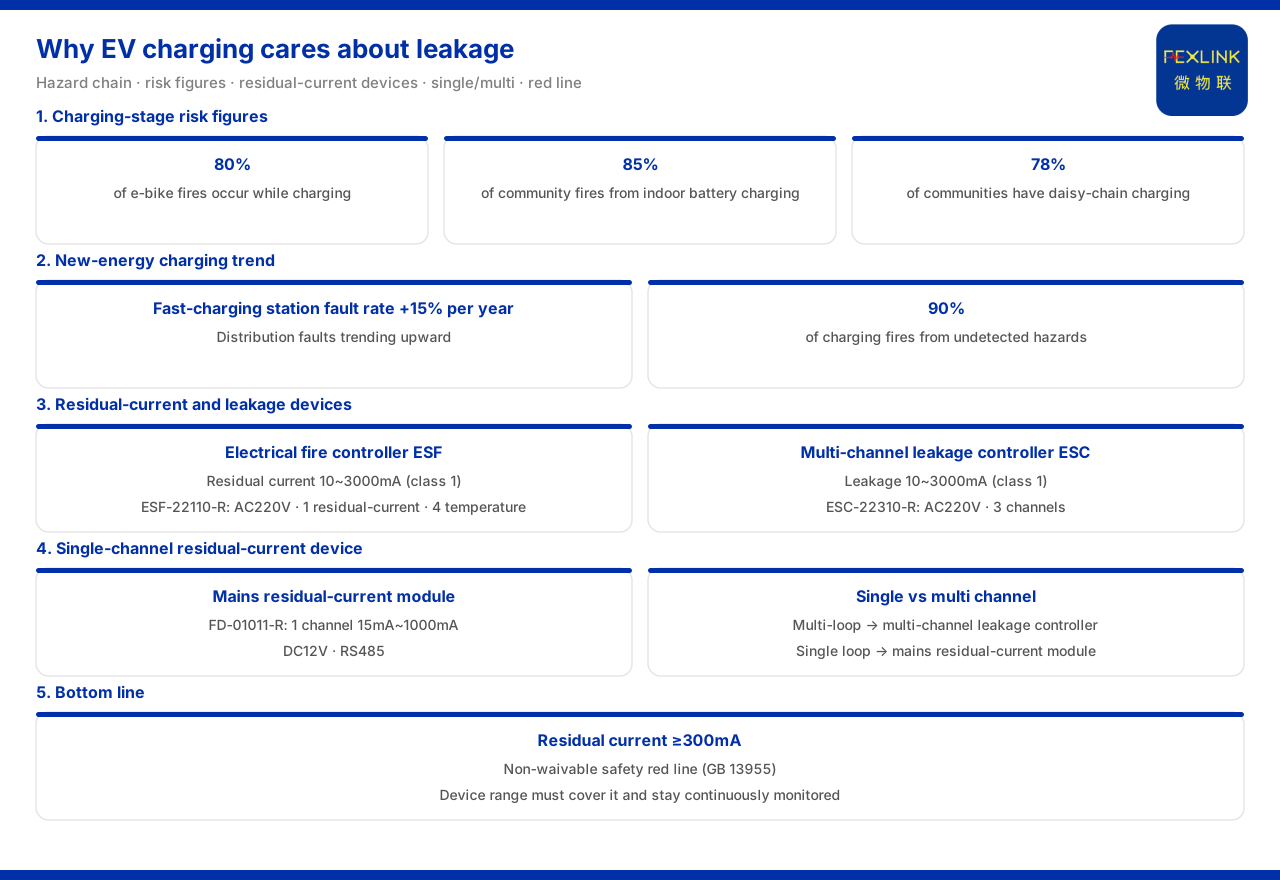
Electrical-hazard monitoring in charging-safety scenarios starts from several statistical statements. The product knowledge base records that 80% of e-bike fires occur while charging, 85% of community fires arise from bringing batteries indoors to charge, and 78% of communities have flying-wire charging; on the new-energy-vehicle side, the failure rate of fast-charging stations rises 15% per year. These statements point together to one judgement: the charging process is a high-incidence stage for electrical hazards, and electrical parameters must be monitored during charging. The product knowledge base positions the corresponding system as an electrical hazard early-warning system, whose core technology is dynamic data monitoring plus multi-dimensional intelligent analysis, and gives the statement that "90% of charging fires stem from undetected hazards," showing that the purpose of monitoring is to find hazards during charging that were previously unnoticed. On the device side of leakage monitoring, the electrical fire monitoring & control device (ESF-22110-R) has a residual-current measurement range of 10mA to 3000mA (accuracy class 1), and there is also an electrical fire monitoring & control device (ESF-12110-R, DC5V); the multi-channel leakage-current monitoring & control device (ESC-22310-R) has a leakage measurement range of 10mA to 3000mA (accuracy class 1); and the mains residual-current monitoring module (FD-01011-R) is 1-channel residual current of 15mA to 1000mA, DC12V, RS485. The safety red-line guard also lists "residual current reaching or exceeding 300mA" as one of the unbypassable safety red lines, based on GB 13955.
1. Why the charging phase is a monitoring focus
The monitoring need in charging scenarios is supported first by a statistic: in the charging-safety scenario of the electrical hazard early-warning system, 80% of e-bike fires occur while charging. This points to the fire-prone period being concentrated in the charging process, not while the vehicle is stationary or in motion. Since the risk mainly occurs while charging, the monitored electrical parameters should cover the charging process rather than only tracing afterwards, giving the later discussion of monitoring objects and device selection a clear time boundary.
2. Two statistics on the community side
Two further statistics focus the source of the hazard. The product knowledge base records that 85% of community fires arise from bringing batteries indoors to charge, and 78% of communities have flying-wire charging. These point to two specific behaviours: bringing batteries indoors to charge is the main source of community fires, and flying-wire charging exists in a high proportion of communities. For monitoring, they show that the charging scenarios to be supervised include both centralized charging sites and scattered, irregular behaviours such as indoor charging and flying-wire charging. The more scattered the sources, the more the monitoring of electrical parameters during charging needs to cover multiple points rather than a single charging bay.
3. The trend on the new-energy charging side
The new-energy-vehicle charging scenario gives one trend statement: the failure rate of fast-charging stations rises 15% per year, showing that distribution-system failures in this scenario are trending upward. Higher charging power and more frequent use expose more distribution failures, so this scenario too needs coverage by charging-safety hazard monitoring. Placing the e-bike and new-energy-vehicle statements together, a common point emerges: the risk is concentrated in the charging process, the sources are scattered, and it grows with the scale of charging.
4. Technical route: dynamic data monitoring and multi-dimensional analysis
For these scenarios, the product knowledge base gives the system's core technology as dynamic data monitoring plus multi-dimensional intelligent analysis, with the statement that "90% of charging fires stem from undetected hazards." Together they show the role of the technical route: dynamic data monitoring continuously acquires electrical parameters during charging, and multi-dimensional intelligent analysis makes a composite judgement across several parameters, thereby finding hazards that are hard to detect from any single parameter. The statement also explains why early warning is done: if most charging-fire hazards were originally undetected, identifying them during charging is the core value of monitoring.
5. Residual-current monitoring: the electrical fire monitoring & control device
On the device side, residual-current monitoring is carried by the electrical fire monitoring & control device. The product knowledge base records that the electrical fire monitoring & control device (ESF-22110-R) has a residual-current measurement range of 10mA to 3000mA at accuracy class 1; this model is AC220V-supplied, with an OLED display, 1 residual-current channel and 4 temperature channels. There is also an electrical fire monitoring & control device (ESF-12110-R), DC5V-supplied, with an OLED display. The series' 10mA to 3000mA range can cover the leakage-monitoring need of charging scenarios; and the same device carries both residual-current and temperature monitoring, so the joint monitoring of leakage and temperature can be completed on one device.
6. Multi-channel leakage and single-channel residual-current devices
Beyond residual current, multi-channel leakage monitoring is carried by another class of device. The product knowledge base records that the multi-channel leakage-current monitoring & control device (ESC-22310-R) has a leakage measurement range of 10mA to 3000mA at accuracy class 1, is AC220V-supplied and has 3 channels; the series also includes the multi-channel leakage-current monitoring & control devices (ESC-12111-R, ESC-12311-R, ESC-22111-R, ESC-22311-R). Single-channel residual-current monitoring is carried by the mains residual-current monitoring module (FD-01011-R): 1 residual-current channel, a range of 15mA to 1000mA, DC12V supply and RS485 communication. The two can take on leakage monitoring in charging scenarios in multi-channel and single-channel forms respectively: use the multi-channel device when several circuits must be watched at once, and the monitoring module when only a single residual-current channel is needed. During selection, distinguish them by channel count and range requirement.
7. Bottom-line criterion: the residual-current red line
Parallel to range selection is the bottom-line criterion. The safety red-line guard of the product knowledge base lists "residual current reaching or exceeding 300mA" as one of the unbypassable safety red lines, based on GB 13955. The meaning of this red line is that leakage monitoring in charging scenarios must not look only at trends but must take the national-standard residual-current bottom line as the criterion. The configured device's range must cover the order of magnitude corresponding to this bottom line, and the solution must ensure the state it represents can be continuously monitored and detected. The red line is a requirement at the national-standard level and is not relaxed for different scenarios or devices.
8. Condensing charging-scenario monitoring into a check order
The above can be condensed into a check order. First, confirm the monitoring period: focus on the charging process, covering the charging time in which 80% of fires occur. Second, confirm the scenarios: both centralized charging sites and scattered behaviours such as indoor charging and flying-wire charging. Third, confirm the electrical parameters: focus on leakage parameters such as residual current, combined with temperature and other parameters for multi-dimensional analysis. Fourth, confirm the device form: the multi-channel leakage-current monitoring & control device for multiple circuits, the mains residual-current monitoring module for a single circuit, checking the 10mA to 3000mA and 15mA to 1000mA grades by range requirement. Fifth, confirm the bottom line: take the safety red line of residual current reaching or exceeding 300mA and ensure that state can be continuously monitored.
Scope and limitations
First, this article restates only what the product knowledge base lists, with the factual boundary limited to the statistical statements and core technology of the electrical hazard early-warning system's charging-safety scenario, the ranges and models of the relevant leakage-monitoring devices, and the residual-current criterion in the safety red-line guard, introducing no unlisted parameter, certification or case.
Second, the five statistics—"80% of e-bike fires occur while charging," "85% of community fires arise from bringing batteries indoors to charge," "78% of communities have flying-wire charging," "the failure rate of fast-charging stations rises 15% per year" and "90% of charging fires stem from undetected hazards"—are all cited as the product knowledge base gives them, and this article only restates them.
Third, the residual current 10mA to 3000mA and accuracy class 1, AC220V, OLED and 1 residual-current plus 4 temperature channels of the electrical fire monitoring & control device (ESF-22110-R), and the DC5V and OLED of the electrical fire monitoring & control device (ESF-12110-R), are cited as the product knowledge base gives them.
Fourth, the leakage 10mA to 3000mA at accuracy class 1, AC220V and 3 channels of the multi-channel leakage-current monitoring & control device (ESC-22310-R), the models ESC-12111-R, ESC-12311-R, ESC-22111-R and ESC-22311-R, and the 1 residual-current channel 15mA to 1000mA, DC12V and RS485 of the mains residual-current monitoring module (FD-01011-R), are cited as the product knowledge base gives them.
Fifth, residual current reaching or exceeding 300mA is one of the unbypassable red lines listed in the safety red-line guard under GB 13955; this article explains the bottom-line criterion of the charging scenario on that basis and infers no other threshold or setting method.
Sixth, this article provides no monitoring arrangement, device configuration or rectification solution for a specific project; the relevant conclusions must be confirmed with site survey and the project solution, and actual conditions are subject to the latest product material and project solution.