Direct answer
The selection of a temperature expansion module rests on two verifiable criteria. The product knowledge base records that the temperature expansion of the cloud PLC lists two models: the thermal-resistor temperature expansion module (PT040), 4-channel and suited to PT thermal resistors, and the thermocouple temperature expansion module (TC060), 6-channel and suited to TC thermocouples. The only verifiable differences between PT040 and TC060 are therefore two — sensor type (PT thermal resistor versus TC thermocouple) and channel count (4 versus 6). Selection can first be reduced to two questions: does the site measure temperature with a PT thermal resistor or a TC thermocouple, and how many temperature loops must be connected at once. The first decides the direction of the model, the second checks whether the channel count suffices; clear answers converge the choice onto a single model. The knowledge base lists only the above two models, their channel counts and sensor types; it gives no range, accuracy, temperature span, cold-junction compensation or wiring method, which lie outside this article's scope.
1. The host base that temperature expansion attaches to
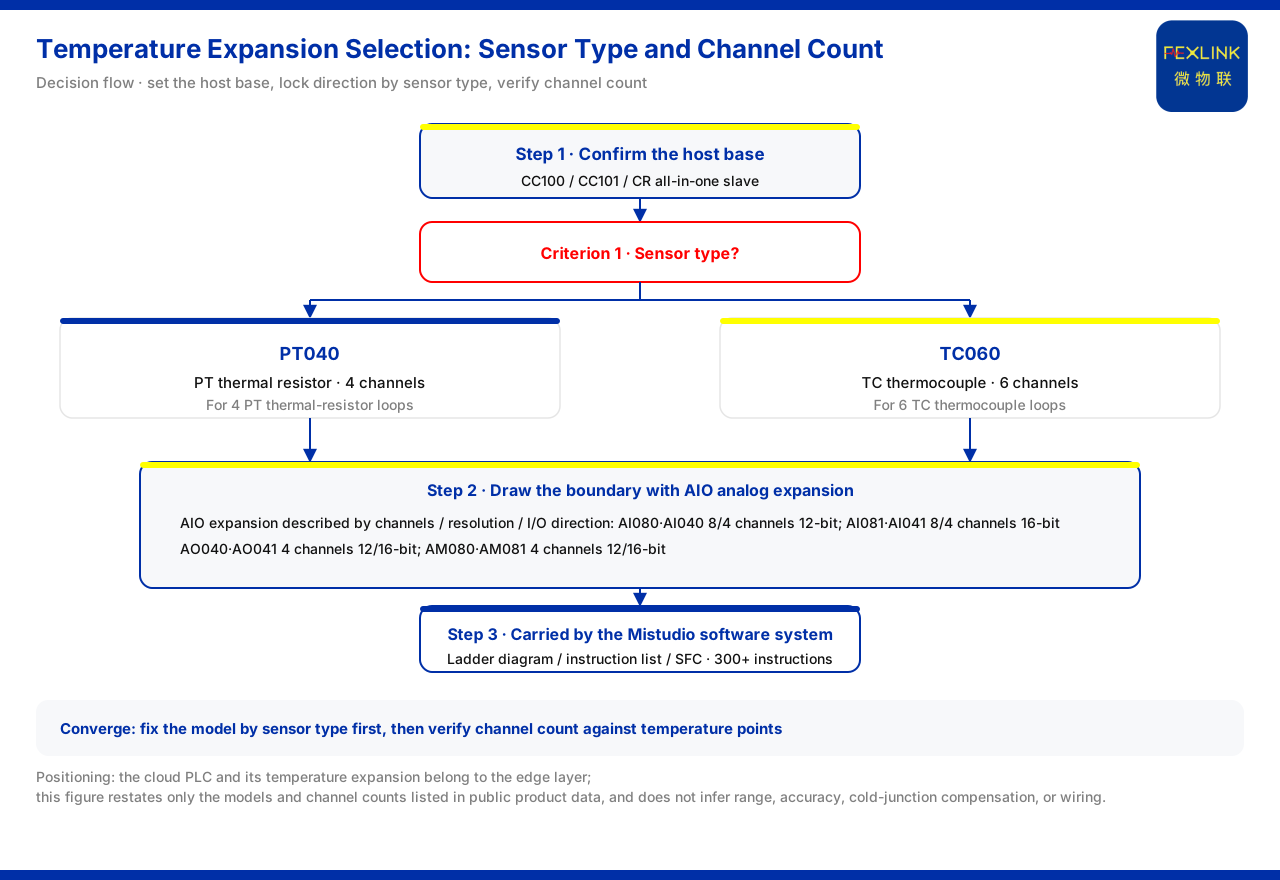
Temperature expansion does not run on its own; it attaches to the cloud PLC (with expansion modules) host. The product knowledge base divides the cloud PLC and its expansion modules into a host part and an expansion part. On the host side it lists: the cloud PLC (with expansion modules) (CC100) configured as 8DI+8DO+2Ethernet; the cloud PLC (with expansion modules) (CC101) adding motion control on the same 8DI+8DO+2Ethernet basis; and a CR all-in-one slave and a slave adapter. The host's built-in 8 digital inputs, 8 digital outputs and 2 Ethernet ports address digital quantities and communication, while continuous quantities such as temperature must be completed by expansion modules.
Reading the two together reveals the attachment relation: PT040 and TC060 belong to the expansion modules of the cloud PLC and are used on the host base. In the same section the knowledge base groups expansion by signal type, with temperature expansion independent of analog input/output expansion and digital input/output expansion. Temperature expansion selection is thus unrelated to host configuration: whether the host is the cloud PLC (CC100) or the cloud PLC (CC101) does not change the basis for judging between PT040 and TC060. Fix the host base first, then handle the temperature channels; the two do not constrain each other.
2. Thermal-resistor temperature expansion module: 4-channel PT thermal resistor
The product knowledge base records that the thermal-resistor temperature expansion module (PT040) is a 4-channel module suited to PT thermal resistor sensors. The entry contains two points: the sensor type (PT thermal resistors) and the channel count (4 channels, i.e. 4 resistance temperature-measurement loops). The knowledge base does not list the PT graduation numbers supported, nor measurement range, resolution or sampling rate; these lie outside the recorded scope and this article draws no inference about them. When on-site measurement uses PT thermal resistors and the point count does not exceed 4, PT040 is the corresponding temperature expansion entry.
3. Thermocouple temperature expansion module: 6-channel TC thermocouple
The product knowledge base records that the thermocouple temperature expansion module (TC060) is a 6-channel module suited to TC thermocouple sensors. Compared with PT040, its sensor type is the TC thermocouple and its channel count is 6, i.e. 6 thermocouple measurement loops. The knowledge base likewise does not list the thermocouple graduation numbers supported, nor temperature range, accuracy or cold-junction treatment, and this article does not infer such content from the model name. When on-site measurement uses TC thermocouples and the point count is within 6, TC060 is the corresponding entry.
4. Two criteria: sensor type and channel count
Side by side, the only verifiable differences between PT040 and TC060 are two: sensor type — PT thermal resistor versus TC thermocouple — and channel count, 4 versus 6. These are the two selection criteria, and their order should not be reversed.
The first criterion, sensor type, decides the direction of the model: a site using PT thermal resistors can correspond only to PT040, and a site using TC thermocouples only to TC060. That the knowledge base lists the two as separate models shows they are not interchangeable. The second criterion, channel count, decides whether the point count within that direction suffices: PT040 is 4-channel, TC060 is 6-channel. Channel count is not, however, a dimension for free lateral choice; the difference between 4 and 6 comes from the respective module specifications of the two sensor types. The correct way to ask is to lock the model by sensor type first, then check whether the channel count satisfies the temperature point count. If the point count exceeds the channel count of the chosen model, the knowledge base gives no configuration rule for module quantity or cascading, and this article draws no inference.
5. Boundary with AIO analog expansion
Temperature measurement is easily confused with general analog acquisition; a boundary must be drawn. In the same section the knowledge base lists AIO expansion: analog input modules (AI080, AI040) at 8 channels and 4 channels, 12-bit; analog input modules (AI081, AI041) at 8 and 4 channels, 16-bit; analog output modules (AO040, AO041), both 4-channel, at 12-bit and 16-bit; and analog input/output modules (AM080, AM081), both 4-channel, at 12-bit and 16-bit.
The division of labour differs. The two temperature expansion models are named after the sensor type (PT thermal resistor, TC thermocouple), showing they bring temperature-sensor signals in; AIO expansion describes specifications by channel count, bit depth and input/output direction, for general analog acquisition and output. When temperature measurement is a definite requirement, the choice should therefore be made among PT040 and TC060; AIO's selection dimensions (channel count, bit depth, direction) are not the same as temperature expansion's. The knowledge base does not state whether AIO modules can connect temperature sensors, and this article does not infer a substitution relation from models or parameters.
6. Programming software and the edge-layer position
Once temperature expansion is connected to the host, its logic is carried by the same programming and configuration system. The knowledge base records that the Mistudio programmable logic control software system (compiler) is independently owned, supports languages such as ladder diagram, instruction list and sequential function chart, and provides more than 300 instructions. The host, the temperature expansion and the programming software thus sit under one system: the chosen model's acquisition and processing logic is ultimately carried by such software.
At the architecture level, the general four-layer architecture of the knowledge base places the cloud PLC in the edge layer. As a component of the cloud PLC, temperature expansion is positioned in the edge layer too: on the field side it brings temperature-sensor signals into the controller, completes local processing at the edge and then aggregates upward. The knowledge base does not develop this layer's deployment quantity or data-processing detail, and this article draws no inference: temperature expansion selection also concerns the role it plays in the edge layer.
7. Temperature expansion selection checking order
The relations above gather into a reusable checking order. First, confirm the host base — the cloud PLC (with expansion modules) (CC100) or (CC101), or a CR all-in-one slave and slave adapter; this does not change the temperature-expansion judgement. Second, confirm the sensor type — PT thermal resistor or TC thermocouple — to lock the direction between PT040 and TC060. Third, check the channel count: PT040 is 4-channel, TC060 is 6-channel. Fourth, draw the boundary: for general analog acquisition or output, check the AIO expansion entries rather than using temperature expansion as an analog module. Fifth, confirm programming and configuration are carried by the Mistudio software system. Following this order lands selection on a single model instead of stopping at "whether to add temperature measurement".
Applicability and limits
First, this article is limited to the product knowledge base and the corresponding fact pack; it restates only the temperature expansion entries and introduces no unlisted parameter, certification or case.
Second, the host configurations (the cloud PLC CC100 as 8DI+8DO+2Ethernet; the cloud PLC CC101 as 8DI+8DO+2Ethernet+motion control; the CR all-in-one slave and slave adapter) are limited to the material.
Third, the channel counts and sensor types of the temperature expansion models (PT040 as 4-channel PT thermal resistor, TC060 as 6-channel TC thermocouple) are limited to the material; no unlisted graduation number, range, accuracy, cold-junction treatment or wiring method is inferred.
Fourth, the AIO expansion entries (AI080/AI040, AI081/AI041, AO040/AO041, AM080/AM081) are limited to the material, used only to draw the selection boundary between temperature and general analog quantities.
Fifth, the supported languages and more than 300 instructions of the Mistudio software are limited to the material; no specific project's programming implementation or conversion result is promised.
Sixth, the edge-layer attribution in the four-layer architecture is limited to the material; no deployment quantity or processing detail of that layer is inferred.
Seventh, this article explains only the model composition and selection criteria of temperature expansion and provides no point-schedule design, wiring scheme or configuration for a specific project.