Direct answer
The leakage-monitoring capability of the intelligent circuit breaker (with residual-current protection) is marked only as "supported" in the product knowledge base; no leakage range or accuracy is given. In the model table, this model has two variants: the intelligent circuit breaker (with residual-current protection) (FECB2SLP-2P) and the intelligent circuit breaker (with residual-current protection) (FECB2SLP-4P). A footnote below the table defines SLP as "with RCD (leakage monitoring plus residual-current protection function)" and SP as "standard model." In the same table, the "residual-current protection" and "leakage monitoring" columns of the FECB2SP standard intelligent breaker (e.g. FECB2SP-1P/2P/3P/4P) are all marked "—," and only the two RCD models are marked "supported" in these two columns. Whether a breaker has leakage monitoring therefore hinges on whether the variant is SLP or SP, not on pole count or current step. On other specifications, the 2P model is 16A/32A at AC230V and the 4P model is 32A/63A at AC400V, both including voltage, current and temperature monitoring and energy consumption, with RS485 communication. If the leakage range or accuracy is required, the product knowledge base does not list it and it must be confirmed against the manufacturer's material; the product knowledge base separately contains leakage and residual-current ranges of 10mA to 3000mA, which belong to the multi-channel leakage controller and the electrical fire controller and cannot be applied to the RCD-model breaker.
1. The dividing line between the RCD model and the standard model
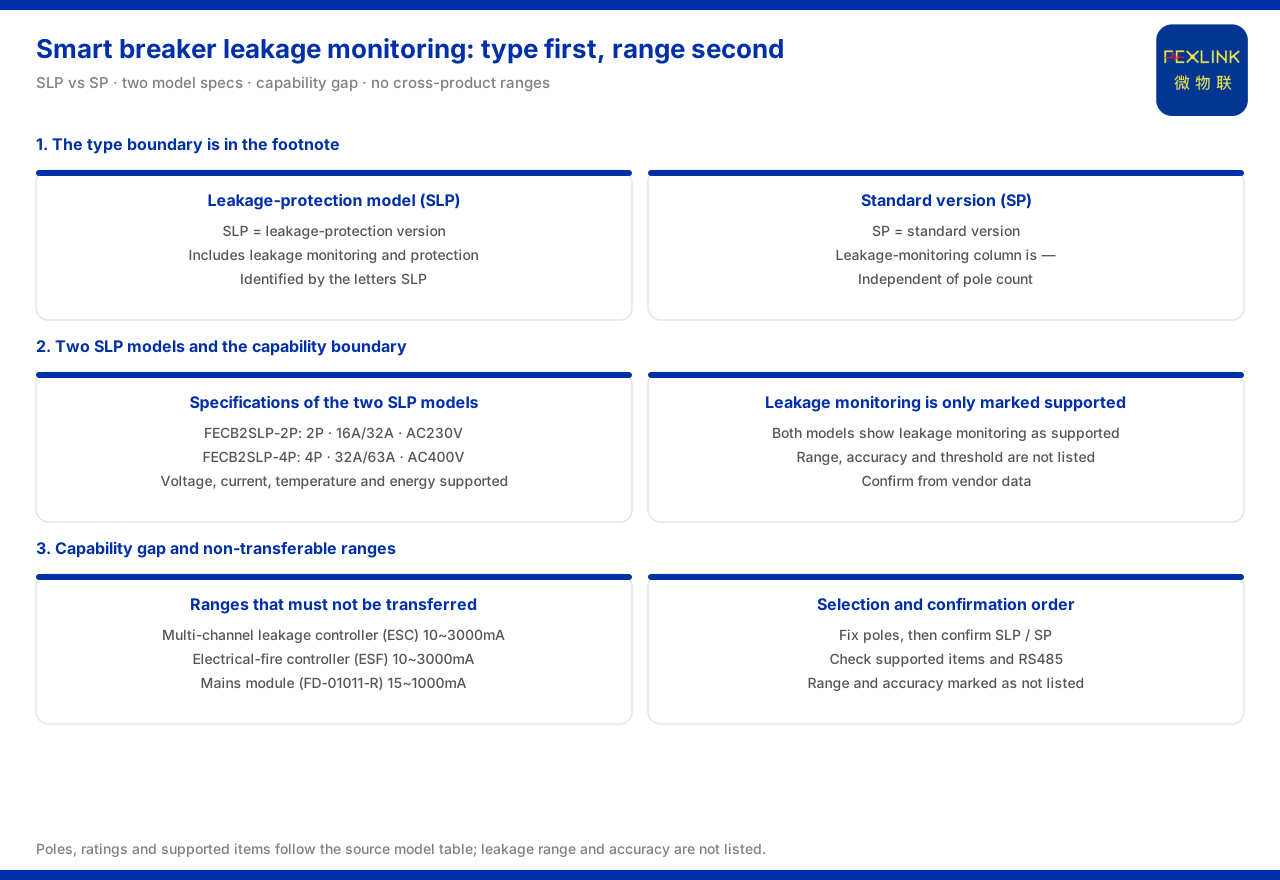
The dividing line is written in a footnote to the model table. The footnote defines SLP as the RCD model, meaning leakage monitoring plus residual-current protection, and SP as the standard model. This definition splits the intelligent circuit breaker into two branches: one with leakage monitoring and residual-current protection, and one in standard configuration. When judging, one cannot look only at pole count, because both branches may appear as 2P or 4P; what really decides whether leakage monitoring is present is the SLP or SP wording in the model. Making this dividing line clear first keeps the two branches from being conflated when specifications and monitoring are discussed later. The footnote is the sole basis for this dividing line; under its definition, "with residual-current protection" and "with leakage monitoring" exist together on the SLP model.
2. Specifications of the two RCD models
Two models are currently listed for the RCD model. The intelligent circuit breaker (with residual-current protection) (FECB2SLP-2P) is 2P, with a rated current of 16A/32A and a rated voltage of AC230V; residual-current protection, voltage, current and temperature monitoring, leakage monitoring and energy consumption are all "supported," and communication is RS485. The intelligent circuit breaker (with residual-current protection) (FECB2SLP-4P) is 4P, with a rated current of 32A/63A and a rated voltage of AC400V; its other supported items are the same as the 2P model and its communication is likewise RS485. It can be seen that the two models share the same set of functional support, and the differences are mainly pole count, rated current and rated voltage. In selection, first take a value between 2P and 4P according to the loop conditions, then confirm that the chosen model is an RCD model.
3. Leakage monitoring is marked only as "supported"
The leakage-monitoring column of both RCD models is "supported." This marking answers the question "is it present" but does not answer "how wide is the range and what is the accuracy." On leakage monitoring, the intelligent circuit breaker table of the product knowledge base gives only support or not, without leakage range, accuracy class or alarm threshold. By contrast, the leakage-monitoring column of the four standard models is "—," meaning that item is not provided. Reading the two sets of markings together yields a clear dividing line: leakage monitoring is a capability unique to the RCD model and absent from the standard model, while its range and accuracy are left blank in the knowledge base.
4. How to handle the gap in range information
Since the knowledge base writes only "supported," the range and accuracy belong to the known-information gap. The approach is to split the question in two: first confirm from the model table that the variant has leakage-monitoring capability, then confirm the range and accuracy against the manufacturer's material or formal technical documents. One must not, because other products in the line have a specific leakage-monitoring range, transfer those figures directly to the name of the intelligent circuit breaker (with residual-current protection); different products each have their own parameter table, and parameters cannot be carried across products. Marking the gap truthfully is more reliable than giving a seemingly concrete figure with no source. From a selection standpoint, the gap is itself information: it shows that within the knowledge base the capability judgment for the RCD model can only remain at "has this monitoring," and any conclusion about range and accuracy needs a separate source and must not be conflated with the model rule.
5. Ranges that must not be carried across products
The product knowledge base does contain leakage and residual-current entries with concrete ranges, but they belong to separate products. The leakage measurement of the multi-channel leakage controller is 10mA to 3000mA at accuracy class 1; the residual-current measurement of the electrical fire controller is likewise 10mA to 3000mA at accuracy class 1. In addition, the mains residual-current monitoring module (FD-01011-R) is 1-channel residual current from 15mA to 1000mA, that is, the 10mA to 1000mA range. All these figures are marked under their own product entries, and the product knowledge base does not mark them as the leakage-monitoring range of the intelligent circuit breaker (with residual-current protection). These ranges can therefore serve as references for other products in the line, but cannot be used as the leakage range of the RCD-model breaker.
6. Other monitoring items and communication
Beyond leakage monitoring, the two RCD models also support voltage, current and temperature monitoring and energy consumption; these items are marked "supported" alongside residual-current protection and leakage monitoring, and communication is uniformly RS485. Under the general suffix and protocol convention of the knowledge base, RS485 is a device-side downlink interface; after conversion by the gateway, the data is uplinked to the platform. It should be noted that the intelligent circuit breaker marks its models by pole count and the SLP or SP variant, and its communication is uniformly RS485 as a fixed configuration of this product line; the protocol convention above is used to explain the place of RS485 in the link and does not infer that the breaker has other communication suffix variants.
7. Check order for selection and confirmation
The above can be arranged into a check order. First, determine the pole count from the loop conditions, taking a value between 2P and 4P, and verify whether the rated current and rated voltage fall in the corresponding step. Second, confirm the variant: choose the SLP model when leakage monitoring and residual-current protection are needed, and the SP model when only the standard configuration is needed. Third, verify the functional support items, confirming whether voltage, current and temperature monitoring, energy consumption and leakage monitoring are "supported." Fourth, confirm that communication is RS485 and plan access accordingly. Fifth, if the project requires a leakage range or accuracy, state clearly that the knowledge base does not list it, turn to the manufacturer's material for confirmation, and do not substitute another product's range. Followed in this order, selection answers "which model has the required capability," while the range question is correctly handed over to documentation confirmation.
Scope and limitations
First, the citations in this article are limited to the product knowledge base and its corresponding records, and introduce no unlisted parameter, certification or case.
Second, the division between the RCD model and the standard model follows the model-table footnote, with SLP as the RCD model (leakage monitoring plus residual-current protection) and SP as the standard model; this article infers no other variants from it.
Third, the pole count, rated current and rated voltage of the two models of the intelligent circuit breaker (with residual-current protection), and the support conventions for residual-current protection, voltage, current and temperature monitoring, leakage monitoring, energy consumption and RS485, are cited as the knowledge base model table gives them.
Fourth, the range and accuracy of leakage monitoring are not listed in the knowledge base; this article does not add them, nor substitute another product's range.
Fifth, the 10mA to 3000mA at accuracy class 1 of the multi-channel leakage controller and the electrical fire controller, and the 15mA to 1000mA of the mains residual-current monitoring module (FD-01011-R), are cited under their own entries and identified as belonging to separate products.
Sixth, this article explains only the specifications and information gaps within the scope of the product knowledge base, and constitutes no commitment regarding selection or field results for a specific project; actual results are subject to the latest product documentation and the project solution.