Direct answer
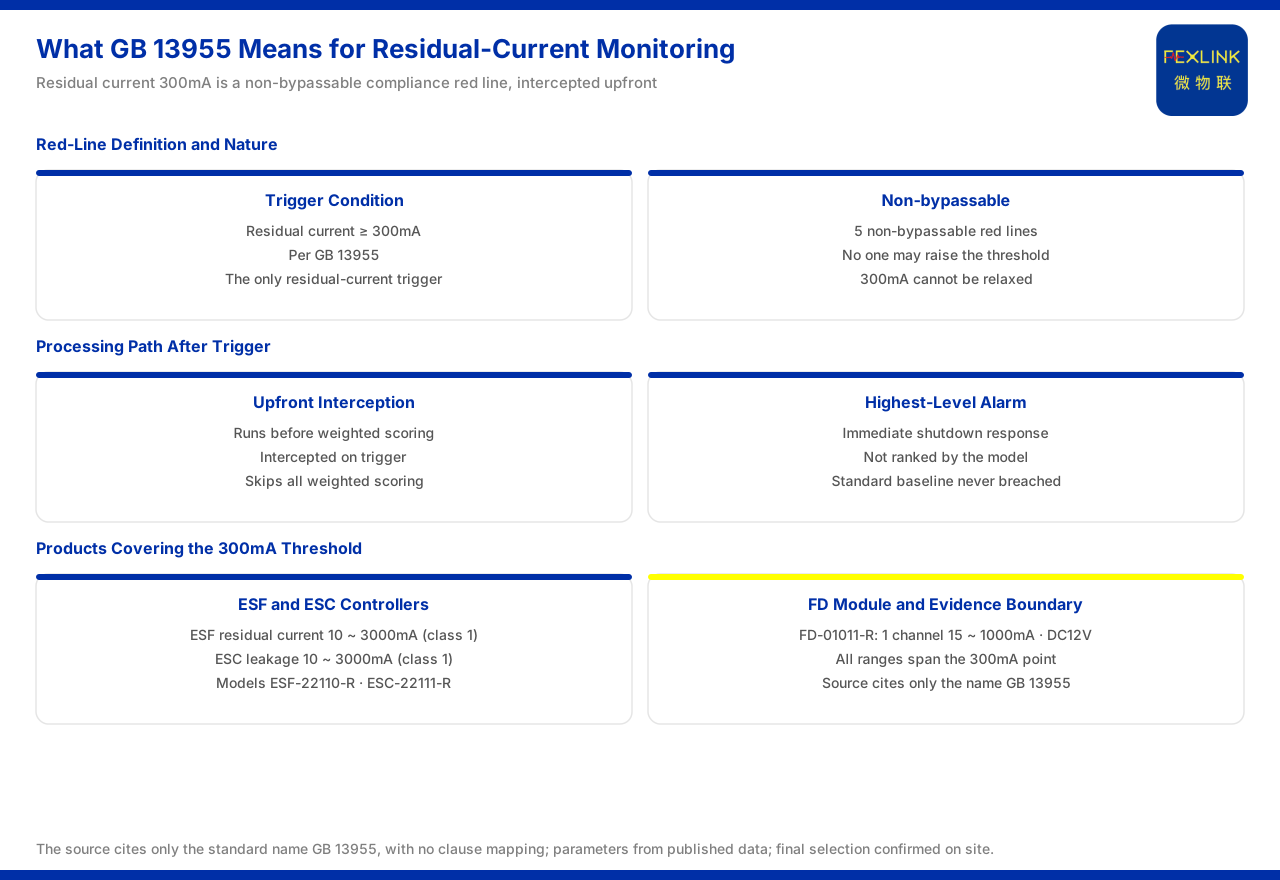
The safety red-line guard of the product knowledge base defines the residual-current red line as "residual current ≥ 300mA", based on GB 13955. This red line has three meanings for residual current monitoring. First, 300mA is a non-bypassable threshold; the safety red-line guard has 5 in total, and no one can raise the threshold. Second, it is the only red line in the product knowledge base whose trigger condition is residual current. Third, once triggered it no longer enters the subsequent weighting operation but outputs the highest-level alarm directly. Its alarm system records the highest level as BJ2 (0 to 19, immediate shutdown), and the front-end standard verification specifies that safety red-line pre-verification runs before the Qianzhi sub-model computation, with a red-line trigger outputting the highest-level alarm and skipping all weighting operations. The meaning of GB 13955 for residual current monitoring is therefore not to give a negotiable reference value but to nail 300mA as the compliance bottom line.
1. Trigger condition and standard basis of the residual-current red line
First make the definition clear. The safety red-line guard of the product knowledge base defines the residual-current red line as "residual current ≥ 300mA", marking the standard name GB 13955 beside it; 300mA is this red line's trigger threshold. The product knowledge base also states that the safety red-line guard has 5 in total, from the residual-current red line (residual current no less than 300mA, GB 13955) to the insulation-resistance red line (insulation resistance less than 0.5MΩ, GB/T 16895); this red line is the one whose trigger condition is residual current. Note that only this red line in the product knowledge base uses residual current as its trigger condition, so its threshold is not an ordinary limit among many monitored quantities but a compliance criterion listed separately as a red line.
2. Why "non-bypassable": the threshold cannot be adjusted
The property of this red line most worth emphasising is that it cannot be bypassed. The product knowledge base expresses the safety red-line guard as "5 non-bypassable, no one can raise the threshold". The meaning for residual current monitoring is direct: 300mA is not a parameter that can be relaxed per site conditions, nor a threshold the user may raise on their own. Placed in the context of the monitoring system, this means that once the residual current reaches the threshold, the system cannot "remove" the alarm by raising the threshold but can only respond at the prescribed handling level. Because the threshold cannot be adjusted, residual current monitoring's compliance position differs from ordinary trend monitoring: the latter watches variation and deviation, while the former guards a bottom line that cannot be crossed.
3. After triggering: pre-verification and the highest-level alarm
The handling path after a red-line trigger is also specified by the product knowledge base. In the front-end L3 standard verification (that is, safety red-line pre-verification), the product knowledge base explains that it is executed before the Qianzhi sub-model computation, and a red-line trigger outputs the highest-level alarm BJ2 directly and skips all weighting operations, so the national-standard bottom line is never breached. That is, once the residual current reaches this red line's threshold, the relevant data does not first enter the Qianzhi sub-model weighting flow to produce a score but is intercepted at the front end and given the highest-level alarm directly. This order of "intercept first, compute afterwards" is exactly the mechanism by which the red line cannot be bypassed: it does not depend on a model judgment but blocks ahead of the flow.
4. The place of 300mA in the alarm system
Which level the "highest-level alarm" output by the front-end pre-verification corresponds to in the alarm system is also answered by the product knowledge base. In its 6-level alarm system, the product knowledge base records the highest level as BJ2 (0 to 19, immediate shutdown); the highest-level alarm output after the front-end standard verification trigger is BJ2, corresponding to immediate-shutdown handling. Putting the two records together, the handling level of the residual current red-line alarm is the highest tier in the system. This explains a common question: why reaching the residual current threshold is treated as more serious than an ordinary abnormality — because it is not evaluated and ranked but directly judged as the highest level at the front-end layer.
5. Monitoring products supporting the 300mA threshold
For the red line to land, acquisition products covering the threshold are needed. The product knowledge base records that the ESF electrical fire monitoring & control device (e.g. ESF-22110-R) has a residual current measurement range of 10mA to 3000mA, accuracy class 1, and includes 4 NTC temperature channels (-20 to 100℃, ±1℃, external lead length 1m), with models including ESF-22110-R (AC220V / OLED / 1 residual-current channel / 4 temperature channels) and ESF-12110-R (DC5V / OLED); its residual current range covers this red line's 300mA threshold. The product knowledge base also records that the ESC multi-channel leakage-current monitoring & control device (e.g. ESC-22111-R) has leakage measurement likewise of 10mA to 3000mA, accuracy class 1, with models including ESC-22310-R (AC220V / 3 channels), ESC-12111 / 12311-R (DC5V / 1 or 3 channels) and ESC-22111 / 22311-R (AC220V / 1 or 3 channels); and the FD mains residual-current monitoring module (e.g. FD-01011-R) provides 1 residual-current channel with a range of 15mA to 1000mA, supplied at DC12V and communicating over RS485. The ranges of these three classes all cross 300mA, so all can observe the threshold point; multi-channel leakage monitoring can also cover several monitoring points.
6. The boundary of the standard basis
When citing the standard basis, its boundary must also be made clear. For this red line the product knowledge base marks only the standard name GB 13955 and gives no item-by-item correspondence between 300mA and specific clause numbers, nor a citation-implementation note; it also does not include the full text of GB 13955. Clause-level basis therefore cannot be traced further within the product knowledge base, and this article can only transcribe the record of this red line as "residual current ≥ 300mA, based on GB 13955"; it cannot replace the standard's original text or infer its clause structure. This boundary does not affect the force of the red line itself — the threshold, the non-bypassable nature and the front-end interception mechanism are all explicitly recorded by the product knowledge base — but it limits the level to which this article can trace.
7. Reducing the standard meaning to a checking order
Putting the above together, the meaning of GB 13955 for residual current monitoring reduces to a checking order. First, confirm the red-line definition: the trigger condition of this red line is residual current no less than 300mA. Second, confirm its nature: the safety red-line guard has 5 in total and is non-bypassable, and the threshold cannot be raised. Third, confirm the handling path: in the front-end standard verification it is executed before the Qianzhi sub-model, and a trigger outputs the highest-level alarm and skips weighting. Fourth, confirm the handling level: the highest-level alarm is BJ2, corresponding to immediate shutdown. Fifth, confirm acquisition coverage: whether the selected residual current monitoring product's range crosses 300mA. Sixth, confirm the boundary of the basis: the product knowledge base marks only the standard name GB 13955 and gives no clause-number correspondence.
Scope and limitations
First, this article restates only what the product knowledge base lists, with the factual boundary limited to the definition and standard marking of this red line in the safety red-line guard, the expression of the 5 red lines, the execution order and output of the front-end standard verification, and the records of the 6-level alarm system.
Second, this red line with residual current no less than 300mA (GB 13955), as one of the 5 non-bypassable red lines that no one can raise, and the highest-level alarm BJ2 (0 to 19, immediate shutdown) executed before the Qianzhi sub-model computation, are all cited from the product knowledge base.
Third, the residual current 10mA to 3000mA (accuracy class 1), the 4 NTC temperature channels and the model configuration of the ESF electrical fire monitoring & control device, the leakage 10mA to 3000mA (accuracy class 1) and the model configuration of the ESC multi-channel leakage-current monitoring & control device, and the 1 residual-current channel 15mA to 1000mA, DC12V and RS485 of the FD mains residual-current monitoring module, are all cited from the product knowledge base.
Fourth, the product knowledge base gives no correspondence between the 300mA of this red line and specific clause numbers of GB 13955.
Fifth, this article only explains the meaning of the standard basis for residual current monitoring and provides no specific project threshold setting, product selection quantity or installation-point arrangement; the relevant conclusions must be confirmed with site conditions and the project solution.
Sixth, this article constitutes no commitment about the selection result, alarm-handling result or field behaviour of a specific project; actual conditions are subject to the latest product material and project solution.