Direct answer
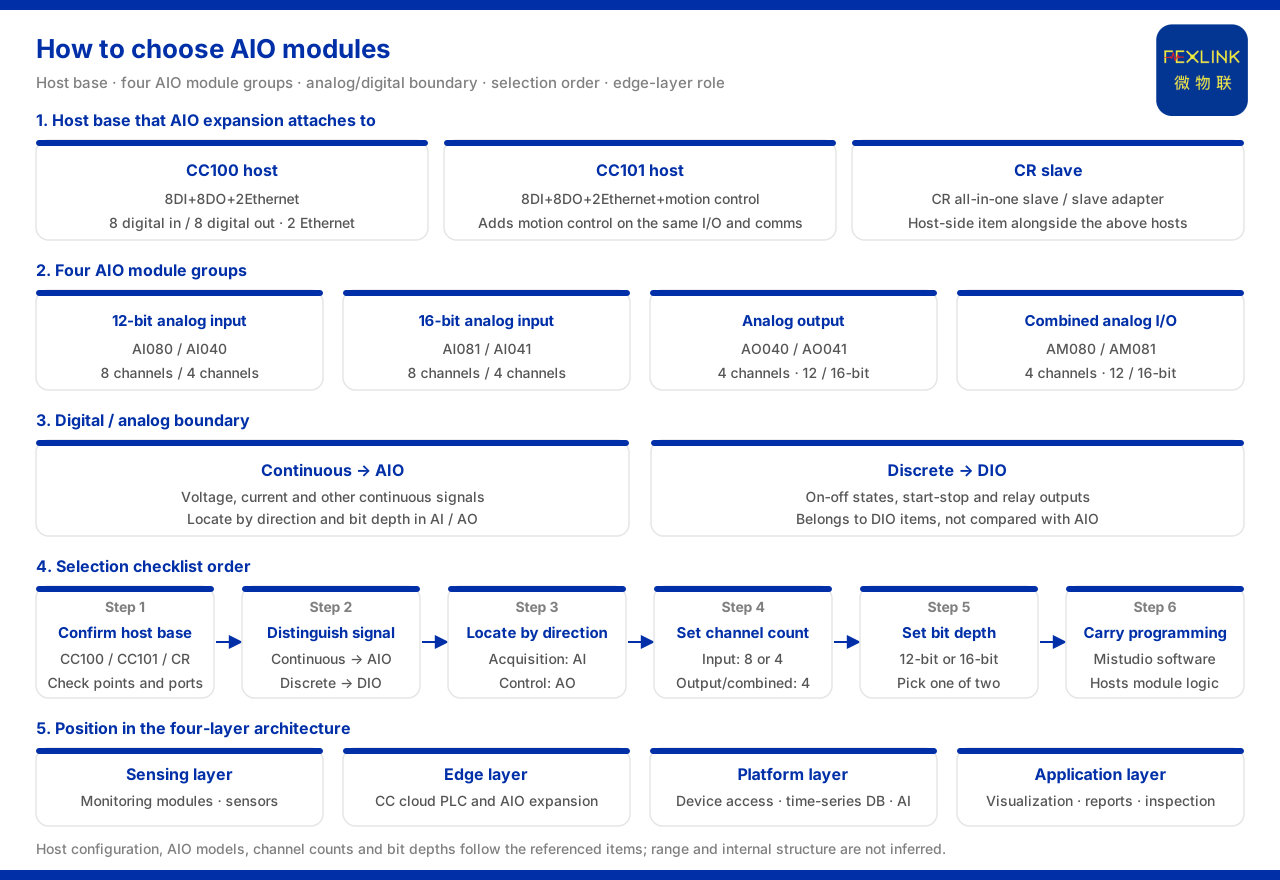
The analog capability of the cloud PLC (with expansion modules) (CC100) and the cloud PLC (with expansion modules) (CC101) is carried by AIO expansion. The product knowledge base groups AIO expansion into four: the 12-bit analog input modules (AI080, AI040), providing 8 channels and 4 channels; the 16-bit analog input modules (AI081, AI041), likewise 8 channels and 4 channels; the analog output modules (AO040, AO041), both 4-channel at 12 bits and 16 bits; and the analog input/output combined modules (AM080, AM081), both 4-channel at 12 bits and 16 bits. Selection therefore turns on two questions: whether the acquired quantity is a continuous value such as voltage or current, or a switching value; and whether the accuracy requirement falls at 12 bits or 16 bits. Matching channel count and direction then locates a specific model.
1. The host base that AIO expansion attaches to
The knowledge base divides the cloud PLC and expansion modules into host and expansion levels. The host side gives three entries: the cloud PLC host CC100 is configured as 8DI+8DO+2Ethernet; the cloud PLC host CC101 is configured as 8DI+8DO+2Ethernet+motion control; and there is also a CR all-in-one slave and a slave adapter. The host thus carries 8 inputs and 8 outputs with 2 Ethernet ports, and CC101 adds motion control on the same base.
The host provides only digital input and output, so analog acquisition and output are filled in by expansion modules. AIO expansion is a slave-style capability unit attaching to this host base, not a standalone product: the host carries the digital points and Ethernet communication, while the AIO module brings continuous values in and sends control values out.
2. Analog input: two groups, 12-bit and 16-bit
AIO analog input is divided by bit depth. The 12-bit group, AI080 and AI040, has 8 channels and 4 channels; the 16-bit group, AI081 and AI041, likewise has 8 channels and 4 channels. Bit depth divides the accuracy grade, and within a grade the channel count sets the points.
This gives two independent dimensions: channel count determines how many analog signals connect at once, and bit depth determines the resolution at which each is quantized. 12-bit and 16-bit are the two grades the knowledge base explicitly gives; this article infers nothing about sampling speed, range or measured physical quantity. In engineering, first fix 8 or 4 channels by the number of quantities to acquire, then 12 or 16 bits by the accuracy requirement.
| Module | Type | Channels | Bit depth | | --- | --- | --- | --- | | AI080 | analog input | 8 channels | 12 bits | | AI040 | analog input | 4 channels | 12 bits | | AI081 | analog input | 8 channels | 16 bits | | AI041 | analog input | 4 channels | 16 bits |
3. Analog output modules
AO040 and AO041 are both 4-channel analog output, at 12 bits and 16 bits. The output side lists only the 4-channel specification, with the difference lying solely in bit depth, so the channel count is not a comparison dimension and the accuracy grade is the main difference.
Input modules read site continuous values into the host; output modules send the host's control values out as analog signals. The counts are not symmetrical—input reaches 8 channels, output 4—so a site needing both should account for the two sides separately rather than assuming a one-to-one correspondence.
4. Analog input/output combined modules
The knowledge base also lists analog input/output combined modules. AM080 and AM081 are both 4-channel, at 12 bits and 16 bits, combining input and output on one module alongside the separate AI and AO series.
These suit a site whose points are unevenly distributed: where a local part needs a little acquisition and a little control at once and neither count is large, one module covers both. The knowledge base describes them as "4-channel 12/16-bit analog input+output"; this article infers neither how many channels are input and how many output, nor their internal electrical structure.
5. The digital boundary with DIO expansion
The knowledge base also lists DIO expansion for digital quantities: the digital hybrid modules (DM160, DM169) provide 8-point source-type input plus 8-point high-side output; the 16-point digital input modules (DI160, DI161) are source-type or sink-type input; the 16-point digital output module (TO160) is high-side output; and the relay output modules (RO080, RO160) provide 8-point or 16-point output. Expansion thus separates by signal type: continuous values go to AIO, switching values to DIO.
A two-state field signal such as status feedback, start/stop commands or relay output is digital and chosen from DIO; only a continuously varying signal enters AIO. The source/sink and high-side/relay distinctions within DIO should not be conflated with the bit-depth and channel-count dimensions of AIO.
6. Programming software and instruction support
The knowledge base records that the Mistudio programmable logic control software system (compiler) is independently owned, supports ladder diagram, instruction list and sequential function chart, provides more than 300 instructions, can run on Windows 10/8/7/Vista/XP, and allows some programming languages to be freely converted. The host and the AIO and DIO expansion thus sit under the same programming and configuration system.
7. Position in the general four-layer architecture
The knowledge base summarizes the monitoring system as a four-layer architecture: perception (monitoring modules, smart meters, sensors); edge (gateways, industrial wearables, the cloud PLC), undertaking protocol conversion, edge computing and local caching; platform (the IoT cloud platform, for device access, the time-series database and AI inference); and application (visualization, alarm management, analysis reports, mobile inspection). The cloud PLC and its AIO expansion belong to the edge layer.
AIO expansion therefore is not equipment facing the platform or application layer directly but part of the edge layer: it connects continuous values into the controller, completes protocol conversion and local processing at the edge, then converges upward to the platform.
8. A selection checklist order
A reusable order condenses the above. First, confirm the host base—CC100, CC101, or the CR all-in-one slave or slave adapter—and check its built-in digital points and Ethernet ports. Second, separate signal types: continuous values to AIO, switching values to DIO. Third, locate within AIO by direction: the AI series for pure acquisition, the AO series for pure control, the AM series for both at small point counts. Fourth, fix the channel count—8 or 4 on the input side, 4 for output and combined modules. Fifth, fix the bit depth—12 or 16 bits by accuracy. Sixth, confirm programming and configuration are carried by the Mistudio software system. Converging in this order lands the selection on a specific module model rather than stopping at whether to add analog.
Scope and limitations
First, this article is limited to the product knowledge base and the corresponding fact pack, and introduces no unlisted parameter, certification or case.
Second, the host configurations (CC100: 8DI+8DO+2Ethernet; CC101: 8DI+8DO+2Ethernet+motion control; CR all-in-one slave and slave adapter) are limited to the material, and no specification of unlisted hosts is inferred.
Third, the models, channel counts and bit depths of AIO expansion (AI080/AI040 as 8/4-channel 12-bit input, AI081/AI041 as 8/4-channel 16-bit input, AO040/AO041 as 4-channel 12/16-bit output, AM080/AM081 as 4-channel 12/16-bit input+output) are limited to the material; no unlisted parameter such as range, sampling rate or isolation method is inferred.
Fourth, the DIO expansion entries (DM160/DM169, DI160/DI161, TO160, RO080/RO160) are limited to the material and are used only to draw the selection boundary between digital and analog quantities.
Fifth, the support languages, more than 300 instructions and Windows 10/8/7/Vista/XP environment of the Mistudio software are limited to the material, and no programming implementation or conversion result for a specific project is promised.
Sixth, the four-layer architecture is limited to the perception, edge, platform and application layers described in the material, and no specific product list or deployment quantity of each layer is inferred.
Seventh, this article covers only the model composition and selection dimensions of AIO analog expansion, and gives no I/O point-table design, wiring scheme or configuration setup for a specific project.