Direct answer
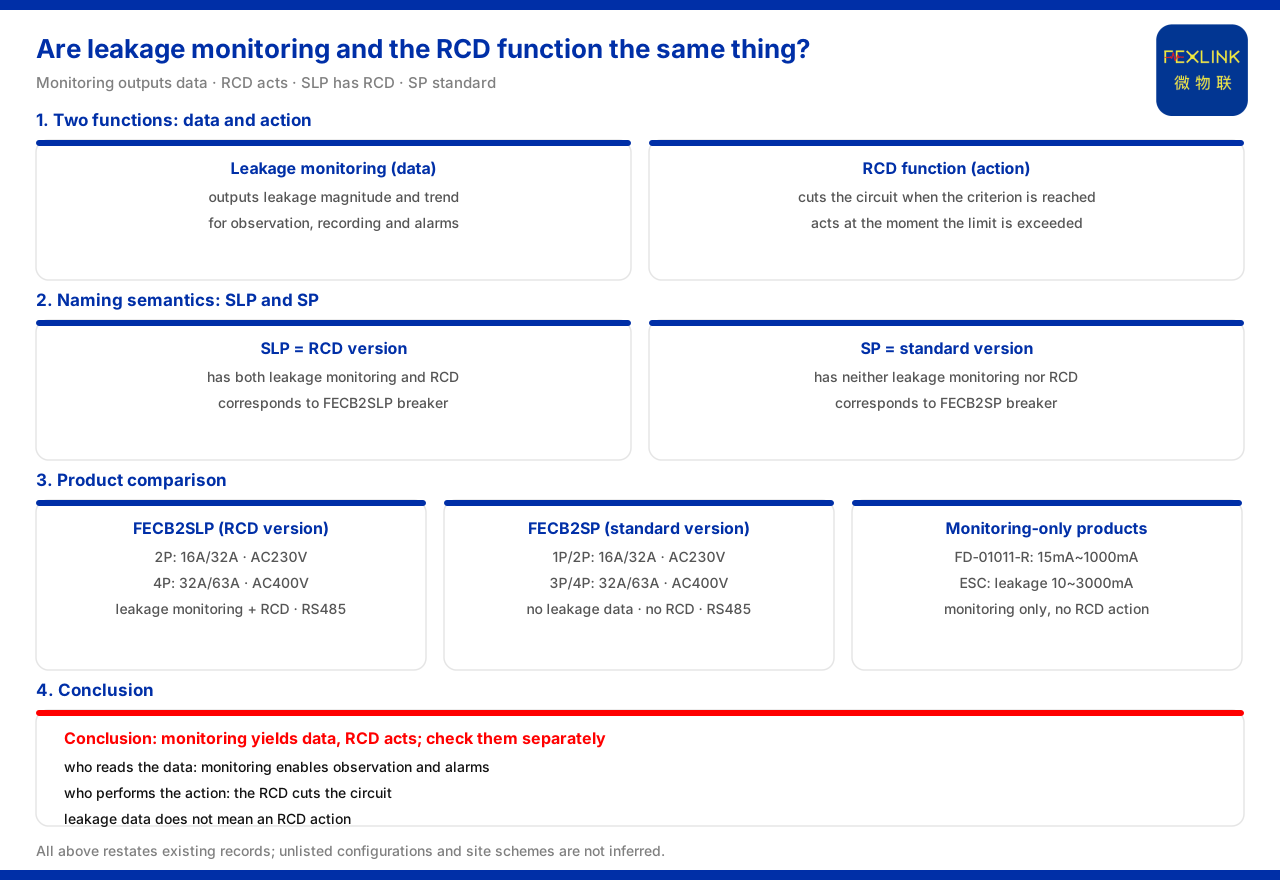
Leakage monitoring and the RCD function are not the same thing: leakage monitoring outputs data, answering "how large the leakage current is now"; the RCD function executes an action, answering "whether the circuit is cut when the criterion is exceeded". The intelligent circuit breaker table of the product knowledge base writes this distinction into its naming semantics: SLP means the RCD version, having both leakage monitoring and the RCD function; SP means the standard version, having neither. Taking the FECB2SLP intelligent circuit breaker (with residual-current protection) (e.g. FECB2SLP-2P) as an example, in addition to voltage, current and temperature monitoring and electricity consumption, it contains both leakage monitoring and RCD protection; while the FECB2SP intelligent circuit breaker (standard model) (e.g. FECB2SP-1P) performs only voltage, current and temperature monitoring and electricity consumption, with neither leakage monitoring nor RCD protection. Beyond circuit breakers, the other residual-current / leakage monitoring products listed by the product knowledge base monitor only and do not execute the breaker-side RCD action. Judging "whether leakage protection exists" therefore cannot rely on the presence of leakage data alone.
1. Two functions: data and action
Split the two functions apart and the difference is clear. The output of leakage monitoring is a readable quantity: the magnitude of the leakage current and its variation over time, used for observation, recording and alarming. The output of the RCD function is an action: when the leakage current reaches the criterion, the device cuts the circuit. The former serves "knowing what happened", the latter serves "preventing it from continuing". Monitoring produces a process quantity and protection executes a result action; the process quantity can be reviewed afterwards, while the action is completed at the moment the limit is exceeded. In the note under the intelligent circuit breaker table, the product knowledge base defines SLP precisely as the combination of "leakage monitoring plus the RCD function", writing the two functions side by side rather than merging them into one concept. Understanding this distinction is the precondition for not misjudging during selection: having monitoring does not mean having protection, and having protection does not mean the data is readable. If the two are conflated, a circuit needing action protection may be fitted with monitoring only, or a circuit needing trend observation may be fitted with protection only and obtain no data.
2. Coexistence on one product: the RCD version
On the RCD version, both functions exist at the same time. The product knowledge base records that the FECB2SLP intelligent circuit breaker (with residual-current protection) includes FECB2SLP-2P (2P, rated current 16A / 32A, rated voltage AC230V) and FECB2SLP-4P (4P, rated current 32A / 63A, rated voltage AC400V); both types support RCD protection, leakage monitoring, voltage / current / temperature monitoring and electricity consumption, with RS485 communication. As can be seen, the RCD version gathers both "monitoring" and "action" into one device: the leakage data can be sent out over RS485, and the RCD action is also executed on the same device. For occasions that need both leakage trend knowledge and a leakage-protection action, the landing point given by the product knowledge base is this version.
3. The standard version: monitoring only, no RCD
The standard version has a different capability boundary within the same grouping. The product knowledge base records that the FECB2SP intelligent circuit breaker (standard model) includes FECB2SP-1P / 2P (1P / 2P, 16A / 32A, AC230V) and FECB2SP-3P / 4P (3P / 4P, 32A / 63A, AC400V); all have neither RCD protection nor leakage monitoring, and support voltage / current / temperature monitoring and electricity consumption, with RS485 communication. Against the note under the table, the standard version's "no RCD protection and no leakage monitoring" hold at the same time: it produces neither leakage data nor an RCD action. This version agrees with the RCD version in voltage, current and temperature monitoring, electricity consumption and RS485 communication, and the difference is concentrated exactly on the two items of leakage monitoring and RCD protection. Placed side by side, the naming semantics and the actual capability match.
4. Monitoring-only products: FD and ESC
Beyond circuit breakers, the product knowledge base lists several products that monitor only and do not execute an RCD action, further confirming that "monitoring can be separated from protection". The FD mains residual-current monitoring module (e.g. FD-01011-R) provides 1 residual-current channel with an acquisition range of 15mA to 1000mA, supplied at DC12V and communicating over RS485; it performs monitoring only and contains no RCD action. The ESC multi-channel leakage-current monitoring & control device (e.g. ESC-22111-R) provides 1 or 3 leakage-current channels (leakage 10mA to 3000mA, accuracy class 1) and relay outputs, supplied at AC220V or DC5V and communicating over RS485; it belongs to the monitoring class that monitors only and may carry relay outputs but contains no breaker-side RCD action. The ESF electrical fire monitoring & control device provides 1 residual-current channel (10mA to 3000mA, accuracy class 1), 4 temperature channels and relay outputs, also a residual-current / leakage monitoring and control product. These classes show that leakage data can be produced by an independent monitoring module without depending on a circuit breaker with an RCD.
5. Why monitoring cannot be treated as protection
Treating monitoring as protection causes safety misjudgment. If a circuit is fitted only with a residual-current monitoring module, the data can be sent up continuously, but the circuit does not thereby gain leakage-protection action capability; if one wrongly believes "leakage data means RCD protection", a device with an RCD will be omitted where action protection is needed. Conversely, if a circuit has only an RCD breaker without reading the leakage data, then although it has action capability, the leakage trend cannot be observed. The product knowledge base writes monitoring and protection as two parallel capabilities precisely so that during selection the two can be checked separately: who reads the data, and who performs the action. For safety-related configurations, confirming these two things separately is more reliable than saying vaguely that "something about leakage was installed".
6. Scenario landing points
In its typical application scenarios and selection comparison, the product knowledge base gives the recommended combination for "distribution automation three-phase governance" as the ESB three-phase imbalance monitor (e.g. ESB-22111-R) plus the FECB2SLP intelligent circuit breaker (with residual-current protection). This combination shows that, where both monitoring and RCD protection are needed, the landing point given by the product knowledge base is the RCD version, not the standard version plus an independent monitoring module. Conversely, if the occasion only needs to observe the leakage trend without a breaker-side protection action, the landing point can be the independent residual-current / leakage monitoring product. The model quick reference of the product knowledge base marks FECB2SP and FECB2SLP together as "intelligent circuit breaker (standard / RCD)", also indicating that the two are two versions of the same product line, to be chosen by the single item of "whether RCD protection is needed".
Scope and limitations
First, this article restates only what the product knowledge base lists, with the factual boundary limited to the names, poles, rated currents, rated voltages and function items of the standard and RCD versions in the intelligent circuit breaker model table, the note's definitions of SLP and SP, and the parameters and scenario combinations of residual-current / leakage monitoring products such as the mains residual-current monitoring module, the multi-channel leakage-current monitoring & control device and the electrical fire monitoring & control device, introducing no unlisted parameters, certifications or cases.
Second, the 2P (16A / 32A, AC230V) and 4P (32A / 63A, AC400V) of the FECB2SLP intelligent circuit breaker (with residual-current protection), the 1P / 2P (16A / 32A, AC230V) and 3P / 4P (32A / 63A, AC400V) of the FECB2SP intelligent circuit breaker (standard model), and the RCD protection, leakage monitoring, voltage / current / temperature monitoring, electricity consumption and RS485 specifications of the two versions, are cited from the product knowledge base.
Third, the 1 residual-current channel of FD-01011-R at 15mA to 1000mA, DC12V and RS485, the 1 / 3 leakage-current channels of the ESC multi-channel leakage-current monitoring & control device at 10mA to 3000mA (accuracy class 1) with relay outputs, AC220V / DC5V and RS485, and the 1 residual-current channel of the ESF electrical fire monitoring & control device at 10mA to 3000mA (accuracy class 1), 4 temperature channels and relay outputs, are cited from the product knowledge base.
Fourth, this article only explains the functional difference between leakage monitoring and the RCD function and the respective landing points of the two classes of device, and provides no specific project RCD setting, action criterion or circuit configuration; the relevant conclusions must be confirmed with site conditions and the project solution.
Fifth, this article constitutes no commitment about the selection result or field behaviour of a specific project; actual conditions are subject to the latest product material and project solution.