Direct answer
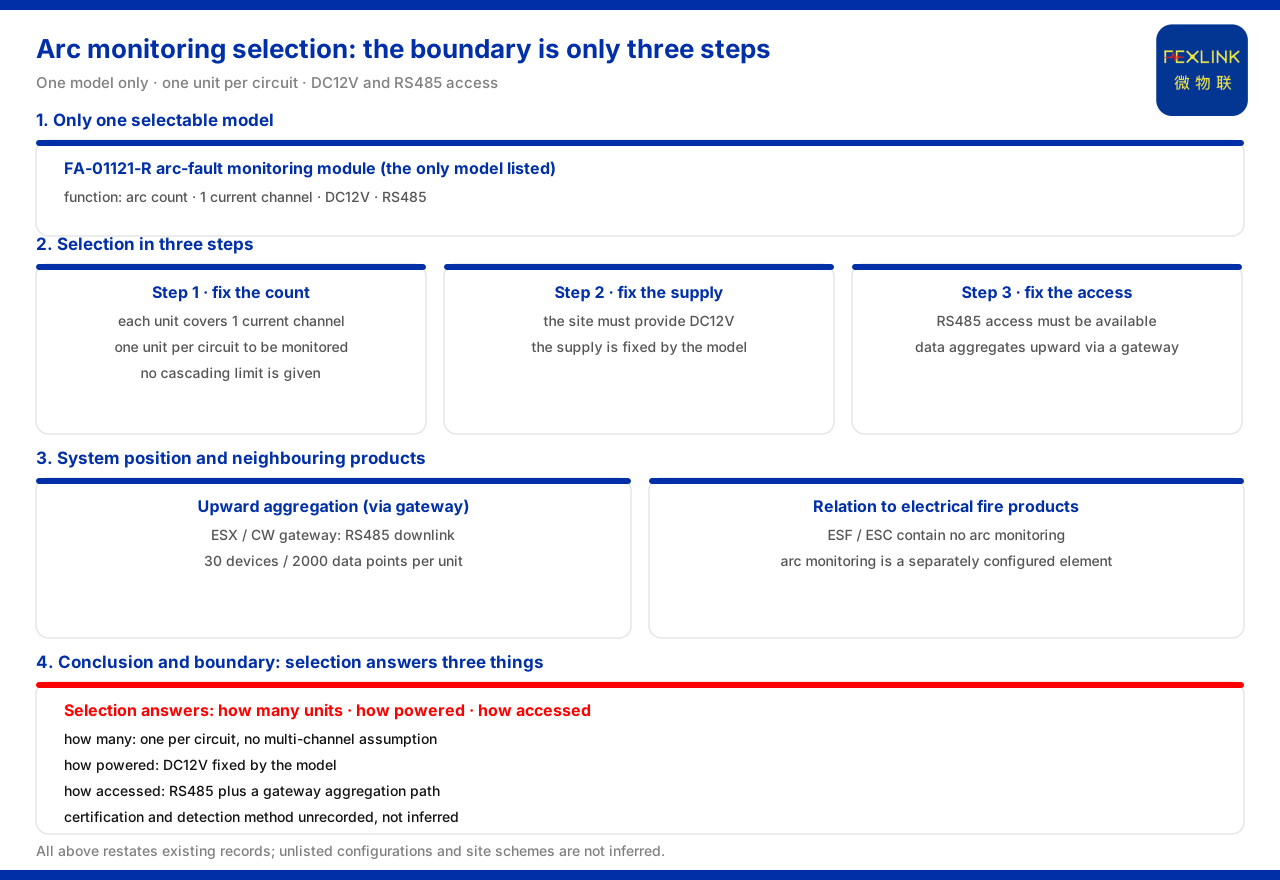
Under the current specification of the product knowledge base, the selection of arc monitoring is a question with a very narrow boundary: the product knowledge base lists only one arc-fault monitoring module, the FA arc-fault monitoring module (e.g. FA-01121-R), whose function is arc count, monitoring 1 current channel, supplied at DC12V and communicating over RS485. "Selection" therefore comes down to three things: determine the number of modules by the number of circuits to be monitored, since each module covers only 1 current channel; confirm that the site can provide DC12V; and confirm that RS485 networking conditions exist. The product knowledge base gives no second arc-monitoring model, and provides no model gradient, detection method or certification record. In other words, the feasible boundary of arc monitoring selection is exactly these three things, not a comparison of parameters across several models. Stating the boundary clearly is more useful than piling up a non-existent model gradient.
1. Only one selectable model
In the module entry of the intelligent lightning-protection product line, the product knowledge base lists only one arc-fault monitoring module, FA-01121-R: function arc count, monitoring 1 current channel, supplied at DC12V, communicating over RS485. The product model quick reference likewise marks the FA prefix as the arc-fault monitoring module. That is, within the records of the knowledge base there is no second model available for horizontal comparison in arc monitoring. A selection recommendation therefore cannot be written as "choose the best among several" but only as "starting from this one model's capability boundary, determine how many units are needed, how they are powered and how they are accessed". With this as the premise, later judgments will not exceed the scope of the knowledge base.
2. The sole selection dimension: circuit count
Since there is only one model, the selection dimension concentrates on quantity. Because FA-01121-R covers only 1 current channel each, a distribution system with several current circuits needing arc monitoring requires several modules configured by the number of circuits. This is a quantity relation directly derived from the capability boundary of "1 current channel". The product knowledge base gives no upper limit for cascading, nor any statement of "extending one unit to several channels", so the quantity configuration can only correspond unit by unit to the circuit count and cannot assume that one module can handle several circuits. For the same reason, this article's statement that "multiple circuits need multiple units" is an application-level inference derived from the single-unit single-channel boundary; the product knowledge base does not give it as a written rule.
3. Access method: DC12V and RS485
Once the quantity is fixed, the access conditions must be confirmed. The product knowledge base records that FA-01121-R is supplied at DC12V and communicates over RS485. In the general suffix rule, -R means RS485 (Modbus); in the communication protocol matrix, the device downlink protocol includes Modbus RTU (RS485). The two specifications corroborate each other: the module uses RS485 as its device-side access method, belonging to the device downlink protocol. The site therefore needs to provide DC12V and RS485 access conditions for the module. These two are written into the model itself and do not change as the circuit count increases; only the number of modules and corresponding access points increase.
4. Its position in the system
After access, how does the data aggregate upward? The product knowledge base records that the ESX intelligent edge-computing gateway (e.g. ESX-0223-GR) and the CW industrial gateway (e.g. CW-C1) use RS485 downward and a single unit can access 30 devices and 2000 data points. The FA arc-fault monitoring module, communicating over RS485, can be accessed through this layer of gateway. Note that in the perception-layer example of the general four-layer architecture of the monitoring system, the product knowledge base lists the surge protective device monitor, the grounding resistance monitor, the lightning current / transient current monitor and the electrical-safety monitoring module series, but does not include the arc-fault monitoring module in that example. This means its deployment position in the system must be determined separately by the on-site circuit and access method, and cannot be assumed from the product list in the perception-layer example. Making this relation clear during selection is more prudent than an assumed placement.
5. Relationship with electrical fire monitoring products
Arc monitoring is an independent element in the knowledge base, as can be corroborated from the records of adjacent products. The product knowledge base records that the ESF electrical fire monitoring & control device (e.g. ESF-22110-R, 1 residual-current channel plus 4 temperature channels) and the ESC multi-channel leakage-current monitoring & control device (e.g. ESC-22111-R, 1 / 3 leakage-current channels) do not include arc monitoring; in the typical application scenarios, the recommended combination for "low-voltage distribution cabinet electrical fire early warning" is the ESF electrical fire monitoring & control device, the ESC multi-channel leakage-current monitoring & control device and the EST multi-channel temperature intelligent controller (e.g. EST-12111-R), plus IoTBox, with no arc-fault monitoring module listed either. Put together, these give a clear conclusion: arc monitoring is not an incidental function of electrical fire monitoring products but an independent element requiring separate configuration. An electrical fire early-warning combination therefore cannot replace arc monitoring, and vice versa.
6. What cannot be inferred: certification and parameter gradient
A selection statement must also make clear what cannot be done. The product knowledge base records neither the arc detection method nor the certification status of the FA arc-fault monitoring module — terms such as AFCI and AFDD and the corresponding certification statements do not appear in the knowledge base — nor a multi-model parameter gradient. It therefore cannot be inferred what certification category it belongs to or what protection type it satisfies, nor can a further unlisted model be assumed. For procurement and solution design this means two things: first, a certification conclusion cannot be used as a selection basis, and the relevant determination must be confirmed with the manufacturer's technical material; second, one cannot reserve the assumption that "a higher-tier model can be swapped in later", because under the knowledge-base specification no such gradient exists.
7. Reducing selection to a checking order
Putting the above together, arc monitoring selection reduces to an order. First, count the current circuits needing arc monitoring and fix the number of modules at one unit per channel. Second, confirm that the site can provide DC12V. Third, confirm RS485 access conditions and plan the upward aggregation path through a gateway. Fourth, confirm whether electrical fire monitoring products are to be configured separately, avoiding mistaking the arc element for an incidental function of the other products. Fifth, make no inference about certification and unlisted parameters, confirming with the manufacturer's technical material where necessary. By this order, arc monitoring selection answers "how many units, how powered, how accessed", not "whose parameters are better" — because a second comparable model does not exist.
Scope and limitations
First, this article restates only what the product knowledge base lists, with the factual boundary limited to the function and parameters of the arc-fault monitoring module FA-01121-R, the model quick reference and outsource-production classification in the appendix, the general suffix rule and communication protocol matrix, the gateway access capability, and the relationship with electrical fire monitoring products, introducing no unlisted parameters, certifications or cases.
Second, the function of FA-01121-R as arc count, monitoring 1 current channel, supplied at DC12V and communicating over RS485, the general suffix -R as RS485 (Modbus), and the gateway's single-unit access to 30 devices and 2000 data points, are cited from the product knowledge base.
Third, the product knowledge base lists only one arc-fault monitoring module, FA-01121-R; this article's statement that "multiple circuits need multiple units" is an application-level inference derived from the single-unit single-channel boundary, which the knowledge base does not give as a written rule and for which it gives no cascading upper limit.
Fourth, the product knowledge base records neither the arc detection method, the certification status (such as AFCI, AFDD) nor a multi-model parameter gradient of this module; this article makes no certification determination or model extrapolation, and the relevant conclusions must be confirmed with the manufacturer's technical material.
Fifth, this article only explains the feasible boundary of arc monitoring selection and provides no specific project circuit division, module quantity or installation scheme; the relevant conclusions must be confirmed with the on-site circuits and the project solution.
Sixth, this article constitutes no commitment about the selection result or field behaviour of a specific project; actual conditions are subject to the latest product material and project solution.