Direct answer
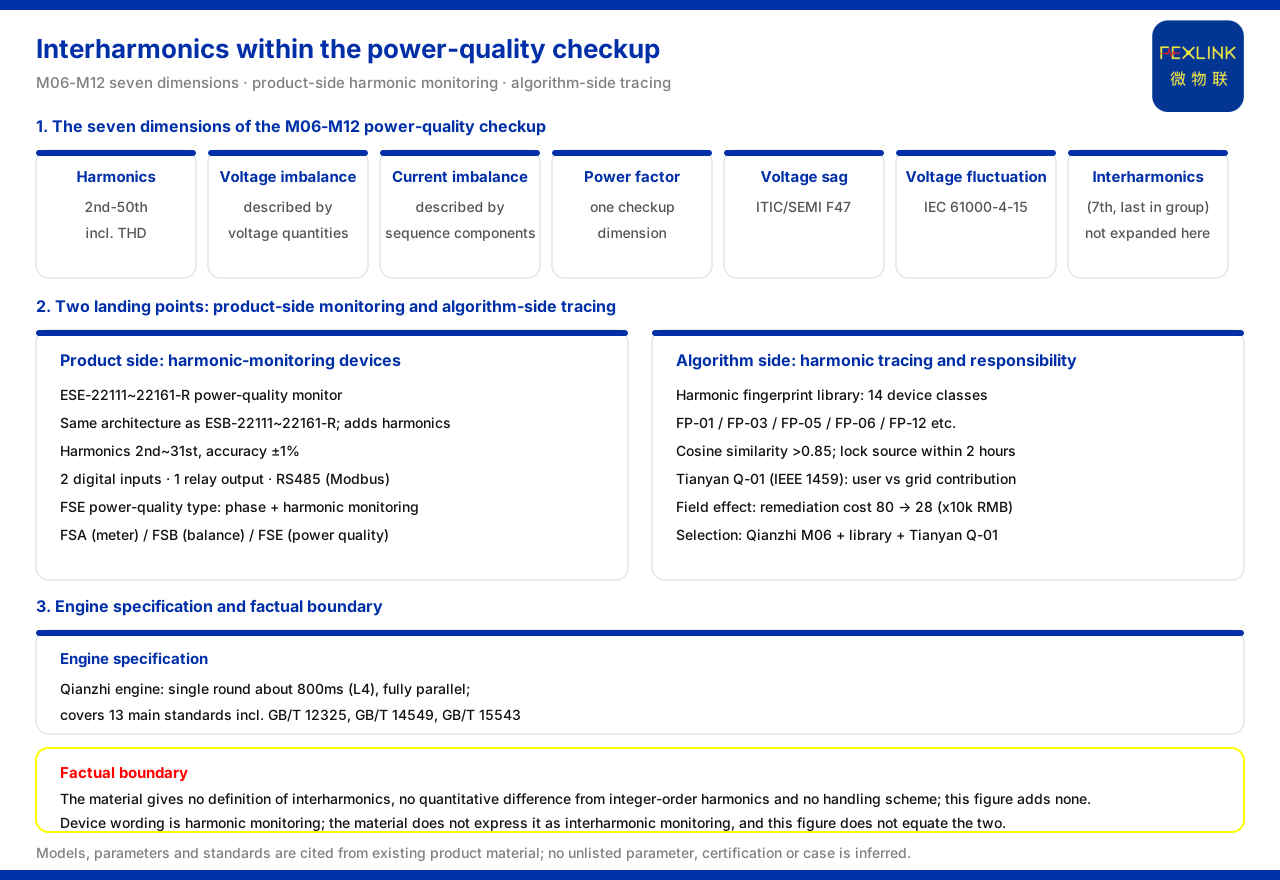
In the product knowledge base, interharmonics is not an independent product line but one dimension of the "power-quality checkup" analysis group, listed last in that group. The knowledge base numbers the group M06 to M12 and lists seven dimensions: harmonics (2nd-50th and total harmonic distortion, THD), voltage imbalance, current imbalance (sequence components), power factor, voltage sag (ITIC/SEMI F47), voltage fluctuation (IEC 61000-4-15) and interharmonics. A boundary must be drawn first: the knowledge base gives interharmonics only as a listed analysis dimension, with no definitional parameter, no quantitative difference from integer-order harmonics and no handling scheme. This article can therefore answer only "where interharmonics sits and where the boundary is", not "what it is and how it is handled", and it will not supply a definition, threshold or disposal step the knowledge base has not written down. The confirmable capabilities around the quantity class of harmonics — harmonic monitoring, harmonic tracing and responsibility allocation — have separate product-side and algorithm-side landing points, described below.
1. Interharmonics is the seventh item in the knowledge base
Placed back into the structure of the knowledge base, interharmonics has a clear attribution: it belongs to one of the twenty dedicated submodels of the Qianzhi engine, the "power-quality checkup" submodel group numbered M06 to M12. It is therefore not separately listed as a product capability but appears as one analysis dimension of the checkup, side by side with harmonics, voltage imbalance, current imbalance, power factor, voltage sag and voltage fluctuation, and it is listed last. The order carries no priority meaning, but it shows that interharmonics belongs to the same checkup group as the other six rather than being an externally supplemented concept.
2. What the seven dimensions from M06 to M12 are
To make the position of interharmonics verifiable, the seven dimensions are listed with the wording the knowledge base attaches:
| Dimension | Wording listed in the knowledge base | |:--|:--| | Harmonics | 2nd-50th, including total harmonic distortion THD | | Voltage imbalance | imbalance described by voltage quantities | | Current imbalance | described by sequence components | | Power factor | one dimension of the power-quality checkup | | Voltage sag | ITIC/SEMI F47 | | Voltage fluctuation | IEC 61000-4-15 | | Interharmonics | listed as the last dimension of the group |
For the six items other than interharmonics, the knowledge base attaches a definite wording; interharmonics alone is named but not expanded. This is why the boundary is emphasised: the knowledge base's record of interharmonics itself stops at "it is the seventh dimension of the group".
3. On interharmonics: no definition or handling is given
A reader who asks "how does interharmonics differ from integer-order harmonics" or "what should be done when interharmonics is found" must first accept one fact: the knowledge base gives no definitional statement for interharmonics, no difference from integer-order harmonics in mechanism or quantity, and no treatment step. This article therefore cannot apply the properties of integer-order harmonics to interharmonics, because whether the two are the same and how large the difference is are exactly what the knowledge base does not state. Only three points can be confirmed: interharmonics is a listed power-quality analysis dimension; it belongs with the other six to the M06 to M12 group; and it ranks last in that group.
4. Confirmable monitoring devices around harmonics
Although the knowledge base does not expand interharmonics, around the class of harmonics it gives a verifiable monitoring and selection wording. The capabilities below are all expressed as "harmonic monitoring", not as interharmonic monitoring, and readers should not equate the two.
The landing point for power-quality monitoring is the power-quality monitor (ESE-22111~22161-R). The knowledge base states that it shares the same architecture as the ESB three-phase imbalance monitor (ESB-22111~22161-R) and adds harmonic monitoring on top of phase monitoring, covering 2nd~31st at ±1% accuracy; it is configured with 2 digital input channels and 1 relay output channel, with RS485 (Modbus) communication.
The landing point for the multi-parameter unit is the multi-parameter electrical intelligent controller (power quality type). Three tiers are distinguished by function: the FSA (meter type) has no phase or harmonic monitoring, the FSB (three-phase balance type) adds phase monitoring, and the FSE (power quality type) adds harmonic further. Their common functions include 1 residual-current channel, voltage 3×220/380V, temperature monitoring 4 channels, digital input 2 channels, relay output 2 channels, electricity-meter monitoring and two RS485 (Modbus) channels. Choosing the power quality type merges phase and harmonic monitoring into one controller, in a different product family from the ESE power-quality monitor.
5. Harmonic tracing and responsibility allocation: the algorithm-side landing point
On the algorithm side, the knowledge base gives landing points for harmonic tracing and responsibility allocation. The harmonic fingerprint library of the Qianzhi engine contains 14 device fingerprint classes, such as FP-01 three-phase rectifier, FP-03 six-pulse variable-frequency drive, FP-05 UPS, FP-06 charging pile and FP-12 photovoltaic inverter; matching uses a threshold of cosine similarity greater than 0.85, and the knowledge base says the pollution source can be locked within 2 hours, whereas the traditional method takes several weeks. The Q power-quality block of the Tianyan engine lists 15 items across 12 wordings, among which the P0 first-release model Q-01 is "harmonic responsibility allocation (IEEE 1459)", used to quantify the harmonic contributions of the user side and the grid side; the knowledge base records its field effect as a remediation cost reduced from RMB 800,000 to RMB 280,000.
In the product selection and AI capability comparison, the selection combination for "harmonic tracing and responsibility allocation" is Qianzhi M06 plus the fingerprint library, plus Tianyan Q-01 (IEEE 1459). Monitoring is acquired on the product side, while tracing and responsibility allocation are completed on the algorithm side; the two are listed separately.
6. The analysis engine's technical convention
The Qianzhi engine's technical specification is a single analysis round of about 800ms, at the L4 layer, fully parallel; on standard coverage, the knowledge base lists 13 main standards including GB/T 12325, GB/T 14549 and GB/T 15543. These wordings show that the analysis underpinning M06 to M12 is standardised, fast and parallel, but they describe engine capability and are not equivalent to interharmonics itself having a definition or a limit value.
7. Reducing the boundary to a checklist
The confirmable content reduces to a checklist:
1. Interharmonics is a dimension of the power-quality checkup group, ranked seventh in it; 2. The group is numbered M06 to M12 and lists harmonics, voltage imbalance, current imbalance, power factor, voltage sag, voltage fluctuation and interharmonics; 3. The knowledge base gives no definition of interharmonics, no quantitative difference from integer-order harmonics and no handling scheme, and this article does not supplement them; 4. The device landing points for harmonic monitoring are the ESE power-quality monitor (2nd~31st, ±1%) and the FSE multi-parameter electrical intelligent controller (power quality type); the wording is harmonic monitoring, not interharmonic monitoring; 5. The algorithm landing points are the Qianzhi harmonic fingerprint library (14 fingerprint classes, cosine similarity greater than 0.85, 2-hour locking) and Tianyan Q-01 (IEEE 1459), with the selection combination Qianzhi M06 plus the fingerprint library plus Tianyan Q-01.
The checklist produces no new parameter conclusion; it only keeps the position of interharmonics separate from the confirmable monitoring and analysis capability around harmonics, so the latter is not mistaken for a definition or handling of interharmonics.
Scope and limitations
First, this article's account of interharmonics is limited to the knowledge base's record: interharmonics is one dimension of the "power-quality checkup" submodel group M06 to M12 and ranks last; this article does not infer its definition, mechanism, calculation method, limit value or quantitative difference from integer-order harmonics.
Second, the knowledge base gives no treatment scheme for interharmonics, and this article supplements and infers no disposal step.
Third, the harmonic-monitoring wording is limited to the ESE power-quality monitor's 2nd~31st at ±1% and the FSE multi-parameter electrical intelligent controller (power quality type) adding harmonic monitoring on top of phase monitoring; the knowledge base does not express these as interharmonic monitoring, and this article makes no such equation or extrapolation.
Fourth, the M06 to M12 seven dimensions, the 14 fingerprint classes with cosine similarity greater than 0.85, 2-hour pollution-source locking, the Tianyan Q block's 15 items and 12 wordings, Q-01 (IEEE 1459) and the remediation cost reduced from RMB 800,000 to RMB 280,000, and the Qianzhi engine's about-800ms single round (L4 layer) covering 13 main standards are all wordings listed in the knowledge base; the cost figure is a recorded field effect, restated only and not a commitment to other project results.
Fifth, references to IEEE 1459, IEC 61000-4-15 and ITIC/SEMI F47 are limited to the knowledge base's listing, and this article does not expand on standard clauses, limit values or scope of application.
Sixth, this article does not constitute a commitment to the selection result or field performance of a specific project; actual conditions are subject to the latest product material and project scheme.