Direct answer
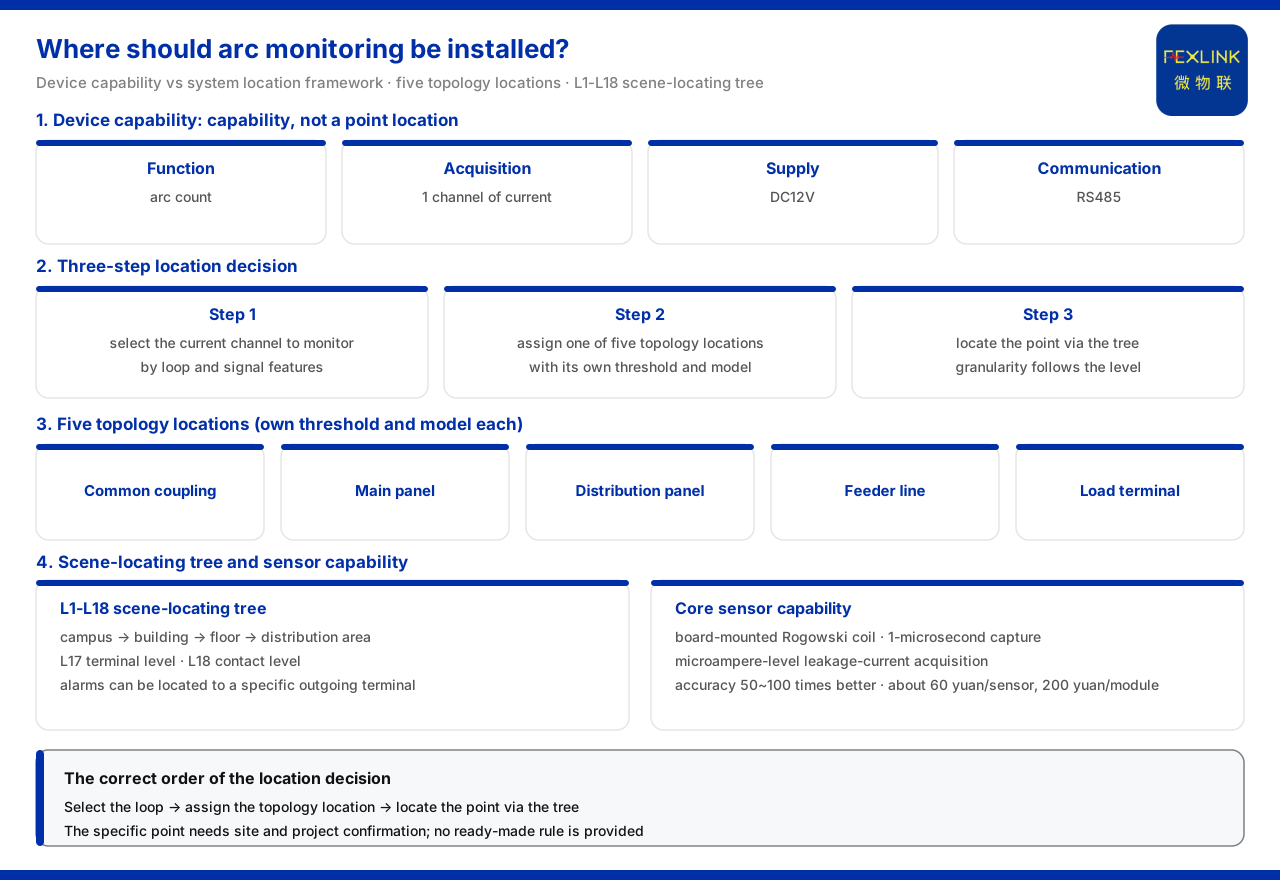
The product knowledge base does not give a recommended installation location or deployment rule for the arc-fault monitoring module. What can be confirmed is this: the FA arc-fault monitoring module (e.g., FA-01121-R) has the function of arc count, collects 1 channel of current, is supplied at DC12V and communicates over RS485; the knowledge base appendix lists it as an arc-fault monitoring module and notes that it belongs to an outsourced production category. Location-related capability, by contrast, is placed within the framework of the Wanxiang engine (large model): Wanxiang location awareness divides the electrical topology into five location types and maintains independent thresholds and risk models for each type; the Wanxiang scene-locating tree covers eighteen levels and can locate an alarm precisely to a specific outgoing terminal. Therefore, the correct way to answer "where should arc monitoring be installed" is to separate two things: the device entry contains no point-location rule, while the system side provides location modeling and locating capability. The specific measuring point still needs to be confirmed in combination with the site and the project scheme, and a rule of "should be installed at a certain place" cannot be read directly from the knowledge base.
1. What the device provides: FA's acquisition and access
The record of the FA arc-fault monitoring module (e.g., FA-01121-R) in the knowledge base concentrates on three points: its function is arc count, it monitors 1 channel of current, and it is supplied at DC12V and communicates over RS485. That is, it is a monitoring module with single-channel current acquisition and arc count as its output, accessing the system over RS485. These three points determine its requirements for the measuring point: it needs to be connected in series or clamped onto the monitored current loop, and RS485 access conditions must be available. The knowledge base does not further specify where this channel of current should be taken, only what it collects, how it is supplied and how it communicates. Understanding the deployment location begins with accepting this starting point — the device entry gives capability, not a point location.
2. The knowledge base gives no installation-location rule
It should be made clear that the knowledge base does not give an installation location or deployment rule for the arc-fault monitoring module. Apart from model and function, the only record about it in the appendix is the classification "outsourced production category"; there is no stipulation such as "should be installed at the distribution-cabinet incoming line" or "should be installed at the end circuit", nor any rule on branch quantity, spacing or layered arrangement. Therefore, any statement treating a specific point location as a requirement of the knowledge base exceeds the knowledge base's basis. For the scheme designer, this means the point-location decision must be made according to the actual site conditions of the project; the knowledge base can only provide device capability and system locating capability as support, and cannot substitute for on-site judgment.
3. Location clues from the electrical-fire warning scenario
Although the knowledge base gives no point-location rule for arc monitoring, it does give the combination form of electrical-fire warning, which can serve as a reference for location thinking. The knowledge base records that the ESF electrical fire monitoring & control device includes 1 channel of residual current and 4 channels of temperature, and the ESC multi-channel leakage-current monitoring & control device includes 1 or 3 channels of leakage; in the "low-voltage distribution cabinet electrical-fire warning" scenario, the recommended combination is the ESF electrical fire monitoring & control device, the ESC multi-channel leakage-current monitoring & control device and the EST multi-channel temperature intelligent controller, together with a gateway-type access device. This combination points the landing point of electrical-fire warning clearly to the low-voltage distribution cabinet. Arc monitoring, as one class of electrical safety monitoring, may refer to the site level given by this scenario for its location choice, but the knowledge base does not write arc monitoring directly into this combination, nor does it thereby specify the concrete measuring point of arc monitoring.
4. The location-awareness framework: five topology locations
The modeling of location on the system side is undertaken by Wanxiang location awareness of the Wanxiang engine (large model). The knowledge base records that location awareness divides the electrical topology into five location types: the point of common coupling, the main distribution panel, the distribution panel, the feeder line and the load terminal, maintaining independent thresholds and risk models for each type. The significance of this framework is that the same channel of current at different topological locations has different judgment thresholds and risk models. For arc monitoring, this means that even though the device itself does not specify a point location, the system still needs to know which location type a channel of data belongs to when it is accessed, in order to apply the corresponding threshold and model. Therefore, "where it is installed" corresponds on the system side to "which location type it is assigned to".
5. The eighteen-level scene-locating tree
Matching the location types is the eighteen-level scene-locating tree of the Wanxiang engine. The knowledge base records that the locating tree covers L1 to L18, probing level by level from campus, building, floor and distribution area down to L17 terminal level and L18 contact level, so an alarm can be precisely located to a specific outgoing terminal. This hierarchical structure shows that the system's description of "location" can be fine enough to reach terminals and contacts. For the choice of arc-monitoring measuring points, the levels of the locating tree provide a reference: the closer a measuring point is to the end, the more it can correspond to a specific terminal or contact; the closer it is to the upstream, the coarser the corresponding level. What the knowledge base gives is this locating capability, not a specification of the level of arc-monitoring measuring points.
6. What sensor capability means for location choice
The sensor capability behind the device also influences location choice from the side. The knowledge base records that the core sensor technology is a board-mounted special-shaped Rogowski coil, which can achieve 1-microsecond-level abnormal-current capture and support microampere-level leakage-current acquisition, with accuracy 50 to 100 times better than comparable products, at a cost of about 60 yuan per sensor and 200 yuan per module. The 1-microsecond-level capture capability targets fast-changing abnormal currents, while microampere-level acquisition targets weak leakage currents. These capabilities determine that arc monitoring is more suited to capturing instantaneous, burst-like current features.
7. Stating the location question clearly
Back to the core question: how should the deployment location of the arc-fault monitoring module be determined? The answer of the knowledge base is layered. At the device level, the FA arc-fault monitoring module (e.g., FA-01121-R) gives only arc count, 1 channel of current, DC12V and RS485, with no point-location rule; at the system level, Wanxiang location awareness and the eighteen-level scene-locating tree provide location-type division and end-locating capability. Therefore, the correct order of the location decision is: first select the channel of current to be collected according to the loop and signal features that need monitoring; then confirm which topological location type it should be assigned to; and finally, with the levels of the locating tree, bring the measuring point down to a locatable granularity. The specific point location needs to be confirmed in combination with the site and the project scheme; the knowledge base does not provide a ready-made installation-location rule.
Scope and limitations
First, this article only restates content listed in the product knowledge base, and its factual boundary is limited to the FA arc-fault monitoring module entry, the appendix model quick-reference and outsourced-production classification, the combination and scenario of electrical-fire warning, the five location types of Wanxiang location awareness, the eighteen-level scene-locating tree, and the record of core sensor technology.
Second, the knowledge base does not give an installation location or deployment rule for the arc-fault monitoring module; the statement about the location decision in this article is induced from the device capability and the system location framework, and does not mean that the knowledge base gives a formal stipulation of the installation point.
Third, the arc count, 1 channel of current, DC12V and RS485 of FA-01121-R, as well as the board-mounted special-shaped Rogowski coil's 1-microsecond-level capture, microampere-level acquisition, accuracy 50 to 100 times better than comparable products, and about 60 yuan per sensor and 200 yuan per module, are all based on the knowledge base's stated basis, and this article does not infer the cost or performance of unlisted models from them.
Fourth, the five topology locations and the eighteen-level scene-locating tree are records of system capability in the knowledge base, and this article does not infer that they can achieve the same locating granularity at any site.
Fifth, this article does not constitute a commitment to the deployment effect or on-site performance of any specific project; actual conditions are subject to the latest product documentation and project scheme.