How a charging-pile harmonic fingerprint is identified
Direct answer
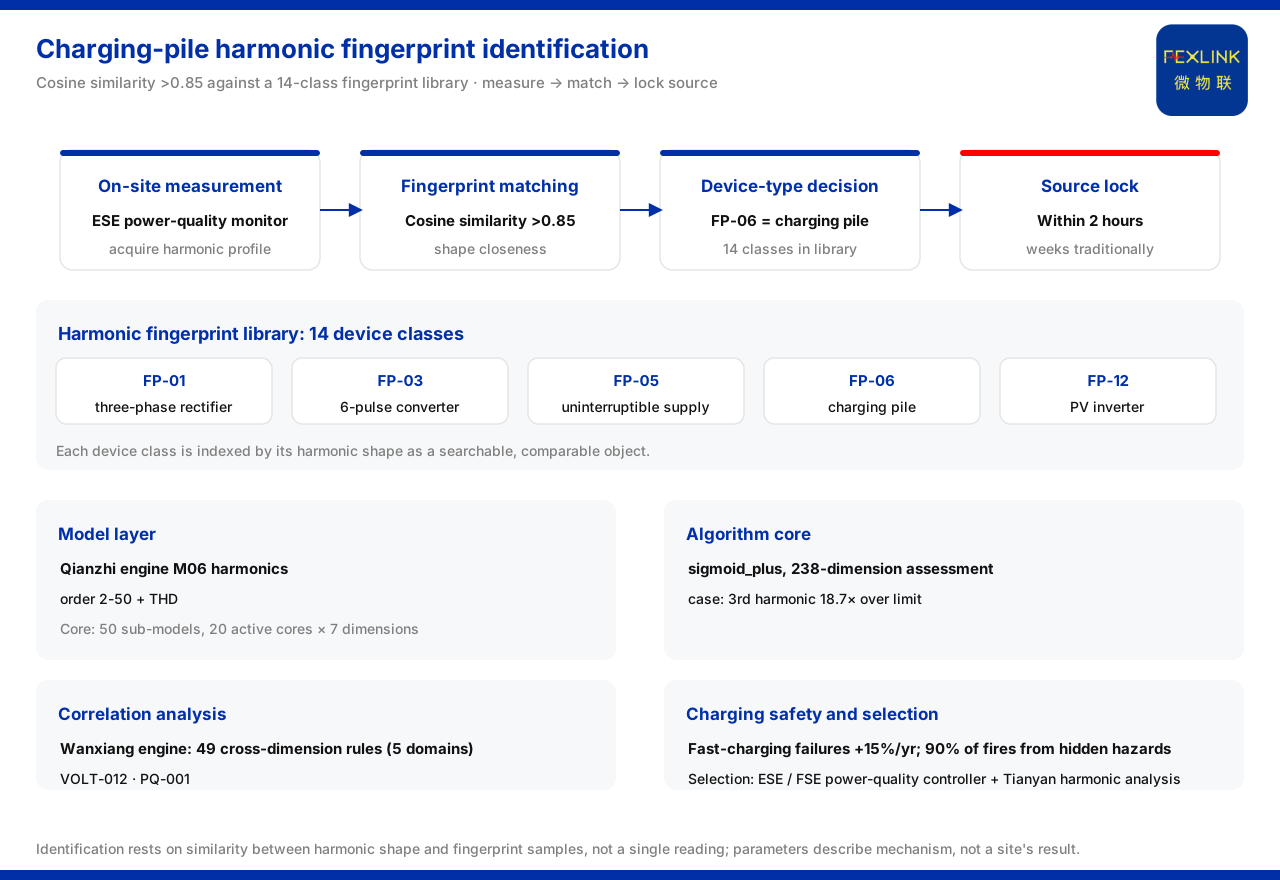
In the harmonic fingerprint library, a charging pile has its own fingerprint entry. The product knowledge base records that the library holds 14 device fingerprint classes, among which the charging pile is FP-06, while the same library also lists the three-phase rectifier (FP-01), the 6-pulse variable-frequency drive (FP-03), the uninterruptible power supply (FP-05) and the PV inverter (FP-12), each with its own number. Matching uses a cosine similarity greater than 0.85 and can lock the pollution source within 2 hours, whereas the conventional method takes weeks. Identifying a charging-pile harmonic is therefore not an empirical judgement based on a single harmonic reading but a comparison of the measured harmonic distribution against the fingerprints held in the library. After identification, the judgement side is carried by the dedicated harmonic sub-model of the Qianzhi engine / large model (V4.1), which covers harmonics of orders 2 to 50 including total harmonic distortion; the cross-dimensional association rules of the Wanxiang engine / large model (V4.0) further assist the study. In the charging-safety scenario this capability sits against a background in which the failure rate of fast-charging stations rises 15% per year and 90% of charging fires originate in undetected hazards. For selection, the combination corresponding to "power quality and dedicated harmonic treatment" is the ESE power-quality monitor or the FSE multi-parameter electrical intelligent controller (power quality type), together with the harmonic analysis of the Tianyan engine / large model.
1. Why the fingerprint library needs a "charging pile" entry
The harmonic fingerprint library of the product knowledge base holds 14 device fingerprint classes. A device fingerprint is the harmonic distribution that a class of device exhibits in operation, fixed into an object that can be compared. The charging pile is listed among them under fingerprint number FP-06. The same library also lists the three-phase rectifier, the 6-pulse variable-frequency drive, the uninterruptible power supply and the PV inverter, each with an independent number. Listing the charging pile as a separate item shows that, like these devices, it has a distinguishable harmonic signature rather than being lumped together with other rectifier-type loads. A charging station usually has multiple piles connected to the grid, and several piles and other non-linear loads may coexist in the same distribution network; here fingerprint identification separates the harmonics produced by the charging load from those produced by other devices, answering whether a given part of the distortion is brought by the charging pile.
2. How fingerprint identification matches
The product knowledge base records that fingerprint matching uses a cosine similarity with a threshold set above 0.85, that a pollution source can be locked within 2 hours, and that the conventional method takes weeks. Cosine similarity compares the closeness of the measured harmonic distribution to the fingerprint shape in the library, rather than simply comparing the magnitude of total harmonic distortion. This means that even when two sources have similar overall distortion levels, they can still be distinguished as long as the distribution of the individual harmonic orders differs. The contrast between 2 hours and weeks shows that the library turns a comparison process that once relied on manual investigation into an executable retrieval. This time limit is the convention given by the product knowledge base to explain the identification mechanism; it does not constitute a commitment regarding identification time at any arbitrary site.
3. The model-layer attribution after identification
A harmonic fingerprint resolves which class of device a signal resembles, while whether the harmonic level is abnormal and how severe the distortion is falls to the model layer. The product knowledge base records that the power-quality examination of the Qianzhi engine is composed of several dedicated sub-models, among which harmonics are the responsibility of sub-model M06, covering harmonics of orders 2 to 50 and including total harmonic distortion. The core architecture of the Qianzhi engine is 50 parameter sub-models, of which 20 core sub-models (M01 to M20) are currently implemented, together with 7-dimensional perception. Placing fingerprint identification and M06 together forms the link from identifying the source to quantifying the degree: the fingerprint answers which class of device, and M06 answers how large the distortion is.
4. Algorithmic core and one out-of-limit case
At a lower level, the product knowledge base records that the integrated electrical-hazard intelligent analysis model supports 238-dimensional electrical parameter assessment with a sigmoid_plus non-linear risk function. Within the deep harmonic-fingerprint analysis of this model, a case is recorded in which a 3rd-order harmonic exceeded the limit by 18.7 times. This order of magnitude shows that harmonic problems at some sites can far exceed the ordinary level, and that deep fingerprint analysis is precisely what links such significant distortion to a specific device. This article cites the case only to explain the possible magnitude of harmonic exceedance and the depth of the analysis; it does not represent an expectation of results at any site.
5. How cross-dimensional association rules assist the study
Beyond identification and quantification, the product knowledge base records that the Wanxiang engine establishes 49 cross-dimensional association rules distributed across 5 domains. Two of the harmonic-related rules are included: VOLT-012, expressed as high harmonics combined with reactive-power compensation being switched in pointing to resonance risk; and PQ-001, expressed as total harmonic distortion and power factor deteriorating in step, pointing to harmonics interfering with reactive power. The value of these two rules is that they do not treat harmonics as an isolated indicator but require joint study with reactive-power compensation, power factor and other dimensions. For a charging station, the switching of reactive-power compensation devices and the change of harmonics may appear together when multiple piles work at the same time, so the association rules provide a direction of criteria for linking the two.
6. Why the charging scenario deserves a separate entry
The electrical hazard early-warning system of the product knowledge base, in the charging-safety scenario, faces new-energy vehicle charging and covers both slow and fast charging. The material records that the failure rate of fast-charging stations rises 15% per year and that 90% of charging fires originate in undetected hazards. This group of figures explains why charging-pile harmonic identification needs separate treatment: a charging station is a scenario of concentrated load, dense equipment and continuous operation, in which the proportion of undetected electrical hazards is high, and harmonic abnormality is one observable representation of an electrical hazard. Including the charging-pile fingerprint in the library gives this scenario an additional retrievable identification path and provides a usable input for subsequent hazard early warning.
7. Selection landing point
In the typical application scenarios and selection comparison, the product combination corresponding to "power quality and dedicated harmonic treatment" is the ESE power-quality monitor or the FSE multi-parameter electrical intelligent controller (power quality type), together with the harmonic analysis of the Tianyan engine. That is, field measurement is carried by the monitor, harmonic analysis by the Tianyan engine, and fingerprint identification belongs to a capability on the Qianzhi side. The three have different divisions of labour, and during selection it should be confirmed separately whether the site needs an acquisition device, an analysis tool or an identification capability, so that products of different levels are not treated as the same thing.
Scope and limitations
- This article is limited to what the product knowledge base lists: the 14 device fingerprint classes and the charging-pile fingerprint FP-06 in the harmonic fingerprint library, the cosine similarity threshold greater than 0.85, and the timeliness convention of locking the pollution source within 2 hours. - The fingerprint numbers FP-01, FP-03, FP-05, FP-12 and so on are given as listed by the product knowledge base to explain the device classes in the library; this article does not expand other fingerprints. - The 50 parameter sub-models of the Qianzhi engine, the 20 core sub-models currently implemented, the coverage of M06 over harmonics of orders 2 to 50 and total harmonic distortion, and 7-dimensional perception are all conventions listed by the product knowledge base; this article does not infer their internal implementation. - The 238-dimensional assessment of the sigmoid_plus model and the case of a 3rd-order harmonic exceeding the limit by 18.7 times are restated as listed by the product knowledge base and do not constitute a commitment regarding any specific site. - The 49 association rules, 5 domains and the expressions of VOLT-012 and PQ-001 of the Wanxiang engine are limited to the product knowledge base; this article does not infer the content of the remaining rules. - The failure rate of fast-charging stations rising 15% per year and 90% of charging fires originating in undetected hazards are both scenario background listed by the product knowledge base and do not constitute a commitment regarding the results of any specific station. - The selection combination is limited to the selection comparison of the product knowledge base; this article provides no specific engineering configuration or accuracy conclusion.