Direct answer
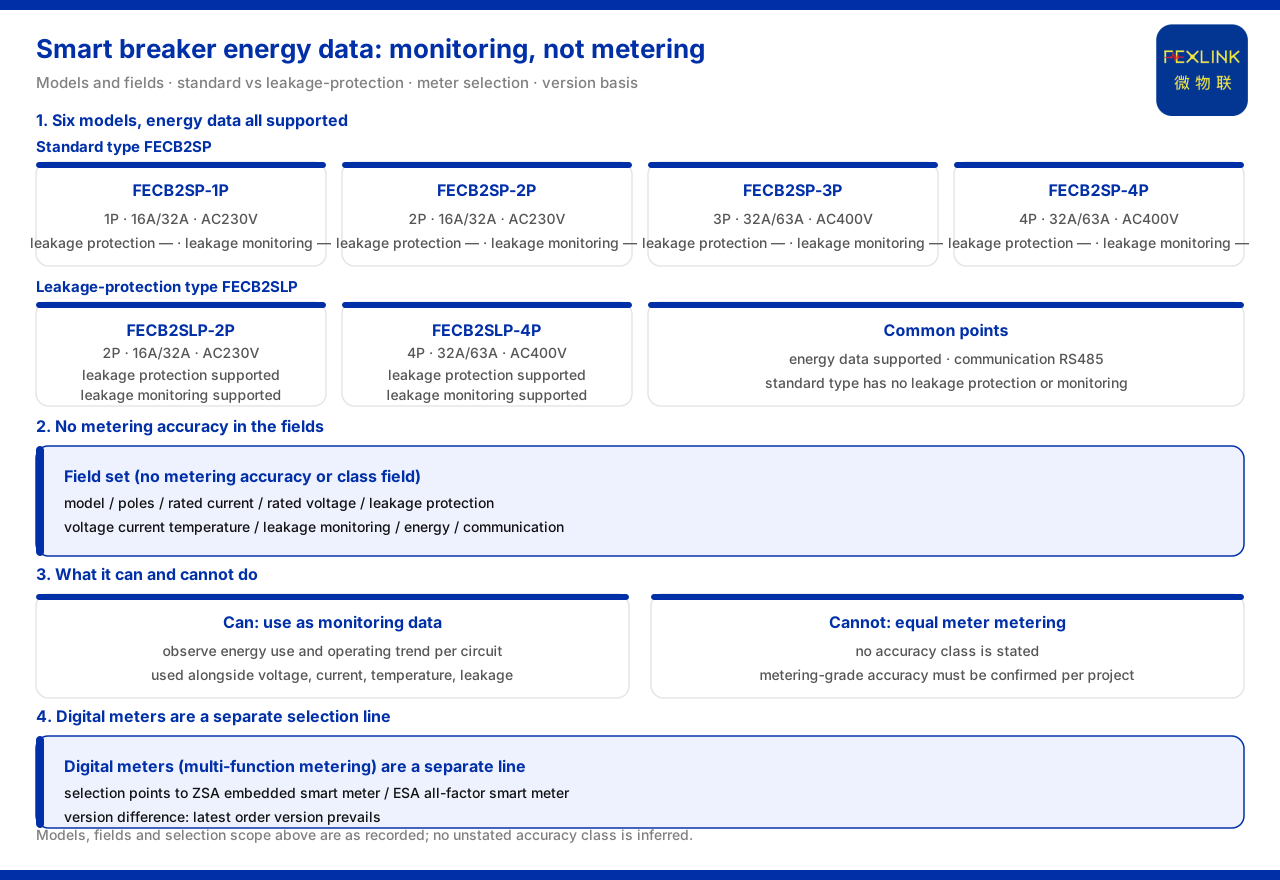
Under the statement of the product material, this question cannot be answered simply "accurate" or "inaccurate". In the table of the intelligent circuit breaker (standard model FECB2SP (e.g. FECB2SP-1P); leakage-protection model FECB2SLP), the "energy" column of all 6 models reads "supported" and the communication is RS485 throughout, showing that the breaker does indeed have an energy-monitoring function; but the field set of the same table does not contain a metering accuracy or accuracy class, and the material gives no accuracy class for the breaker's energy measurement, nor does it claim that it is equivalent to meter metering. The breaker's energy can therefore be used as monitoring data, but if it is to be used as a metering basis, the accuracy must be confirmed separately at the project level. The material also directs the selection of "digital meter (multi-function metering)" to the ZSA embedded multi-function smart meter and the ESA all-parameter smart meter, so the two product lines have separate positioning.
1. First distinguish "supporting energy measurement" from "metering accuracy"
In the intelligent circuit breaker table, "energy" is a functional marker column whose value is "supported". This means the model can collect or record energy data, which is one of its monitoring functions as an intelligent circuit breaker.
"Supported" and "reaching a certain accuracy class" are two different things. The former shows that the function exists; the latter shows that the error range of the function is definitely limited and expressed through a corresponding statement. The product material gives the energy function item in the table but does not give an accuracy class in the same place; therefore, deriving "metering accurate" directly from "energy supported" does not hold. The premise for answering "is it accurate" is first to acknowledge that the material's information on these two points is not symmetrical.
2. There is no accuracy field in the table
The field set of the intelligent circuit breaker table is: model, pole count, rated current, rated voltage, leakage protection, voltage/current/temperature monitoring, leakage monitoring, energy, and communication. It can be seen that this set of fields covers the product's electrical specifications and monitoring capability, but has no metering accuracy or accuracy class field.
The absence of a field is itself a statement. The material lists "energy" as a monitoring-function field rather than as a metering indicator, and it does not claim in the breaker section that this is equivalent to meter metering. This article can therefore state only the boundary shown by the material: the breaker's energy can serve as monitoring data, and if the project requires metering-grade accuracy it should be checked separately rather than assuming the breaker already satisfies it.
3. The correspondence of standard and leakage-protection models
The product material divides the intelligent circuit breaker into a standard model and a leakage-protection model, both with "supported" in the energy column and RS485 communication. The standard model covers 1P, 2P, 3P and 4P: of these, 1P and 2P are 16A/32A, AC230V, with both the leakage-protection and leakage-monitoring columns reading "—"; 3P and 4P are 32A/63A, AC400V, with the leakage-protection and leakage-monitoring columns likewise "—". The leakage-protection model covers 2P and 4P: 2P is 16A/32A, AC230V and 4P is 32A/63A, AC400V, with the leakage-protection, leakage-monitoring and energy columns all "supported". A note below the table further explains that the leakage-protection model includes leakage monitoring and leakage-protection functions, while the standard model does not.
This correspondence answers the question "which model to buy". If the site needs leakage protection and leakage monitoring, one should land on the leakage-protection model; if only the standard model's functions are needed, the standard model corresponds. In either case, however, energy is a "supported" monitoring function; whether leakage-related capability is needed is the main basis for distinguishing the two. The material listing energy as supported on both product types also shows, indirectly, that it is a common monitoring item of the breaker rather than a differentiator between models.
4. Digital meters have a separate selection line
In its selection comparison, the product material lists the selection of "digital meter (multi-function metering)" as the ZSA embedded multi-function smart meter and the ESA all-parameter smart meter. These two product types correspond to the digital-meter selection line.
By contrast, the intelligent circuit breaker belongs to the breaker product line, and its "energy" is a field of the breaker's monitoring function and is not listed in the digital-meter selection. The significance of this distinction is: when the requirement is "multi-function metering", one should follow the selection comparison to a smart meter; when the requirement is "circuit breaking and status monitoring", one lands on the breaker. The two product lines each have their own placement and should not be understood as substitutes for each other. Treating the breaker's energy directly as a meter reading is exactly a usage the material does not support.
5. Version differences and the order statement
The product material records in its known information gaps that the naming of some sheets of the selection manual and the model rule document differ by version, and the latest order version should prevail.
This point is relevant to the energy discussion. Since naming and models differ by version, when checking the energy function, pole count, current and voltage parameters of a specific model, one should rely on the latest order version rather than concluding from a single version of the manual. For a question such as "accurate or not" that requires a definite statement, first confirming the model version relied upon is a necessary step. The material lists this difference truthfully, prompting users to keep version awareness when citing parameters.
6. What energy monitoring can and cannot do
Combining the preceding sections, one can draw the boundary of what the breaker's energy monitoring can and cannot do.
What it can do is be observed as part of the circuit's operating state. The breaker itself handles circuit breaking and protection; energy data, alongside other monitoring items (voltage, current, temperature, leakage and so on), can be used to understand the circuit's energy use and operating trend. For monitoring-oriented scenarios such data is useful, and it is deployed together with the breaker, with RS485 as the uniform access method.
What it cannot do is be used as a metering result with a declared accuracy. The material gives no metering accuracy class and does not list it in the digital-meter selection, so it should not be used directly where a definite metering statement is required. If the project truly needs metering, it should follow the selection comparison to the embedded multi-function smart meter or the all-parameter smart meter, and verify the corresponding accuracy statement separately.
Making this boundary clear is more useful than simply answering "accurate" or "inaccurate": it lets users know in which situations the breaker's energy can be used as monitoring data and in which situations a separate metering product should be found.
Scope and limitations
First, the citations in this article are limited to the product material and the corresponding fact pack, and introduce no certification, accuracy standard or case not listed.
Second, the energy of all 6 models in the intelligent circuit breaker table being "supported" and the communication being RS485 throughout, as well as the pole count, rated current, rated voltage and leakage-protection and leakage-monitoring values of each model, are limited to the material statement.
Third, the material does not give an accuracy class for the breaker's energy measurement, nor claim equivalence to meter metering; this article does not infer its accuracy or whether it can serve as a metering basis.
Fourth, the distinction between the standard model and the leakage-protection model follows the note below the table; this article extends no other model or function.
Fifth, the digital-meter selection is limited to the embedded multi-function smart meter and the all-parameter smart meter listed in the selection comparison; this article does not infer the specific accuracy of the two meter types.
Sixth, model naming differs by version, and the latest order version prevails, limited to the material statement.
Seventh, this article explains only the boundary shown by the material, and provides no selection, metering configuration or accuracy calculation for a specific project.