THD and individual harmonic content: which triggers the alarm first
Direct answer
In the power-quality health check of the Qianzhi engine, harmonics are handled by the M06 to M12 group of sub-models, whose convention covers both 2nd-50th harmonics and acquisition of total harmonic distortion (THD). THD and individual harmonic content are not two competing alarm sources but two classes of indicators under the same harmonic sub-model: THD reflects the overall distortion level, and individual harmonic content is used to locate the specific pollution source. Both participate together in the alarm decision of the D7 time-series risk score (0-100). Therefore, asking "which triggers the alarm first" is not an either/or but a clarification of roles: the overall indicator answers "whether attention is needed", and the component indicator answers "where the problem comes from". Setting them in opposition yields two incomplete conclusions — "watching THD alone is enough" or "watching only one order is enough".
1. What each class of indicator answers
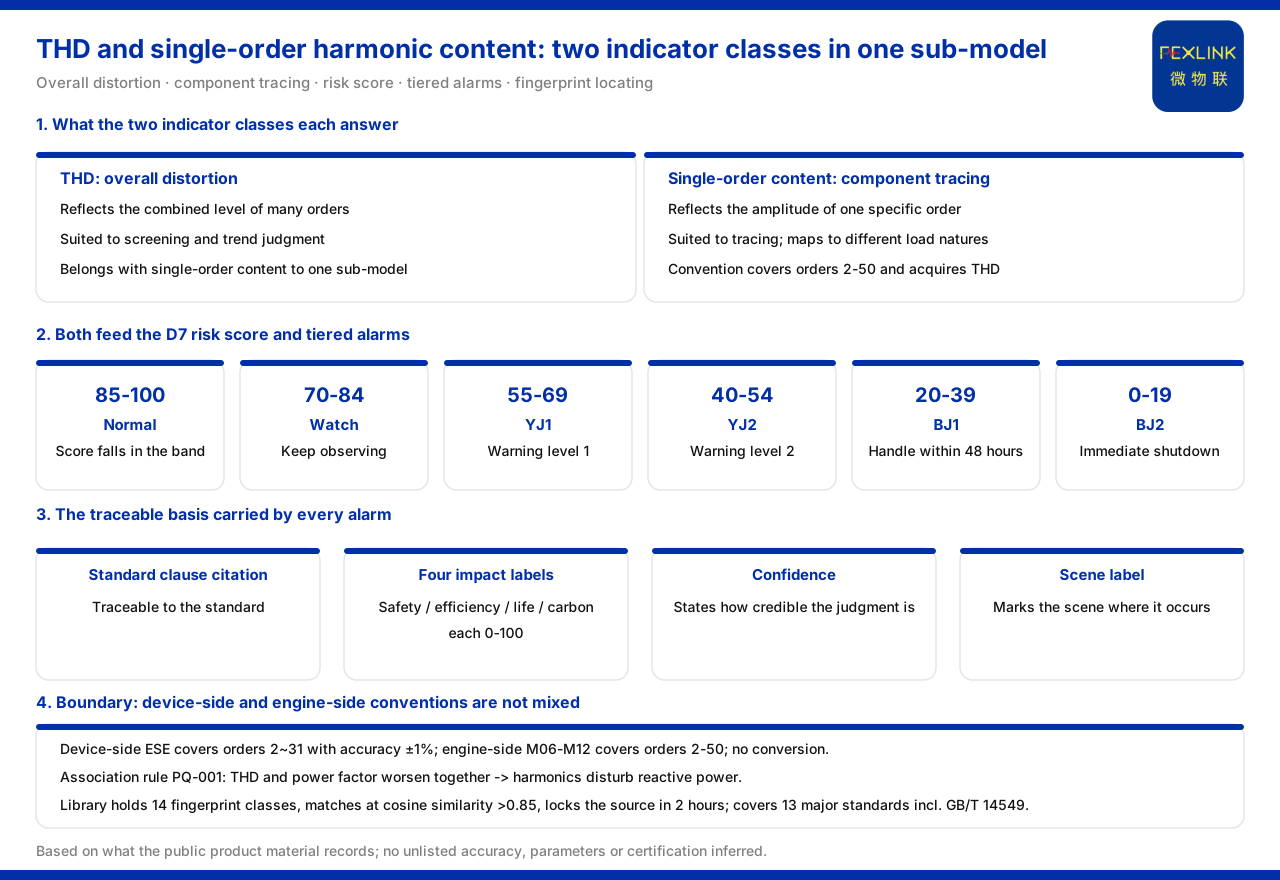
The knowledge base records that the Qianzhi engine's power-quality health check consists of the M06 to M12 group of sub-models, in which the harmonic sub-model covers 2nd-50th harmonics and acquires THD at the same time. THD reflects overall distortion, the composite level after multiple orders are superimposed; individual harmonic content reflects the amplitude level of one specific order. Putting the two conventions in the same sub-model means the same harmonic data can give two classes of results in parallel: one answers whether the whole deviates, and the other answers which orders the deviation mainly consists of.
This division determines their different uses. The overall indicator suits screening and trend judgment, aggregating wide-band distortion into a comparable quantity; the component indicator suits tracing, because different equipment types have different distribution shapes across orders, and which order is high often corresponds to a load of different nature. The knowledge base expresses the former as "reflecting overall distortion" and the latter as "locating the specific pollution source". Note that the 2nd-50th orders are an analysis-side convention describing the coverage of the harmonic sub-model, not a capability label of any field device.
2. How the alarm decision is organized
An alarm is not triggered directly by a single reading. The knowledge base records that the 6-level alarm system of the Qianzhi engine is divided by score intervals: normal 85-100 points, attention Watch 70-84 points, YJ1 55-69 points, YJ2 40-54 points, BJ1 20-39 points requiring handling within 48 hours, and BJ2 0-19 points corresponding to immediate shutdown. THD and individual harmonic content together participate in the D7 time-series risk score (0-100), and that score then falls into the corresponding interval to form a graded result.
Two points follow. First, the alarm output is a composite score, not a hard threshold of "alarm if one harmonic exceeds the limit"; THD and the content of each order are inputs, and the final level is determined by the composite result. Second, handling intensity rises as the score falls, from normal and attention to BJ1 requiring time-limited handling and then BJ2 requiring immediate shutdown, with continuous levels. Therefore, rather than asking which triggers first, both jointly determine which band the score falls into; the level switches only when a change in one item is enough to change the composite score.
3. What evidence each alarm carries
Grading is only the result; the knowledge base also specifies the information each alarm must carry: a standard-clause citation, four-dimensional impact labels (safety, efficiency, lifetime and carbon emissions, each 0-100 points), a confidence level and a scenario label. These show that an alarm is not the phrase "harmonic anomaly" but a decision record traceable to a standard, quantifying impact and giving a confidence level.
This explains the complementary relationship of the two classes of indicators. After THD and individual harmonic content enter the decision separately, their standard bases, impact dimensions and scenarios can be traced separately: overall distortion being high and a specific order being high may differ in standard source and impact emphasis even if they land at the same level. Because each alarm retains these fields, operators can, after receiving one, return to the judgment of "whether it is an overall problem or a component problem" instead of seeing only a composite level.
4. Why power factor must also be combined
Harmonic indicators alone are sometimes insufficient to explain the source and consequence of distortion. The knowledge base records that the Wanxiang engine has established 49 cross-dimensional association rules, of which the first rule of the power-quality series, PQ-001, is expressed as "THD and power factor deteriorating in sync point to harmonic interference with reactive power". This rule means that when overall distortion and power factor change unfavorably at the same time, they should be studied together rather than in isolation.
Putting this rule with the harmonic sub-model gives a more complete reading: THD signals overall distortion, individual harmonic content gives the clue to the pollution source, and the association rule links harmonics with power factor. THD degradation must therefore be studied jointly with power factor, not one order alone, consistent with "THD and individual content jointly participate in the score".
5. From alarm to pollution-source location
After an alarm confirms a harmonic problem, the next step is to locate the pollution source. The knowledge base records that the harmonic fingerprint library contains 14 classes of equipment fingerprints, including FP-01 three-phase rectifier, FP-03 six-pulse inverter, FP-05 UPS, FP-06 charging pile and FP-12 photovoltaic inverter; matching uses a cosine similarity greater than 0.85, locking the pollution source within 2 hours versus several weeks traditionally.
This is where individual harmonic content comes into play. Fingerprint matching compares the distribution shape of each order, not merely the magnitude of overall distortion; even at similar THD levels, distribution differences caused by different loads can be distinguished. Using the overall indicator for screening and the component indicator for fingerprint matching forms a complete chain from "discovering an anomaly" to "locating the source". The device-side convention differs and needs separate explanation.
6. Device-side and engine-side conventions must be viewed separately
The knowledge base records that the ESE power-quality monitor (e.g. ESE-22111-R) adds harmonic monitoring on the basis of phase monitoring, covering 2~31 harmonics with accuracy ±1%. This device-side acquisition convention answers "up to which harmonic can be measured and with what accuracy".
In contrast, the 2-50 order convention of Qianzhi M06 is an algorithm-side decision convention, answering "with what range the power-quality decision is made". The two belong to different product types and uses and must not be mixed, nor may 2~31 and 2-50 be compared as two ratings of one indicator. During selection, first confirm whether field-acquired data or the analysis engine's decision conclusion is needed, then map it to the corresponding convention.
7. Standard coverage
The knowledge base records that the technical specifications of the Qianzhi engine cover 13 major standards including GB/T 12325, GB/T 14549 and GB/T 15543. The GB/T 14549 cited here relates to harmonics in public power grids and falls within that coverage, showing that the decision and limit assessment have a basis source rather than resting only on empirical thresholds.
Common misconceptions
The first is to treat THD and individual harmonic content as either/or; both belong to the same harmonic sub-model and jointly participate in the score, each with a role. The second is to conflate the device-side 2~31 orders with the engine-side 2-50 orders, even comparing capability from them; the two belong to the device side and the algorithm side and cannot be compared directly. The third is to treat an alarm level as the threshold result of a single indicator, ignoring that it results from a composite score falling into an interval. The fourth is to conclude a pollution source from one high harmonic order without fingerprint matching.
Scope and limitations
First, this article restates only what the knowledge base lists: the harmonic sub-model covers 2nd-50th harmonics and acquires THD; THD reflects overall distortion and individual content locates the pollution source; both jointly participate in the D7 time-series risk score (0-100). Second, the 6-level alarm score intervals and handling statements are limited to what the knowledge base lists, without added handling-process details. Third, the standard-clause citation, four-dimensional impact labels (safety, efficiency, lifetime and carbon emissions, each 0-100 points), confidence level and scenario label are limited to the fields listed. Fourth, the 14 fingerprints, the matching threshold of cosine similarity greater than 0.85 and the 2-hour locking convention are limited to what the knowledge base lists; no recognition-accuracy or misjudgment-rate statistics are provided. Fifth, the device-side convention is limited to the 2~31 orders and ±1% accuracy of the power-quality monitor, and the engine-side convention to the coverage items of Qianzhi M06 to M12; the two are not converted. Sixth, standard coverage is limited to the 13 major standards listed. Seventh, this article does not constitute a selection conclusion; specific projects should confirm each item together with field wiring, measurement conditions and compliance requirements.