Direct answer
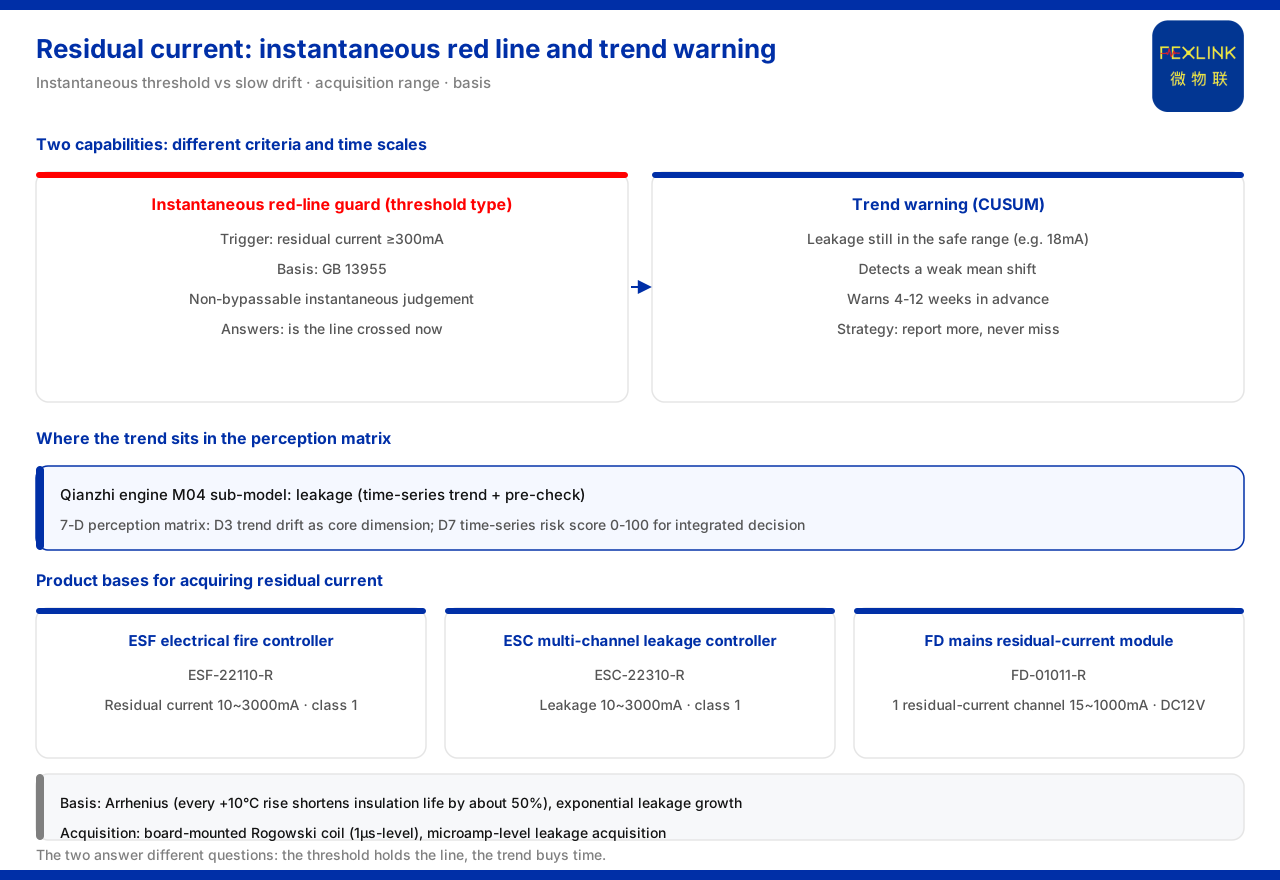
Yes, but the two belong to capabilities on different time scales. The residual-current trend drift of the Tianyan engine S-02, using the CUSUM method, can detect a weak mean shift while the leakage is still in the safe range (e.g. 18mA) and warn 4-12 weeks in advance; the red-line guard, by contrast, takes residual current ≥300mA as its trigger condition and is a non-bypassable instantaneous threshold. The former looks at the slow change of a trend, the latter at the instantaneous magnitude; they do not answer the same question. Trend warning changes the time point at which a hidden hazard is found, and does not replace the instantaneous red line. The distinction matters operationally because the two capabilities are read from different quantities: the threshold is read from a single current value, while the trend is read from a sequence of values against time, so the same device can supply both without either diminishing the other.
1. Threshold alarms look at the instantaneous magnitude
The product material lists residual current ≥300mA as the trigger condition of the red-line guard, with GB 13955 as its basis; this threshold is non-bypassable and is an instantaneous judgement. It answers whether the line has already been crossed at this moment, not whether it is approaching the line. Because the judgement is instantaneous, it is decided by the magnitude of the reading rather than by how that reading has moved over time. A reading below the threshold therefore says nothing about the direction in which the leakage is moving; that is precisely the question the threshold is not designed to answer.
2. Trend warnings look at slow drift
The product material records that the Tianyan engine S-02 residual-current trend drift (CUSUM) can detect a weak mean shift while the leakage is still in the safe range (e.g. 18mA) and warn 4-12 weeks in advance. At that point the value has not yet touched the line, but the trend has already changed. The parameter strategy of this capability is to report more rather than to miss. The 4-12 week lead is the point: it converts a change that would otherwise be noticed only at the threshold into a signal that can be acted on beforehand.
3. The two capabilities operate on different time scales
Putting the two together: the red-line guard is an instantaneous threshold and handles a crossing that has already occurred; S-02 is trend-based early warning and handles a drift that is occurring. The former judges by magnitude, the latter by time-series change. The product material lists the two as capabilities on different time scales, so the trend being earlier than the magnitude refers to lead time, not to a replacement relationship. In other words, the instantaneous threshold and the trend warning can coexist: the former holds the bottom line, the latter buys time for handling. Reading them as alternatives would lose exactly the lead time the trend provides.
4. Where the trend sits in the perception matrix
The product material describes that the Qianzhi engine M04 sub-model is oriented to leakage (time-series trend plus red-line pre-check); its 7-dimensional perception matrix lists D3 trend drift as a core dimension, and D7 time-series risk score uses 0-100 for integrated decision. The trend drift is therefore not an accessory indicator but one of the decision dimensions. Its place in the matrix shows that the trend is treated as a first-class object of evaluation, alongside the instantaneous criteria, rather than as a derivative of them. Listing D3 as a core dimension also means the trend enters the same decision frame as the other dimensions, so an output such as the D7 score is formed with the trend present rather than added after the fact.
5. The product basis for acquiring residual current
A trend judgement needs a usable data source. The bases the product material gives include: the ESF electrical fire monitoring & control device (e.g. ESF-22110-R) and the ESC multi-channel leakage-current monitoring & control device (e.g. ESC-22310-R) both have a residual-current / leakage monitoring range of 10~3000mA (accuracy class 1); the FD mains residual-current monitoring module (e.g. FD-01011-R) has 1 residual-current channel of 15mA~1000mA. Different products have different ranges, and a trend judgement should be built on data acquired within the respective range; it depends on time-series data that is continuously acquired, not on a single reading. A single reading cannot show a mean shift, which is why the acquisition has to be continuous.
6. Theoretical basis and acquisition capability for trend judgement
The product material lists the theoretical bases of the Tianyan engine's predictive analysis, including the Arrhenius equation (for every +10°C rise in temperature, insulation life is shortened by about 50%) and the exponential growth pattern of leakage current; its underlying acquisition capabilities include microamp-level leakage-current acquisition and a board-mounted special-shaped Rogowski coil (1μs-level abnormal-current capture). That the early change of weak leakage can be acquired is the premise on which trend warning holds; if these changes cannot be acquired, even a refined trend method lacks an input. The acquisition capability is therefore not a secondary detail but the condition that makes the trend method usable at all. The theoretical basis explains why a trend is expected to exist, while the acquisition capability explains why it can be observed; a trend method needs both before it can produce an early warning.
Scope and limitations
First, this article explains only the distinction between residual-current threshold alarms and trend warnings; the factual boundary is limited to the product material, and no standard clause, parameter, certification or case not listed there is introduced.
Second, the product material gives no specific CUSUM parameters, false-alarm rate or threshold applicable to a particular site; the statement that the two capabilities belong to different time scales is a general induction drawn from the listed content.
Third, the models and parameters in this article are all as recorded in the material; this article does not infer the specifications or warning effects of unlisted models from them.
Fourth, the specific monitoring scheme and warning threshold must be determined by engineering design in conjunction with the on-site residual-current level; this article provides no setting calculation.