Direct answer
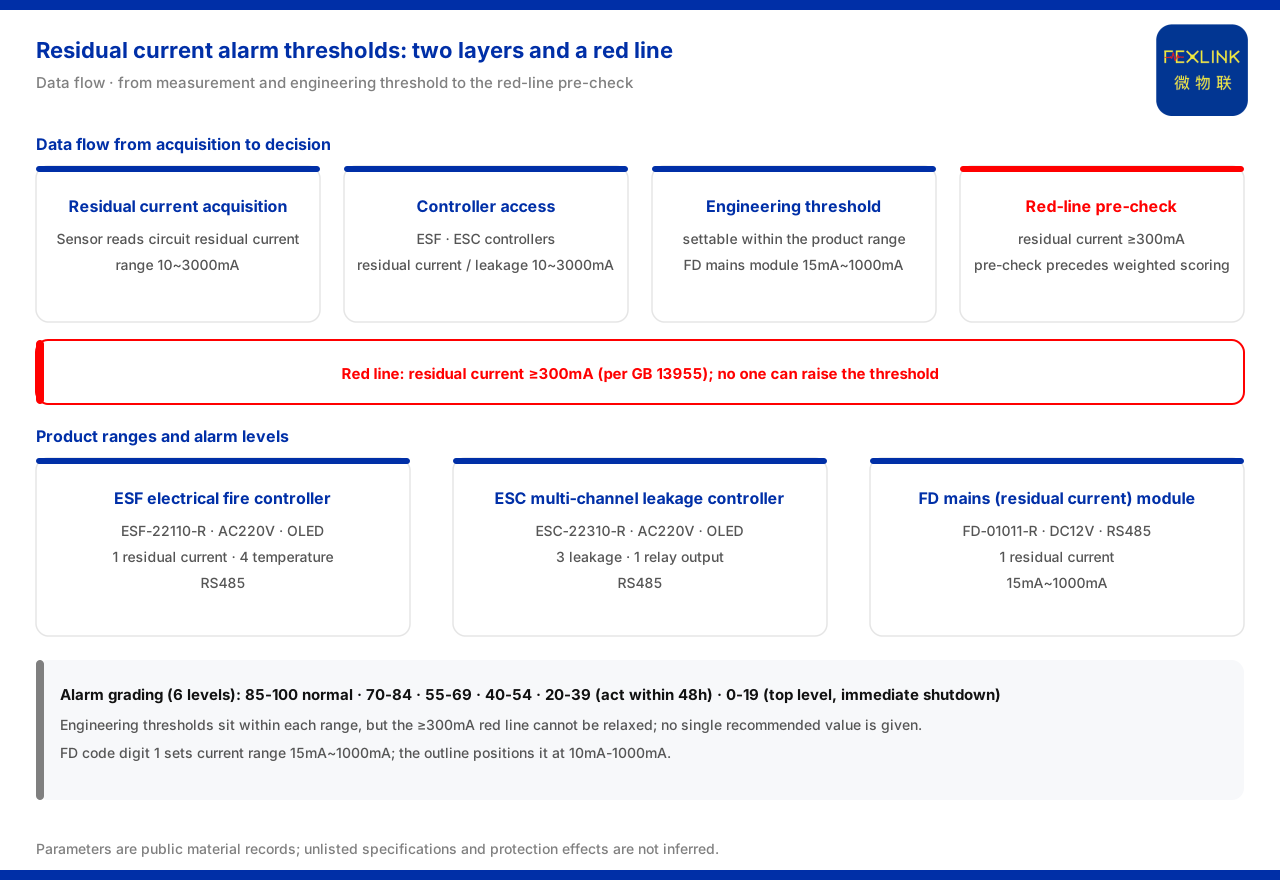
The residual-current alarm threshold has two layers: the engineering threshold can be set within the product range, but the bottom line cannot be relaxed. The product material lists residual current ≥300mA as a non-bypassable safety red line (based on GB 13955), and no one can raise that threshold; when the red line is triggered, the front layer directly outputs the highest-level alarm and skips all weighted computation. The threshold can therefore be set on site, but no setting may relax this red line. The two statements are not in tension: one governs what may be configured, the other governs what may never be configured away.
1. Two layers: the red line is not adjustable, the engineering threshold is
The residual-current threshold is not a limit value that can be freely raised. The product material defines a residual current of ≥300mA as a safety red line and states clearly that no one can raise the threshold; at the same time, the engineering threshold can be set within the product range. The two are boundaries of different nature: the former is a hard condition intercepted at the front layer, the latter an operating parameter configured on site as needed.
The engineering threshold can be adjusted, but it cannot cross the red line. In other words, the red line is a fixed boundary defined by the material and the engineering threshold is a parameter configurable in operation; treating the two as one and the same is what makes the mechanism easy to misread. The adjustable space is real, but it is bounded from above by an entry that the operator cannot move.
2. Why the red line is intercepted at the front layer
The product material states that the standard validation at the front layer (the pre-check preceding the red line) executes before the scoring calculation; once the red line is triggered, the system directly outputs the highest-level alarm and skips all weighted computation. This order means the red line is not affected by later scoring — it is not "remind after computing" but "judge first, alarm first".
It is for this reason that it is called non-bypassable. Placing the safety judgment before scoring also prevents the red line from being diluted by later weights. The correctness of the mechanism depends on this ordering, not merely on the existence of the threshold value. If the check were deferred until after scoring, the same threshold could be overridden by a favourable score, which is exactly what the front-layer placement rules out. The red line is therefore better described as a pre-check than as a high-priority weight: a pre-check decides whether scoring proceeds at all, whereas a weight only influences the result among other weights.
3. The product ranges give the settable range of the engineering threshold
The settable range of the engineering threshold comes from the product range. The ESF electrical fire monitoring & control device (e.g. ESF-22110-R) has a residual-current range of 10~3000mA with accuracy class 1; this model is AC220V, OLED, 1 residual-current channel, 4 temperature channels and RS485. The ESC multi-channel leakage-current monitoring & control device (e.g. ESC-22310-R) has a leakage range of 10~3000mA with accuracy class 1; this model is AC220V, OLED, 3 leakage monitoring channels, 1 relay output and RS485.
The FD mains residual-current monitoring module (e.g. FD-01011-R) has 1 residual-current channel, DC12V and RS485; in its model rule the current-acquisition-range code 1 is 15mA~1000mA, and the product outline positions it as a residual-current monitoring module (10mA-1000mA). All three product classes give a clear range and accuracy basis, and the engineering threshold should fall within the respective range. A threshold set outside a product range is not a threshold that product can enforce, and accuracy class 1 is only meaningful for the range within which it was specified.
4. How alarms are graded
A red-line trigger corresponds to the highest-level alarm. The product material defines a 6-level alarm system, with scoring intervals running from 85-100 (normal) through 70-84, 55-69, 40-54 and 20-39 up to 0-19 (the highest level); the highest level requires immediate shutdown, and the 20-39 level requires handling within 48h. After the residual-current red line is triggered, the system enters this highest level directly, without going through level-by-level weighting.
The point of grading is that different scoring intervals correspond to different handling times and response requirements. The red-line path exists alongside the graded path, and it takes precedence over it. The grading supplies graduated handling for ordinary deterioration; the red line supplies a single immediate response for the condition that must not be graded at all.
5. Boundary of where the threshold is set
Taken together, the engineering threshold can be set within the ranges of the electrical fire monitoring & control device, the multi-channel leakage-current monitoring & control device and the mains residual-current monitoring module, but the ≥300mA safety red line cannot be relaxed. It should be noted that the product material does not give a single recommended engineering threshold; the value to be taken must be determined on site, and this article makes no recommendation of a specific value. The range states where a setting is physically possible; it does not state which setting is correct for a given site.
Scope and limitations
First, this article explains only the layered mechanism of the residual-current alarm threshold; the factual boundary is limited to the product material, and no standard clause, parameter, certification or case not listed there is introduced.
Second, the product material does not give a single recommended engineering threshold or scenario-specific value, and does not permit relaxation of the ≥300mA safety red line; the statement that the engineering threshold must be determined on site is an editorial synthesis.
Third, the models and parameters in this article are all as recorded in the material; this article does not infer the specifications or protection effects of unlisted models from them.
Fourth, actual threshold setting must be determined by engineering design in conjunction with the on-site residual-current level; this article does not provide setting calculations.