How the six-pulse variable-frequency-drive harmonic fingerprint is recognized
Direct answer
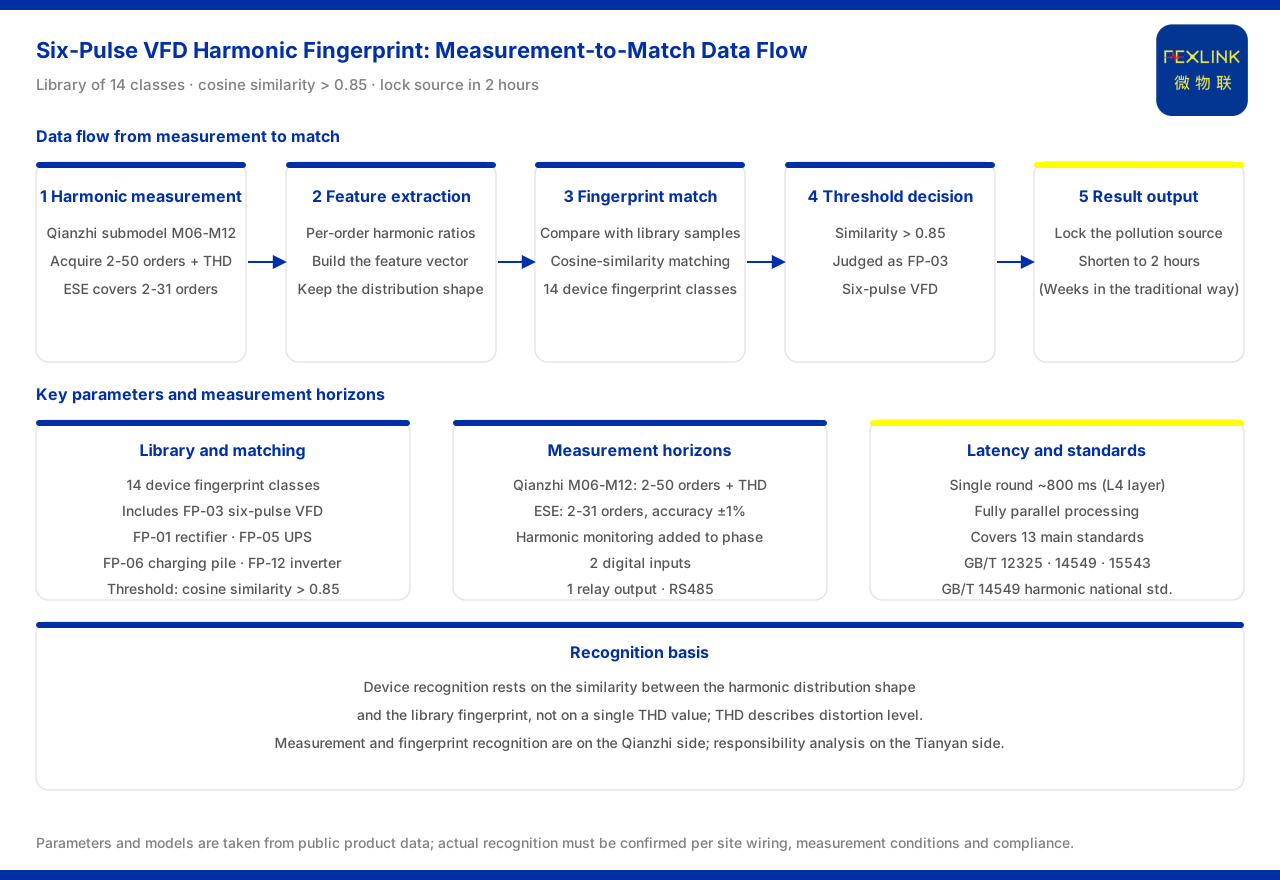
In the harmonic fingerprint library, the six-pulse variable-frequency drive (VFD) is represented by the device fingerprint FP-03. Recognition rests on how closely the characteristic harmonic distribution matches a library sample, not on the magnitude of total harmonic distortion (THD) alone: the system compares the measured harmonic signature with the library fingerprint by cosine similarity, and a similarity greater than 0.85 is judged to be the corresponding device type. Therefore, even when the overall distortion level is not high, a load can still be recognized as a VFD-class load as long as the proportional relationships among the individual harmonics agree with the characteristic distribution of FP-03. This is the practical difference between reading a single distortion index and reading a distribution: two loads can share the same THD while their energy is spread differently across harmonic orders, and it is that spread, not the single number, that carries device identity. On the basis of this fingerprint library, the time to lock a pollution source can be shortened from the weeks of the traditional approach to 2 hours.
Position of FP-03 in the fingerprint library
The Qianzhi engine (Bianwu, V4.1) records 14 classes of device fingerprints in its harmonic fingerprint library, of which FP-03 corresponds to the six-pulse VFD. The same library also contains other device types such as the three-phase rectifier (FP-01), the uninterruptible power supply (UPS, FP-05), the charging pile (FP-06), and the photovoltaic inverter (FP-12). Numbering device types one by one into the library turns "which class of load this is" into an independently retrievable and comparable object, rather than lumping harmonic problems vaguely under "harmonics out of limits." Once a class is an object of its own, a measured signature can be compared against a named entry and the output of the analysis becomes a device type; without that step, the answer can only be a severity statement, which does not say which piece of equipment to act on. The six-pulse VFD is a separate library item because the characteristic harmonic distribution of the rectifier bridge under six-pulse commutation is relatively stable, and distinguishes load types better than a single THD value.
Matching mechanism: cosine similarity
Fingerprint recognition uses cosine-similarity matching, with a matching threshold greater than 0.85. This means the system does not require the measured spectrum to be point-for-point equal to the sample, but compares the directional consistency of the two feature vectors; when the similarity exceeds the threshold, a device-type judgment is issued. The threshold of 0.85 is an engineering compromise between "rather under-report than misjudge easily": too low a threshold would merge different loads into one class, while too high a threshold could miss genuine loads whose shape deviates slightly. The threshold is a matching gate, not a verdict on whether a load is within any operating limit; crossing it means the signature resembles this device class and says nothing about compliance.
Measurement input: the harmonic submodel
Fingerprint comparison needs a measurement input. The power-quality checkup submodel of the Qianzhi engine covers harmonic monitoring, acquiring harmonics from the 2nd to the 50th order and including THD, and provides the data basis for fingerprint matching. Covering the 2nd to the 50th order captures both the low-order characteristic harmonics of rectifier-class loads and retains the shape information of higher-order harmonics; THD is included as an overall distortion index, but it is only one of the inputs and cannot replace the per-order harmonic distribution. In other words, recognizing the six-pulse VFD relies on the combination of "distribution shape plus similarity threshold"; THD describes the distortion level and is not used for device classification. On the monitoring-device side, the ESE power-quality monitor adds harmonic monitoring on top of phase monitoring, covering the 2nd to the 31st harmonic at an accuracy of ±1%, and provides 2 digital inputs, 1 relay output, and an RS485 (Modbus) interface.
Latency and standard coverage
According to the technical specification, a single round of analysis by the Qianzhi engine takes about 800ms (L4 layer), uses fully parallel processing, and covers 13 main standards including GB/T 12325, GB/T 14549, and GB/T 15543. The relatively fast single-round analysis allows fingerprint comparison to be embedded in a continuous monitoring flow rather than performed offline after the fact. Standard coverage provides the basis for harmonic limits and assessment; GB/T 14549 is the harmonic-related national standard and is included in the above coverage list. Based on the harmonic fingerprint library, the pollution source can be located within 2 hours, whereas the traditional approach takes weeks; the time difference comes precisely from the step in which the device type is recognized first.
Selection combination
In the typical application scenarios and selection comparison, the combination for "power quality / harmonic special treatment" is the ESE power-quality monitor or the FSE power-quality controller, together with the harmonic analysis of the Tianyan engine (prediction, V1.0 to V2.0). That is: measurement and fingerprint recognition are borne by the Qianzhi side, and the part involving harmonic responsibility analysis is matched by the Tianyan side. The selection combination gives a capability pairing and does not represent an effect commitment for any specific project.
Scope and limitations
This article answers only "how the six-pulse VFD is recognized in the harmonic fingerprint library." Its content is limited to the fingerprint library entries, matching threshold, harmonic measurement horizon, latency parameters, standard coverage, and selection combination already recorded in the product knowledge base.
This article does not expand the internal details of the fingerprint feature vector (such as the weight of each harmonic or the specific distribution values), as the product knowledge base does not list them; nor does it provide recognition accuracy, misjudgment rate, or any statistical indicator.
The other device fingerprints (such as FP-01, FP-05, FP-06, and FP-12) are mentioned only as items of the same library and are not expanded here.
The parameters in this article are used to explain the mechanism and do not constitute a commitment to the recognition result of a specific site; practical application must be confirmed item by item according to on-site wiring, measurement conditions, and compliance requirements.