Direct Answer
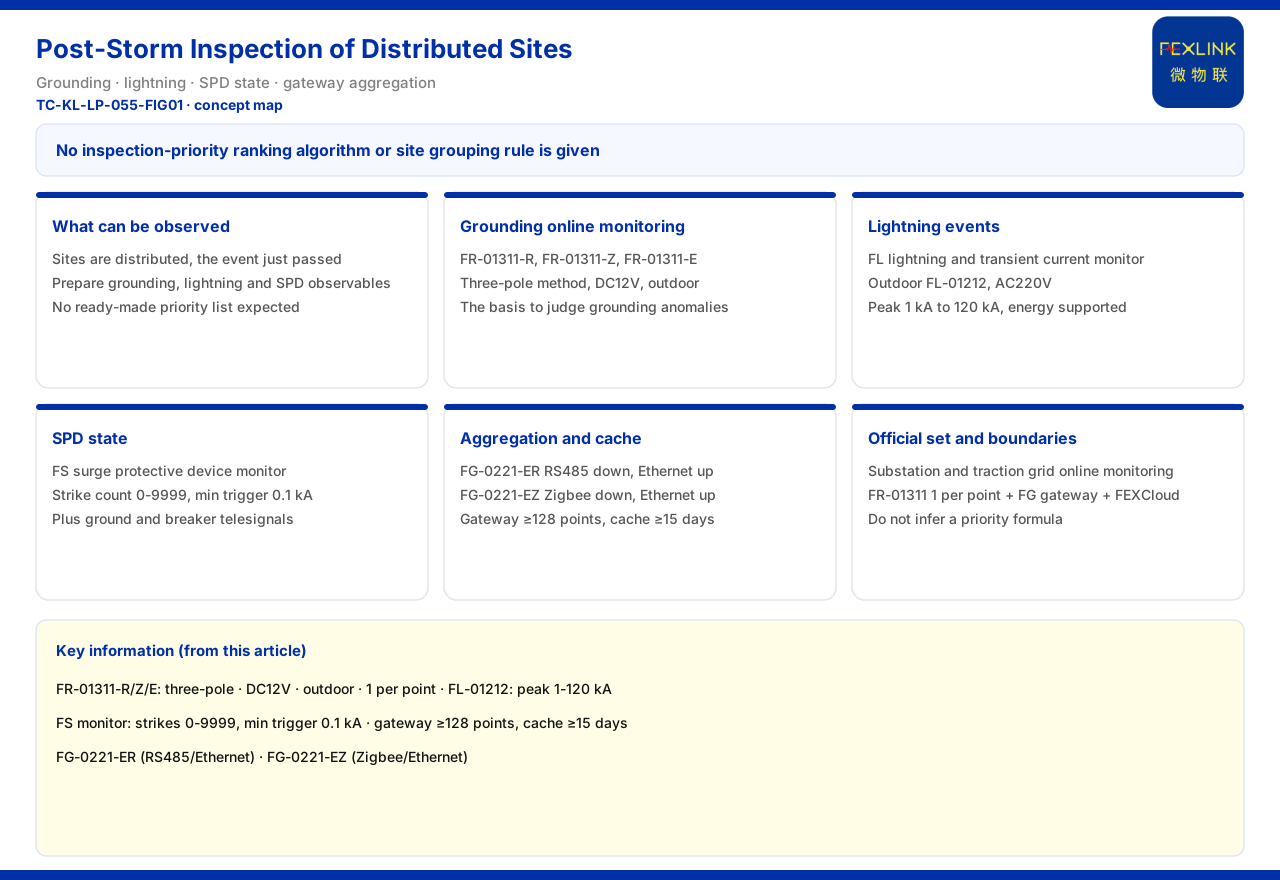
For post-thunderstorm inspection of distributed stations, the product knowledge base provides a set of observable quantities and networking capability rather than an algorithm for inspection priority. The observable quantities include grounding state, monitored online by the grounding resistance monitor (FR-01311-R, FR-01311-Z and FR-01311-E), which uses the three-pole method, DC12V supply and outdoor installation; lightning events, recorded by the lightning current / transient current monitor, for example the outdoor model (FL-01212), with a peak of 1 kA to 120 kA and energy support; and surge protective device status, supplemented by the FS surge protective device monitor, which provides a surge count of 0 to 9999 with a minimum trigger of 0.1 kA, as well as remote signalling such as grounding status and air-switch status. Networking is handled by the lightning-protection smart gateway (FG-0221-ER), which uses RS485 downstream and Ethernet upstream, and FG-0221-EZ, which uses Zigbee downstream and Ethernet upstream; the smart gateway of the grounding resistance monitoring system can mount no fewer than 128 points and can cascade, with no fewer than 4 RS485 channels, no fewer than 2 Ethernet ports, optional 4G 5G LoRa and no less than 15 days of data caching. The official combination is one FR-01311 per point plus the FG gateway plus FEXCloud for the grounding-grid online monitoring of substations and traction substations. It should be noted that the product knowledge base gives no inspection-priority ranking algorithm or station grouping and grading rule, and includes no dedicated chapter on communication-base-station scenarios, so this article cites only the observability and networking capability and does not infer a ranking formula or station-ranking index.
1. After a Thunderstorm, First See What Can Be Observed
The difficulty of post-thunderstorm inspection lies in the fact that stations are distributed, the event has just passed, and a quick judgment is needed of which points deserve priority attention. The product knowledge base handles this by first preparing the observable quantities and only then discussing inspection. It gives three classes of observation, namely grounding, lightning and surge protective device status, and provides the gateway for aggregation and upload. Understanding this avoids expecting the product knowledge base to give a ready-made inspection-priority list, and instead recognizes that it provides the data foundation that supports inspection.
2. Online Monitoring of Grounding State
The product knowledge base records that the grounding resistance monitor (FR-01311-R, FR-01311-Z and FR-01311-E) uses the three-pole method, is supplied at DC12V, is installed outdoors, and communicates over RS485, Zigbee and Ethernet respectively. It can monitor the grounding-grid state of distributed stations online and is the product basis for judging after a thunderstorm whether a station's grounding is abnormal. Grounding anomalies are often related to the discharge path after a lightning strike, so grounding resistance is the first quantity to be read during inspection. The product knowledge base gives no judgment threshold for grounding resistance after a thunderstorm, so this article cites only the online monitoring capability and the parameter figures and does not infer an anomaly criterion.
3. Recording of Lightning Events and the Intensity Basis
Inspection also needs to know whether a lightning strike occurred and how strong it was. The product knowledge base records that the lightning current / transient current monitor, for example the outdoor model (FL-01212), is supplied at AC220V, has a peak of 1 kA to 120 kA and supports energy, and can record station lightning events, providing the basis of lightning presence and intensity for post-thunderstorm station inspection. In other words, lightning records answer "whether this station experienced a lightning strike" rather than directly giving a conclusion about whether grounding was damaged. The product knowledge base gives no correspondence between lightning intensity and equipment damage, so this article cites only the event-recording capability and does not infer a damage criterion.
4. Multi-Factor Supplement to Surge Protective Device Status
Besides grounding and lightning, surge protective device status also forms a basis for inspection. The product knowledge base records that the FS surge protective device monitor provides a surge count of 0 to 9999 with a minimum trigger of 0.1 kA, as well as remote signalling such as grounding status and air-switch status, can supplement the station surge protective device and grounding status, and provides a multi-factor basis for post-thunderstorm inspection. Reading the operation count of the surge protective device together with grounding status gives a more complete picture of the site than looking at a single quantity. The product knowledge base gives no joint judgment rule for multiple factors, so this article cites only the factors themselves and does not infer a combined criterion.
5. Multi-Station Aggregation and Data Preservation
To view distributed stations uniformly, networking and caching are needed. The product knowledge base records that the lightning-protection smart gateways FG-0221-ER and FG-0221-EZ are DC12V and perform protocol conversion, with RS485 and Zigbee downstream respectively and Ethernet upstream, supporting aggregation and upload of distributed-station devices and providing the networking premise for unified multi-station viewing and ranking. The product knowledge base also records that the smart gateway of the grounding resistance monitoring system can mount no fewer than 128 points and can cascade, with no fewer than 4 RS485 channels, no fewer than 2 Ethernet ports, optional 4G 5G LoRa and no less than 15 days of data caching, supporting batch access of distributed stations and resume-after-disconnection. Caching capability means that a short disconnection caused by a thunderstorm will not lose data, which is especially important for after-the-fact inspection. The product knowledge base gives no concrete index for multi-station ranking, so this article cites only the networking and caching capability.
6. The Official Combination and the Investigation Paradigm
Among the typical application scenarios of the product knowledge base, the recommended combination for the grounding-grid online monitoring of substations and traction substations is one grounding resistance monitor FR-01311 per point, the FG gateway and the FEXCloud platform, providing a comparable networking paradigm for inspecting multiple stations or points in batches according to grounding-grid state. This combination covers the chain from field measurement through gateway aggregation to platform presentation. This article cites only the combination itself and does not expand it into a concrete inspection process or priority order.
7. Boundaries That Must Be Held
The above can be gathered into a reading order. The first step is to confirm the three classes of observable-quantity source, namely grounding, lightning and surge protective device status, and their respective models and parameters. The second step is to confirm the networking method and cite the access and caching capability of the FG gateway and the smart gateway. The third step is to confirm the architectural foundation of unified viewing and cite the official combination of FR plus FG plus FEXCloud. The boundary that must be held is that the product knowledge base gives no ranking algorithm for post-thunderstorm station inspection priority or station grouping and grading rule, and includes no dedicated chapter on communication-base-station scenarios, and this article does not infer a priority formula or station-ranking index; the on-site inspection order must be determined separately with reference to operating rules.
Scope and Limitations
First, this article restates only the content listed in the product knowledge base, and its factual boundary is limited to the records of the FR, FG, FL and FS product entries and typical scenarios, without introducing inspection processes or cases not listed in the product knowledge base.
Second, the three-pole method, DC12V supply, outdoor installation and three communication options of the grounding resistance monitor (FR-01311-R, FR-01311-Z, FR-01311-E) are quoted according to the figures listed in the product knowledge base.
Third, the lightning current / transient current monitor (for example the outdoor model FL-01212, peak 1 to 120 kA, AC220V, with energy support) is quoted according to the figures listed in the product knowledge base.
Fourth, the lightning-protection smart gateway (FG-0221-ER and FG-0221-EZ downstream and upstream) and the smart gateway of the grounding resistance monitoring system (mounting no fewer than 128 points, no fewer than 4 RS485 channels, no fewer than 2 Ethernet ports, optional 4G 5G LoRa, caching no less than 15 days) are quoted according to the figures listed in the product knowledge base.
Fifth, the surge count of 0 to 9999, the minimum trigger of 0.1 kA and remote signalling such as grounding status and air-switch status of the FS surge protective device monitor are quoted according to the figures listed in the product knowledge base.
Sixth, the recommended combination for the grounding-grid online monitoring of substations and traction substations is quoted according to the figures listed in the product knowledge base, and this article does not infer project effects from it.
Seventh, the product knowledge base gives no inspection-priority ranking algorithm and includes no dedicated chapter on communication-base-station scenarios, and this article accordingly states that it does not infer a ranking formula or station-ranking index.