Direct Answer
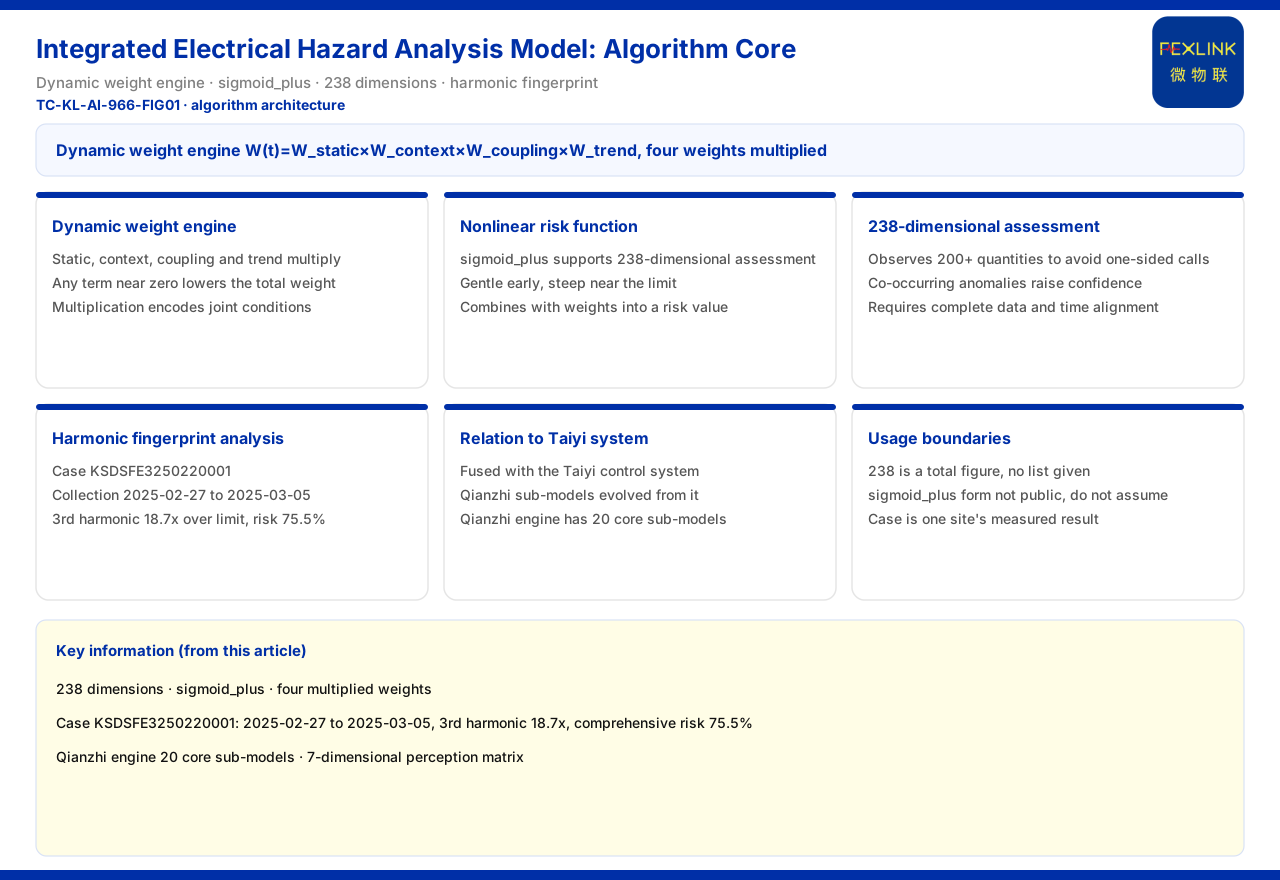
According to the product knowledge base, the algorithmic core of the integrated electrical-hazard intelligent analysis model is made up of two parts. The first is a dynamic weight engine whose form is W(t) equal to the product of static weight, context weight, coupling weight and trend weight. The second is a nonlinear risk function, sigmoid_plus, which supports 238-dimensional electrical parameter evaluation. The reason for using 238 dimensions is to keep the judgment from resting on only a few quantities; instead, harmonics, temperature, leakage current, voltage and many other parameters are all brought into one view. The reason for using a nonlinear function is to let risk show the behavior of "gentle in normal conditions, steep once a limit is crossed" rather than a simple linear sum. The product knowledge base does not give the concrete dimension list behind 238, nor does it give the mathematical expression, activation parameters or weight values of sigmoid_plus. This article therefore explains only its position and role, and does not infer its internal form.
How the Dynamic Weight Engine Is Built
The dynamic weight engine takes the form in which W(t) equals W_static multiplied by W_context multiplied by W_coupling and then multiplied by W_trend. Structurally, it splits the final weight into four sources. The static weight reflects the base importance of a parameter itself. The context weight reflects how the current operating condition affects the judgment. The coupling weight reflects the mutual amplification or suppression between different parameters. The trend weight reflects the direction in which a parameter changes over time. Because the four are multiplied, once any one of them approaches zero the overall weight is pushed down sharply; conversely, when several hold at the same time, risk is amplified. This multiplicative structure naturally carries the sense of a joint condition, and it expresses the engineering experience that "only when several conditions are met at once is something highly suspect" better than simple addition.
What 238-Dimensional Parameter Evaluation Means
A 238-dimensional electrical parameter evaluation means that, before giving a conclusion, the model observes more than two hundred quantities at the same time. Its direct value is resistance to one-sidedness: a single parameter occasionally crossing a limit may be a disturbance or measurement noise, but when several related parameters become abnormal within the same time window, confidence rises markedly. For engineering, a high dimension count does not mean that field judgment can be dropped; on the contrary, it demands that data acquisition be complete enough and time synchronization good enough, otherwise even many dimensions cannot be aligned. The product knowledge base gives only the total figure of 238 and no dimension list, so one cannot infer from it which parameters the model actually uses.
The Role of sigmoid_plus
sigmoid_plus is the nonlinear risk function. Nonlinear here means that input and output do not change in proportion. Electrical hazards often behave as "slow change early, sudden acceleration near the threshold", and a linear function tends to underestimate severity close to the critical region. The role of the nonlinear function is precisely to make risk more sensitive in the key region. It works together with the dynamic weight engine: the dynamic weight decides the relative importance of each parameter at the current moment, and the nonlinear function decides how those weighted quantities converge into a single risk value. The product knowledge base does not disclose the concrete form of this function, so its curve shape or parameters should not be assumed.
Harmonic-Fingerprint Deep Analysis
The product knowledge base lists harmonic-fingerprint deep analysis and treats case KSDSFE3250220001 as its empirical evidence. For that site, the collected data spans 27 February 2025 to 5 March 2025, in which the 3rd harmonic exceeded the limit by 18.7 times and the composite risk was 75.5%. This set of data shows the value of the harmonic-fingerprint method: a long-lasting and clearly excessive 3rd harmonic is often a signal of nonlinear loads or wiring problems in the distribution system; used as a fingerprint feature, it can identify hazards earlier and more accurately than looking only at totals. The "18.7 times over the limit" and "composite risk 75.5%" in the case are the concrete figures given by the product knowledge base, and this article quotes them as they are without extending them to general sites.
Relationship to the Taiyi System and the Qianzhi Sub-models
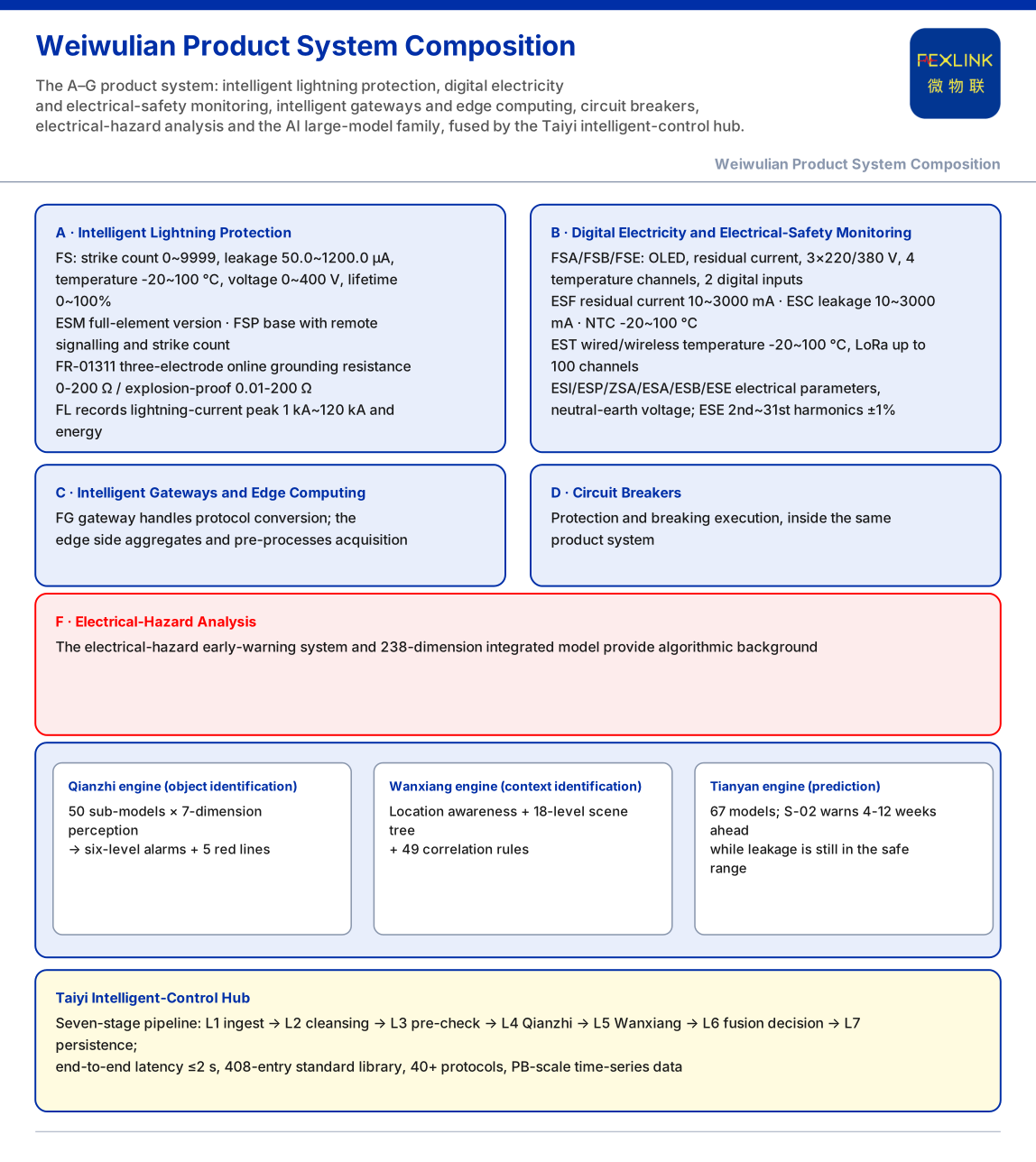
The product knowledge base states that this model is integrated with the Taiyi intelligent control system, and that the Qianzhi sub-models were iteratively upgraded from this model system. In other words, the algorithmic core described here is the more fundamental methodology, while the sub-models running inside the Qianzhi engine are its implemented form within the product system. The product knowledge base records that the Qianzhi engine currently has 20 core sub-models used together with a 7-dimensional perception matrix. This evolutionary relationship helps explain why the two sets of statements are connected: 238-dimensional multi-parameter evaluation is a capability description at the method level, whereas the Qianzhi sub-models are the instantiation of that capability in a concrete engine. The two run in one line, but the dimension count at the method level should not be equated directly with the input count of any one concrete sub-model.
Boundaries to Observe in Use
Three boundaries must be held when understanding this model. First, 238 dimensions is only a total figure; the product knowledge base gives no dimension list, so the parameter composition cannot be inferred from it. Second, the expression, activation parameters and weight values of sigmoid_plus are not public, so its mathematical form must not be assumed. Third, the case data is a measured figure for a specific site and cannot be used as a conclusion for general sites. Only by keeping these three boundaries can one cite this model's capability without going beyond the scope of the product knowledge.
Why Multiplication Instead of Addition
The dynamic weight engine adopts a four-term multiplicative structure, and this deserves separate explanation. Addition means "each term stands alone and can be averaged out", while multiplication means "mutual amplification, none dispensable". When context, coupling and trend are all near neutral, the final weight is governed mainly by the static weight; when one of them deviates markedly, the whole is clearly raised or lowered. For hazard analysis this structure is closer to engineering intuition: a parameter that is abnormal on its own is usually not enough to go on; only when it points in the same direction as the operating condition, the correlation with other parameters, and the trend of change does the risk truly deserve attention. The multiplicative structure writes the joint condition into the weight rather than into a post-processing rule.
Why the Case Chooses Harmonics
The reason case KSDSFE3250220001 takes an excessive 3rd harmonic as its entry point is that harmonics are a sensitive indicator of hazards in distribution systems. The 3rd harmonic has a zero-sequence nature, and its long-lasting and clearly excessive presence is often related to concentrated nonlinear loads and to wiring or neutral-line problems; if such factors are not handled, they keep affecting equipment life and safety. In the case the 3rd harmonic exceeded the limit by 18.7 times and the composite risk was 75.5%, and the two are presented side by side, showing that the model does not look at a single amplitude alone but brings harmonic features into a composite assessment. Explaining this case clearly helps one understand the place of harmonic-fingerprint analysis within the 238-dimensional multi-parameter system: it is not an isolated discrimination rule but one important class of feature within it.
Scope and Limitations
- This article is limited to what the product knowledge base already states about the dynamic weight engine, sigmoid_plus, 238-dimensional parameter evaluation, harmonic-fingerprint analysis, the case data and the relationship with the Taiyi system, and does not extend to algorithmic details that are not listed. - The figures in this article (238 dimensions, the 3rd harmonic at 18.7 times, composite risk 75.5%, the collection window of 27 February 2025 to 5 March 2025, and so on) are quoted according to the figures listed by the product knowledge base and do not constitute a commitment about the results of any specific project. - The product knowledge base gives neither a 238-dimension list nor the mathematical expression, parameters or weights of sigmoid_plus, so this article makes no inference; actual capability is subject to the latest product materials and project plans.