Direct Answer
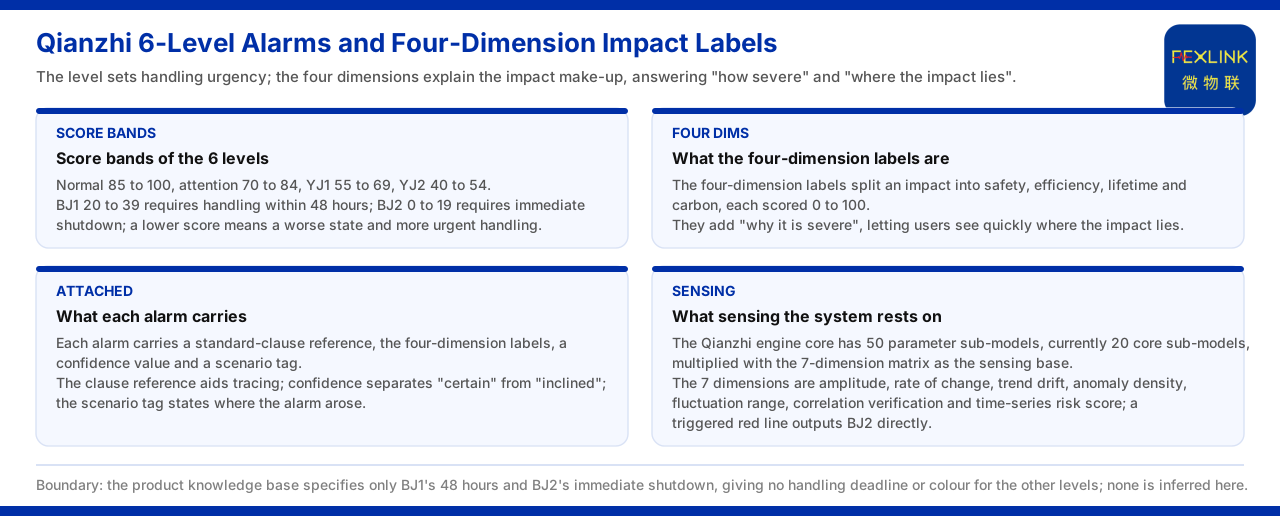
The 6-level alarm system of the Qianzhi engine is a set of rules mapping a comprehensive score to a handling level, and the four-dimensional impact label is a 0-to-100 impact score for each alarm across the four directions of safety, efficiency, lifetime and carbon emission. According to the product knowledge base, the six levels from high to low are: normal (85 to 100), attention (70 to 84), YJ1 (55 to 69), YJ2 (40 to 54), BJ1 (20 to 39, handled within 48 hours), and BJ2 (0 to 19, immediate shutdown). Each alarm simultaneously carries a standard-clause reference, a four-dimensional impact label, a confidence level and a scene label. Together the two answer the questions "how serious" and "where the impact lies": the level sets the weight of handling, and the four-dimensional label explains the composition of the impact. The product knowledge base makes clear only the 48-hour handling time limit of BJ1 and the immediate shutdown of BJ2, and gives no handling time limit or colour definition for the other levels.
The Score Bands of the 6-Level Alarm
The core of the 6-level system is a set of score bands. The normal band is from 85 to 100, indicating a good overall state; the attention band is from 70 to 84, indicating something to watch but not yet a clear risk; YJ1 is from 55 to 69 and YJ2 from 40 to 54, which are intermediate bands requiring further assessment; BJ1 is from 20 to 39 and explicitly requires handling within 48 hours; BJ2 is from 0 to 19 and requires immediate shutdown. The lower the score, the worse the state and the more urgent the handling. Binding a level to an explicit handling action is the key to the operability of this system: the site does not need to judge for itself "whether 20 counts as serious", because the rule has already given the corresponding action.
What the Four-Dimensional Impact Label Is
The four-dimensional impact label splits the impact of a hidden risk into the four dimensions of safety, efficiency, lifetime and carbon emission, each scored from 0 to 100. Its role is not to replace the level but to supplement "why it is serious". Two alarms in the same level may have completely different impact directions: one mainly presses on safety, another mainly damages lifetime. The four-dimensional label lets users quickly see where the impact falls, so that they can trade off among different handling strategies. For an operation and maintenance manager, this is more valuable for decisions than looking at a single total score, because it separates "severity" and "type of impact" into two pieces of information that can be used separately.
What Else Each Alarm Carries
Besides the four-dimensional label, the product knowledge base states that each alarm also carries a standard-clause reference, a confidence level and a scene label. The standard-clause reference ties the alarm to its basis standard, facilitating traceability and re-check; the confidence level expresses the reliability of the conclusion, reminding the user to distinguish "certain" from "tending"; the scene label states under what scene the alarm occurred. These four kinds of information, together with the 6-level grade, form the complete description of an alarm. For engineering personnel this means an alarm is no longer just a red dot but a set of explainable and checkable information.
What Perception the Alarm System Is Built On
The 6-level alarm does not score out of thin air; it is built on a parameter-level perception system. The product knowledge base records that the core architecture of the Qianzhi engine is 50 parameter sub-models, currently 20 core sub-models, multiplied with the 7-dimensional perception matrix to form the perception basis. The 20 sub-models fall into three groups: basic vital signs, power-quality physical examination, and deep hidden-risk mining. The 7-dimensional perception includes amplitude, rate of change, trend drift, anomaly density, fluctuation amplitude, correlation verification and time-series risk score, in which the time-series risk score gives 0 to 100 and shares the same source as the score of the 6-level alarm. Understanding this relationship shows that the alarm score is not an isolated output but the result of multi-dimensional perception converging.
The Link between the Safety Red-Line and the Highest-Level Alarm
The product knowledge base states that, in the standard-verification step of the front-end layer, when the safety red-line pre-check triggers it outputs the highest-level alarm BJ2 directly and skips weighted computation. This is consistent with the highest level BJ2 in the 6-level system, and shows how the safety red-line links to graded alarms: an ordinary hidden risk is mapped to a certain level after multi-dimensional perception, while a case touching the safety baseline lands directly at the highest level. This design keeps the red-line from being diluted by the weighting of intermediate levels and ensures that the output for the most serious case is certain.
Boundaries to Note in Use
When using this system, two boundaries must be held. First, in the 6-level system the product knowledge base makes clear only the handling requirements of BJ1 and BJ2; the handling time limits and colour definitions of the other levels are not given, so they should not be filled in on one's own or promised externally. Second, the score of the four-dimensional impact label is an expression of the degree of impact and should not be read as a commitment to the outcome of a specific project. Using the level to determine the weight of handling and the four-dimensional label to identify the direction of impact is the most prudent way to use this system.
What Each of the 7-Dimensional Perceptions Looks At
The score of the 6-level alarm comes from the 7-dimensional perception, and understanding these seven dimensions helps judge the credibility of the score. Amplitude perception looks at the current size of a parameter; rate-of-change perception looks at how fast it changes per unit time; trend-drift perception focuses on a slow but persistent directional shift, which the product knowledge base marks as the core dimension; anomaly-density perception counts how frequently abnormal events occur; fluctuation-amplitude perception measures the instability of a parameter; correlation-verification perception checks whether different parameters corroborate each other; and the time-series risk score gives a composite score from 0 to 100 and shares the same source as the score of the 6-level alarm. Putting the seven together, one can see that they look at "the present", at "the trend", and at "whether the parameters support each other", which is more complete than single-parameter threshold judgement.
The Three Groups of the 20 Sub-Models
The product knowledge base divides the 20 core sub-models into three groups: basic vital signs, power-quality physical examination, and deep hidden-risk mining. The first group solves "is the device still alive and is its basic state normal"; the second group solves problems at the power-quality level, such as harmonics and imbalance; the third group faces deeper combined hidden risks that can only be found through multi-parameter association. The division of these three groups explains why an alarm may come from different levels: sometimes a basic quantity is abnormal, sometimes a power-quality problem, sometimes a deep hidden risk. If the user can roughly judge which group an alarm comes from, it is easier to understand its nature and handling priority.
How the Four-Dimensional Label Is Used for Decisions
The four-dimensional impact label splits the impact into the four directions of safety, efficiency, lifetime and carbon emission, each from 0 to 100. For decisions it has at least three uses. First, to distinguish priority: between two alarms both falling in YJ2, the one with the higher safety score should be handled first. Second, to guide the handling method: an impact dominated by lifetime may be better suited to planned maintenance, while one dominated by safety tends toward immediate risk control. Third, for communication: setting out the composition of the impact clearly makes it easier for different roles to reach agreement than merely saying "very serious". It should be noted that the four-dimensional score is an expression of impact, not a commitment to consequences, and it should be used as a decision aid rather than the sole basis.
Applicability and Limits
- The content of this article is limited to the product knowledge base's existing statements on the 6-level alarm score bands, the four-dimensional impact label, the information carried by an alarm, the 20 core sub-models and 7-dimensional perception, and the link with the safety red-line, and does not extend to algorithm details not listed. - The values in the text (the score bands of each level, the 48 hours of BJ1, the immediate shutdown of BJ2, the 20 core sub-models, the 7-dimensional perception, 0 to 100, etc.) are cited under the listed convention and do not constitute an effect commitment for a specific project. - The product knowledge base gives no handling time limit or colour definition for the normal, attention, YJ1 and YJ2 levels, and this article makes no inference; actual capability is subject to the latest product documents and project scheme.