Direct Answer
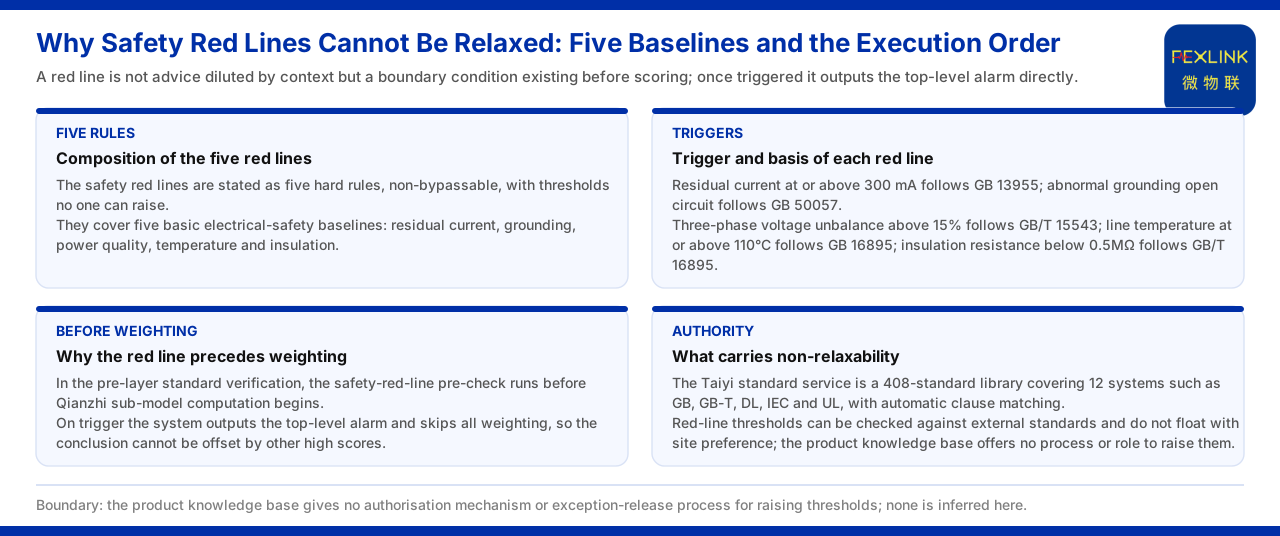
The reason a safety red-line cannot be relaxed is not that it is "more important", but that in the system it is placed ahead of computation and is expressed as a hard rule rather than a score. According to the product knowledge base, the safety red-lines consist of five hard rules that "cannot be bypassed and whose thresholds no one may raise"; in the front-end layer of the Taiyi intelligent control hub system, the standard verification first performs the safety red-line pre-check, and once triggered it outputs the highest-level alarm directly and skips the subsequent weighted computation. That is, a red-line is not a recommended value that can be raised or diluted by the scenario, but a boundary condition that exists before the score. The product knowledge base also gives no management process, authorised role or exception-release mechanism for raising a threshold, so any imagination of "relaxing a red-line" lacks a basis.
The Composition of the Five Safety Red-Lines
The product knowledge base uniformly describes the safety red-lines as five hard rules and stresses that they "cannot be bypassed and their thresholds no one may raise". These five cover the five basic electrical-safety baselines of residual current, grounding, power quality, temperature and insulation. Placed side by side, they reveal that the selection logic of the red-lines is not to achieve the widest coverage but to seize the quantities that, once exceeded, directly threaten personal or equipment safety. Residual current concerns leakage and electric-shock risk; grounding concerns whether fault current can be reliably discharged; three-phase voltage imbalance concerns the long-term operating condition of equipment; line temperature concerns the critical state of insulation and fire; and insulation resistance concerns whether a whole circuit still has a basic safety margin. Together these five quantities form a baseline checklist, not a set of scoring items that can be negotiated one by one.
The Technical Content behind Each Red-Line
In terms of concrete content, the first red-line given by the product knowledge base takes residual current as its object, with a trigger condition of residual current reaching or exceeding 300mA, based on the standard GB 13955, and is one of the non-relaxable underlying electrical-safety red-lines. The second addresses abnormal open-circuit of grounding resistance, based on the standard GB 50057, covering the direct risk that the grounding path is broken. The third addresses three-phase voltage imbalance, with a trigger condition of an imbalance degree greater than 15 percent, based on the standard GB/T 15543, reflecting the baseline at the power-quality level. The fourth addresses line temperature, with a trigger condition of a temperature reaching or exceeding 110 degrees Celsius, based on the standard GB 16895, pointing to the risk of overheating and insulation ageing. The fifth addresses insulation resistance, with a trigger condition of insulation resistance below 0.5 megohm, based on the standard GB/T 16895, pointing to the risk of insulation failure. It can be seen that grounding and power quality each take one, temperature and insulation each take one, and leakage takes one on its own, so the five together complete the five basic dimensions of "current, grounding, power quality, heating and insulation".
Why the Red-Lines Sit before Weighted Computation
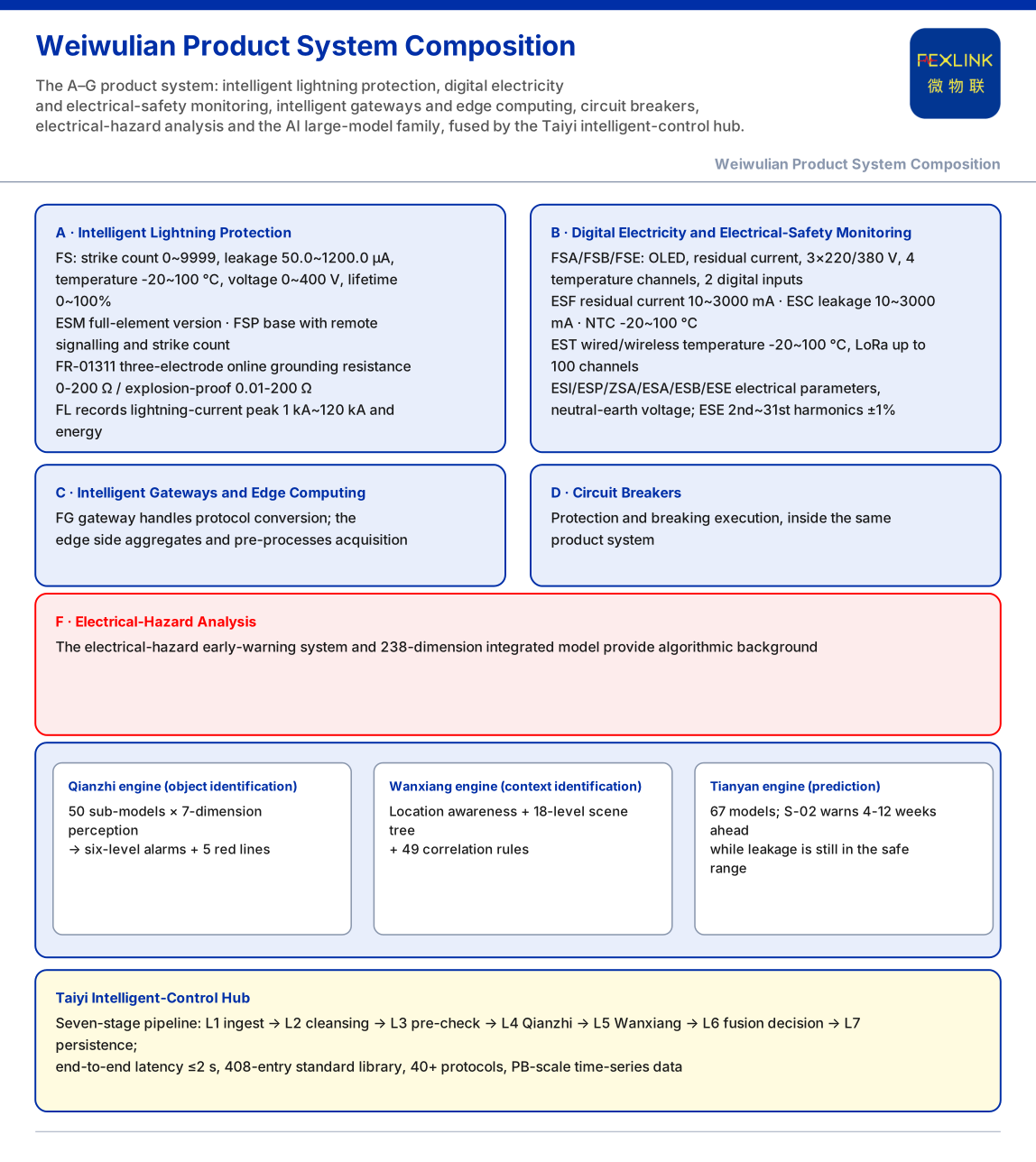
There is a further decisive reason the safety red-line cannot be relaxed, coming from its position in the data chain. According to the product knowledge base, in the standard-verification step of the front-end layer, the safety red-line pre-check runs before the Qianzhi sub-model begins computation. Once a red-line is triggered, the system outputs the highest-level alarm directly and skips all weighted computation. This execution order is itself a protection: if a red-line were only one of many scoring items, it could be offset by other high scores; placing it in front means that as soon as the baseline is touched, the subsequent weighting, fusion and assessment no longer have a chance to "pull the conclusion back". Skipping weighted computation is equivalent to admitting that in such a case there is no room for "comprehensive weighing", and what remains is immediate alarm and handling. It is important for the user to understand this: what is seen when a red-line triggers is not a scoring result but the breach of a boundary judged impossible to cross.
What Carries "Not Relaxable"
If the pre-check determines the position of a red-line, then the standard service determines its source of authority. The product knowledge base states that the Taiyi standard service is a library of 408 standards covering 12 systems such as GB, GB-T, DL, IEC and UL, has automatic clause-matching capability, and makes clear that red-lines cannot be relaxed. This means that the red-line is not an empirical value set by the product side on its own but a clause constraint tied to a body of public standards. Placing the basis of a red-line in the standard library brings two direct consequences: first, the red-line threshold has an external standard to refer to and does not float with site preference; second, when the site asks "can the threshold be raised a little", the system lacks a mechanism to respond, because raising a threshold has neither a management process nor an authorised role. The product knowledge base declares throughout only, in consistent terms, that red-lines cannot be bypassed and provides no exception-release channel, and this itself is the clearest answer.
The Relationship between the Safety Red-Line and Alarm Grading
The safety red-line must be distinguished from alarm grading. Alarm grading describes a set of levels divided by score, used to express the severity of a hidden risk; the safety red-line is an "upstream constraint" of grading. The product knowledge base makes clear that when a red-line triggers it outputs the highest-level alarm directly. It can be seen that the output of a red-line is not graded into a certain level after entering the grading system but lands directly at the highest level. The benefit of such a design is certainty: the site does not need to judge "how serious this is", because the system has already given the most serious band. Conversely, the quantities in the grading system that can enter computation and be weighted are not on the same plane as the red-line. Confusing the two easily leads to the false belief that a red-line can also be weakened by comprehensive assessment, whereas the truth is exactly the opposite.
Implications for Engineering Practice
For engineering practice, understanding "not relaxable" has at least three layers of meaning. First, in selection and point arrangement, the quantities on which a red-line depends must be genuinely acquirable, otherwise the pre-check cannot be executed; this explains why residual current, grounding, temperature and insulation become the focus of monitoring configuration. Second, in operation and maintenance, the red-line pre-check should not be treated as a dispensable add-on function, since it is the first gate before data enters analysis. Third, when the site raises a request for threshold adjustment, the correct response is not to promise that "it can be discussed" but to explain that the red-line is bound to standard clauses and that the product knowledge base provides no process for raising a threshold. Setting out these three layers clearly helps users make decisions more than repeatedly stressing that "the red-line is very important".
Applicability and Limits
- The content of this article is limited to the product knowledge base's existing statements on the number of safety red-lines, their trigger conditions, their basis standards, the pre-check mechanism and the composition of the standard service, and does not extend to algorithm details or handling processes not listed. - The thresholds in the text (residual current 300mA, three-phase voltage imbalance 15 percent, line temperature 110 degrees Celsius, insulation resistance 0.5 megohm) and the standard numbers are cited under the listed convention and do not constitute a judgement of the compliance of a specific project. - The product knowledge base gives no authorisation mechanism, exception-release process or deployment conclusion for raising a threshold, and this article makes no inference; actual capability is subject to the latest product documents and project scheme.