Direct Answer
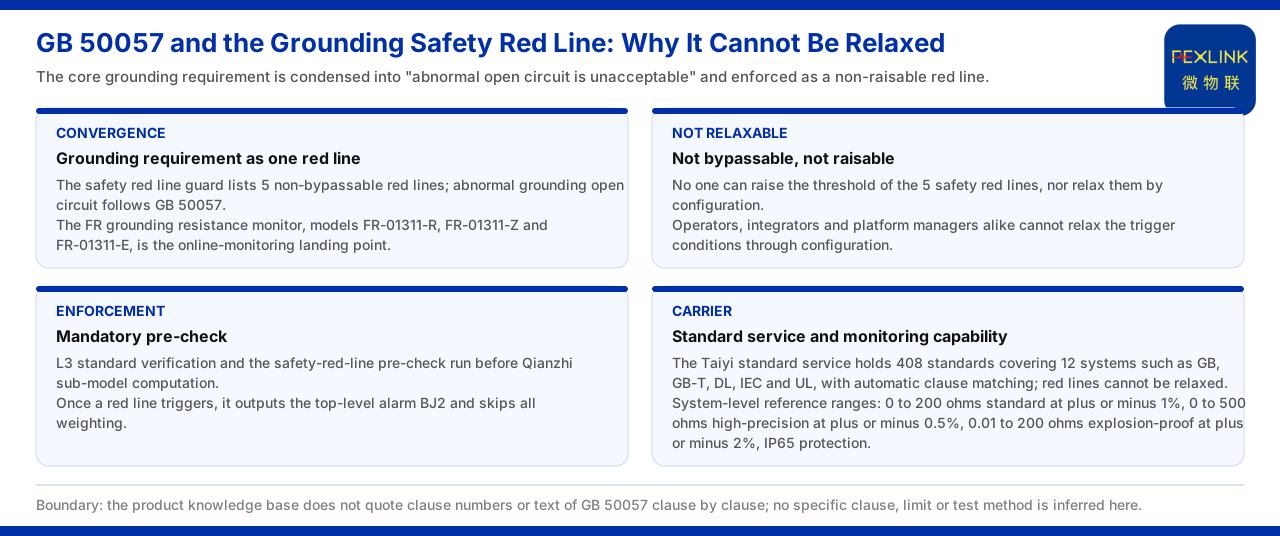
The requirement that GB 50057 places on grounding is condensed, in the product knowledge base, into a single sentence: an abnormal open-circuit of grounding is unacceptable. The product knowledge base lists "abnormal open-circuit of grounding resistance" as a safety red-line, with GB 50057 as the basis; there are five such safety red-lines in total, no one may raise their thresholds, and they cannot be relaxed through configuration. There are two implementing mechanisms. First, the safety red-line pre-check runs before the Qianzhi sub-model computation; once triggered it outputs the highest-level alarm BJ2 and skips weighted computation. Second, the standard service of the Taiyi intelligent control hub system has a built-in library of 408 standards covering 12 systems such as GB, GB-T, DL, IEC and UL, supports automatic clause matching, and its red-lines cannot be relaxed. It should be noted that the product knowledge base does not quote the clause numbers or the text of GB 50057 clause by clause, so this article cites only the fact that it is referenced as the basis of a safety red-line and does not infer specific clauses, limits or test methods.
1. Why the Grounding Requirement Is Condensed into One Safety Red-Line
The product knowledge base records that the safety red-line guard lists five red-lines that cannot be bypassed, one of which is "abnormal open-circuit of grounding resistance", based on the standard GB 50057. Condensing the core grounding requirement into "an abnormal open-circuit is unacceptable" expresses a baseline-style statement: it does not seek to move every clause of the whole standard into the system, but fixes the part of the standard that is least tolerant of breach as a red-line. Landing on the product side, the grounding resistance monitor has the models FR-01311-R, FR-01311-Z and FR-01311-E, uses the three-pole method, has a DC12V supply, is installed outdoors, and communicates over RS485, Zigbee and Ethernet respectively, forming the product landing point for online monitoring of that grounding requirement.
2. The Safety Red-Line Cannot Be Bypassed or Relaxed
The product knowledge base makes clear that no one may raise the threshold of the five safety red-lines. The key to this statement is "no one": it strips the red-line completely away from configurable process parameters. Whether an operator, an integrator or a platform administrator, none can relax the trigger condition of a red-line by adjusting configuration. For grounding, this means that "abnormal open-circuit of grounding resistance" does not take part in the ordinary threshold-setting process, and its result does not change with the preference of the user. This article cites only this property, does not restate its concrete trigger value, and does not infer any relaxation method beyond the trigger condition.
3. The Enforcement Mechanism of the Pre-Check
How the safety red-line is executed is given by the product knowledge base through its position in the flow. The product knowledge base records that, in the front-end layer, the L3 standard verification and the safety red-line pre-check run before the Qianzhi sub-model computation; once a red-line is triggered, the highest-level alarm BJ2 is output directly and all weighted computation is skipped, expressed as "the national-standard baseline is never breached". It can therefore be confirmed that the red-line judgement sits at the front of the analysis chain, ahead of any trend or weighted computation. That is, the judgement of an abnormal open-circuit of grounding does not depend on the weighted result of a later model but is intercepted before the model. This order itself is the technical expression of the grounding requirement of GB 50057 being enforced.
4. The Standard Service Is the Landing Carrier of the Requirement
The product knowledge base records that the standard service of the Taiyi intelligent control hub system, namely the compliance red-line, has a built-in library of 408 standards covering 12 systems such as GB, GB-T, DL, IEC and UL, supports automatic clause matching, and its red-lines cannot be relaxed. This record shows that grounding-related national-standard requirements do not exist in isolation but are brought into a broader standard-library system for unified reference and matching. The treatment of red-lines by the standard service is still "not relaxable", consistent with the safety red-line property described above. The product knowledge base gives no clause-by-clause list of the 408-standard library and does not list the concrete clause numbers of GB 50057, so this article cites only the scale of the library, its system coverage and its matching method, and does not complete the clause content.
5. The Relationship between System-Level Reference Parameters and Compliance Monitoring
The grounding resistance monitoring system of the product knowledge base gives system-level reference parameters: the monitoring unit has a standard type with a range of 0 to 200 ohm and an accuracy of plus or minus one percent; a high-accuracy type with a range of 0 to 500 ohm and an accuracy of plus or minus zero point five percent; and an explosion-proof type with a range of 0.01 to 200 ohm and an accuracy of plus or minus two percent; the protection rating is IP65. These parameters provide a system-level convention for reference in achieving grounding compliance monitoring. What must be distinguished is that range and accuracy are monitoring-capability parameters while the safety red-line is a judgement rule, and the two are not on the same level: the former says what range the system can measure, the latter says what result is unacceptable. Range and accuracy therefore cannot be treated as the red-line threshold, and the red-line is not relaxed because the range is widened or the accuracy improved.
6. Boundaries That Must Be Held
The above can be reduced to a reading order. First, confirm that the grounding requirement is referenced in the product knowledge base as the safety red-line "abnormal open-circuit of grounding resistance", with GB 50057 as the basis. Second, confirm that these five safety red-lines cannot be bypassed or relaxed. Third, understand that their enforcement mechanism is the L3 pre-check, ahead of the sub-model computation and outputting BJ2. Fourth, if the standard-reference system is involved, return to the 408-standard library and the 12 systems of the Taiyi standard service. Fifth, if monitoring capability is involved, cite the grounding resistance monitor models and the system-level range and accuracy parameters. The boundary that must be held is this: the product knowledge base does not quote the clause numbers or clause text of GB 50057 clause by clause, nor does it give the list of the 408-standard library, so this article does not infer their concrete clauses, limits or test methods.
Applicability and Limits
- This article restates only what the product knowledge base lists; its factual boundary is the records of the safety red-line guard, the front-end flow, the Taiyi standard service and the grounding resistance monitor, and it introduces no standard clause or case not listed there. - The safety red-line "abnormal open-circuit of grounding resistance" and its GB 50057 basis, the non-bypassable nature of the five safety red-lines, and the statement that no one may raise the threshold are cited under the listed convention; concrete trigger values are not restated. - The L3 standard verification and the safety red-line pre-check running before the Qianzhi sub-model computation, triggering BJ2 and skipping weighting are cited under the listed convention; no other judgement order beyond the red-line is inferred from them. - The 408-standard library, the 12 standard systems, automatic clause matching and the non-relaxable red-line of the Taiyi standard service are cited under the listed convention; the library list is not completed here. - The models of the grounding resistance monitor (FR-01311-R, FR-01311-Z, FR-01311-E), the three-pole method, DC12V supply, outdoor installation and three communication options, as well as the system-level range, accuracy and IP65, are cited under the listed convention; accuracy or certification not listed is not added. - The product knowledge base does not quote the clause numbers or clause text of GB 50057 clause by clause, and this article accordingly declares that it does not infer their concrete clauses, limits or test methods. - This article does not constitute a commitment to the compliance judgement of a specific project; the current formal text of the standards and the latest product documents prevail in practice.