Direct Answer
For an abrupt change in grounding resistance, the boundary drawn by the product knowledge base is clear. It lists "abnormal open-circuit of grounding resistance" as a safety red-line, with GB 50057 as the basis, and states that such a safety red-line cannot be bypassed and that no one may raise its threshold. If the abrupt change already amounts to an abnormal open-circuit, it should be handled at the safety red-line level first, without passing through trend-weighted computation. The product knowledge base gives no dedicated numerical criterion for an "abrupt change in grounding resistance", meaning it defines no rate-of-change threshold, no magnitude of change and no time window, so no concrete threshold may be inferred from it. What it can support is a judgement framework: first identify the TN, TT or IT grounding type, then use the rate-of-change and trend-drift dimensions of the 7-dimensional perception matrix to separate an abrupt change from a slow drift, and finally land on the 6-level alarm system.
1. Confirm First That the Object Is Grounding Resistance
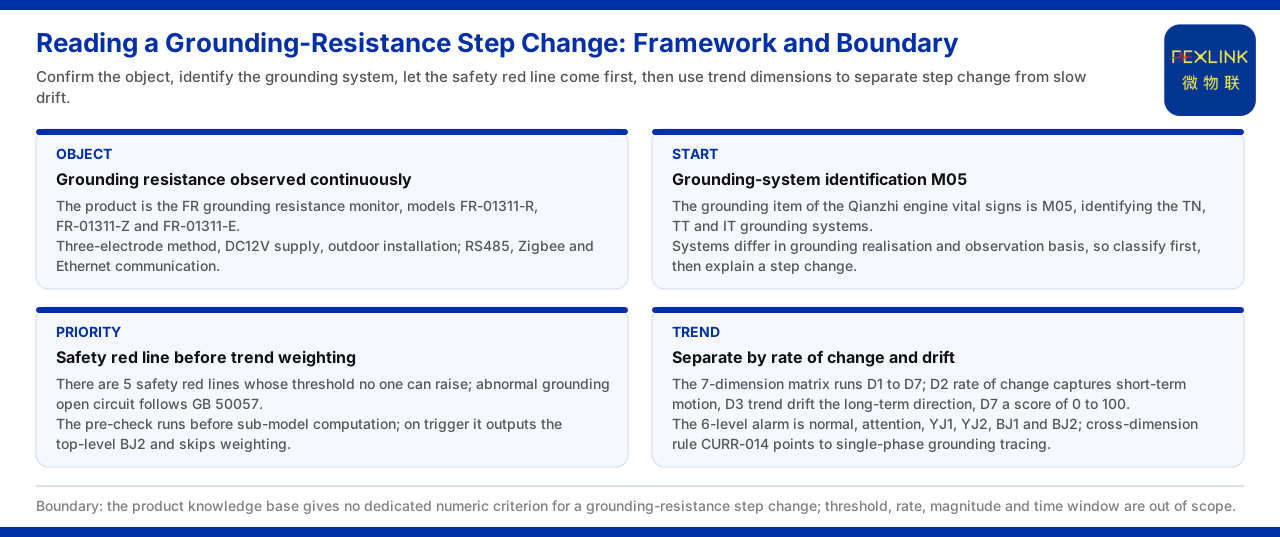
The first step in judging an abrupt change in grounding resistance is to confirm the object. The product knowledge base records that the grounding resistance monitor has the models FR-01311-R, FR-01311-Z and FR-01311-E, uses the three-pole method, has a DC12V supply, is installed outdoors, and communicates over RS485, Zigbee and Ethernet respectively. In other words, grounding resistance is a quantity observed continuously online, and this provides the data entry point for discovering an "abrupt change". An abrupt change describes the shape of the resistance value over time, not its absolute size at a single moment; without a continuous observation series there is no way to separate an abrupt change from a slow drift. Before discussing judgement, therefore, the product landing point must be made clear: it is the grounding resistance monitor, and the data source is that instrument's acquisition of the grounding-grid resistance, not neutral-to-ground voltage or any other quantity.
2. Grounding-Type Identification Is the Starting Point of Perception
The product knowledge base records that, among the basic vital signs of the Qianzhi engine, the grounding item is M05, used to identify the TN, TT and IT grounding types. This shows that grounding-type judgement does not start from a number but first completes type identification, places the grounding form into an existing classification, and only then distinguishes change patterns on that basis. Different grounding types have different implementation methods and observation conventions, and without classifying first, later interpretation of an "abrupt change" easily loses its reference. Placing M05 at the starting point of perception also means that the reading of a grounding resistance monitor has to be understood together with the grounding type of the system it sits in, rather than treating a single resistance figure in isolation.
3. The Safety Red-Line Takes Priority over Trend Weighting
What needs to be explained first in abrupt-change judgement is the position of the safety red-line. The product knowledge base records that the safety red-line guard has five red-lines that cannot be bypassed, among which "abnormal open-circuit of grounding resistance" is based on GB 50057, and that no one may raise the threshold of these five safety red-lines. It also records that the pre-check of the safety red-line runs before the Qianzhi sub-model computation; once the red-line is triggered, the highest-level alarm BJ2 is output directly and all weighted computation is skipped, expressed as "the national-standard baseline is never breached". This establishes an important reading order: when an abrupt change already amounts to an abnormal open-circuit, the judgement need not go through trend weighting first but should be intercepted directly at the safety red-line level. In other words, the safety red-line is not a configurable process parameter but a mandatory baseline.
4. Use Rate of Change and Trend Drift to Separate Abrupt Change from Slow Drift
Beyond the safety red-line, separating an abrupt change from a slow drift belongs to trend-type judgement. The product knowledge base records that the 7-dimensional perception matrix contains D1 amplitude, D2 rate of change, D3 trend drift, D4 anomaly density, D5 fluctuation amplitude, D6 correlation verification and D7 time-series risk score, in which D3 trend drift is marked as the core dimension and D7 is a score from 0 to 100; the 6-level alarm system is normal, attention, YJ1, YJ2, BJ1 and BJ2. For an abrupt change, D2 rate of change describes short-term variation and D3 trend drift describes long-term direction. The product knowledge base gives no numerical division between the two, so this article cites only the division of roles and does not infer a concrete threshold. What can be confirmed is that an abrupt change corresponds to fast short-term variation while a slow drift corresponds to slow long-term drift, and the two are carried by different dimensions of the matrix.
5. Cross-Dimensional Association Offers Clues for Root-Cause Investigation
The product knowledge base records that the Wanxiang engine contains 49 cross-dimensional association rules distributed over five domains, among which CURR-014 is "continuous zero-sequence current to single-phase grounding tracing". This rule shows that grounding-type anomalies can be traced toward the root cause through cross-dimensional association, without looking only at a single resistance reading. For an abrupt change in grounding resistance, this means the judgement is not limited to deciding "whether it changed" but can also look back, together with related dimensions such as zero-sequence current, to see whether it points to a certain kind of grounding event. The product knowledge base gives no dedicated linkage logic between this rule and abrupt-change judgement, so this article cites only the existence and direction of the association rule and does not add a reasoning chain that is not listed.
6. Boundaries That Must Be Held
The above can be reduced to a reading order. First, confirm that the observed object is grounding resistance, with the FR series grounding resistance monitor as the product landing point. Second, perform TN, TT and IT grounding-type identification first. Third, if the abrupt change amounts to an abnormal open-circuit, handle it directly at the safety red-line level without entering trend weighting. Fourth, if an abrupt change must be separated from a slow drift, cite the two dimensions of D2 rate of change and D3 trend drift and land on the 6-level alarm. Fifth, if a root cause must be investigated, cite the cross-dimensional association rule framework. The boundary that must be held is this: the product knowledge base gives no dedicated numerical criterion for an abrupt change in grounding resistance, so the abrupt-change threshold, the rate-of-change threshold, the magnitude of change and the time window are all outside the scope of citation, and field judgement must be determined separately against formal standards and measured data.
Applicability and Limits
- This article restates only what the product knowledge base lists; its factual boundary is the model and parameters of the grounding resistance monitor and the records of the Qianzhi engine and the Wanxiang engine, and it introduces no standard clause, parameter or case not listed there. - The three-pole method, DC12V supply, outdoor installation and three communication options of the grounding resistance monitor (FR-01311-R, FR-01311-Z, FR-01311-E) are cited under the listed convention; resistance range and accuracy are not added. - The grounding-type identification takes the TN, TT and IT convention of M05; the division of roles in the 7-dimensional perception matrix and the 6-level alarm system are cited as listed, and unknown numerical values are not restated. - The safety red-line "abnormal open-circuit of grounding resistance", the non-bypassable nature of the five safety red-lines, and the pre-check that runs before the sub-model computation and outputs BJ2 are cited under the listed convention; concrete trigger values are not restated and no concrete abrupt-change threshold is inferred. - The direction of the cross-dimensional association rule CURR-014 is cited as listed, and its reasoning chain is not completed here. - The product knowledge base gives no dedicated numerical criterion for an abrupt change in grounding resistance, and this article accordingly declares that it provides only a judgement framework and no concrete threshold. - This article does not constitute a commitment to the diagnosis or system integration of a specific project; the latest product documents and formal files prevail in practice.