Direct answer
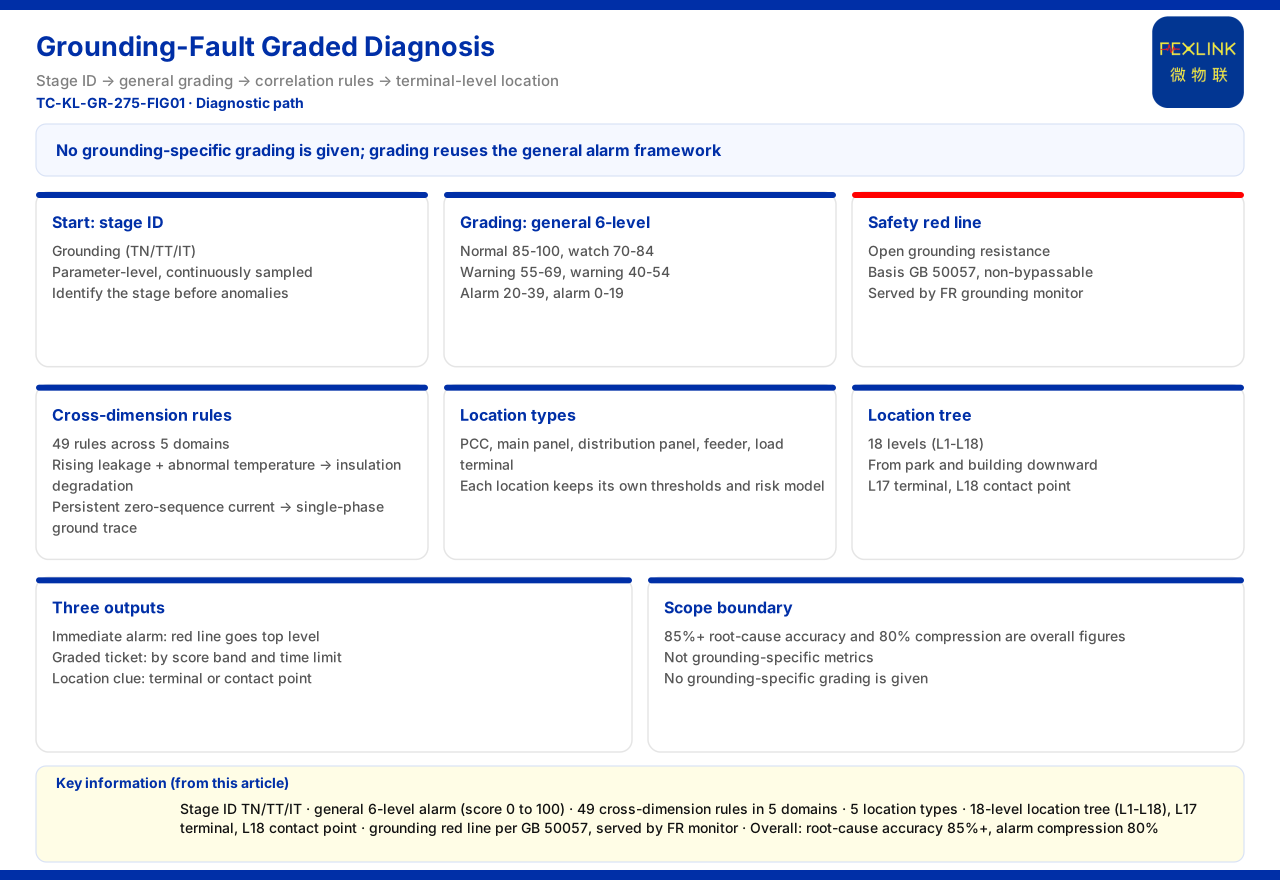
Graded diagnosis of a grounding fault can be understood as a path of identify first, locate next, judge last. The Qianzhi engine in the product material gives grounding (TN, TT and IT system identification) among the basic vital signs, which is the starting point of parameter-level perception; the Wanxiang engine provides an 18-level scenario-location tree that can locate step by step from park and building down to the wiring-terminal level and the contact-point level. A grounding fault is first identified in nature through system type and anomaly, then its range is narrowed with scenario location, and finally the root cause is judged with cross-dimension correlation rules. Note that the product material does not give a grounding-fault-specific grading definition, and grading still follows the general alarm framework.
1. First identify the grounding system: the starting point of diagnosis
A grounding fault differs from other electrical anomalies in that its manifestation is closely related to the grounding system. The product material lists grounding (TN, TT and IT identification) as one of the basic vital signs, showing that the first step of diagnosis is to confirm which grounding system the site uses. The fault-current path and anomaly signature differ by system, and without identifying the system first, subsequent judgement easily loses focus. The product material places this item in the parameter-level perception layer, meaning system identification is continuously collected and updated, not a one-off site label. Diagnosis starts from system identification, and only then is the degree and location of the anomaly discussed.
2. The grading framework uses the general six-level alarm
The severity of a grounding anomaly is expressed by the product material through the general six-level alarm system: normal 85 to 100, watch 70 to 84, level-1 pre-warning 55 to 69, level-2 pre-warning 40 to 54, level-1 alarm 20 to 39 requiring disposition within 48 hours, and level-2 alarm 0 to 19 requiring immediate shutdown. That is, a grounding fault is not given a separate set of level names but is brought into the same scoring framework. The benefit is that different faults can be compared laterally and the disposition time limit has a uniform basis. It should be made clear that the product material gives no independent grading definition specific to grounding faults, so a grounding-specific level must not be named by oneself.
3. From parameter-level anomaly to cross-dimension correlation
A single parameter is often insufficient to judge the nature of a grounding fault, so the product material gives cross-dimension correlation rules. The Wanxiang engine contains 49 cross-dimension correlation rules distributed across 5 domains, among them a rule that rising leakage current combined with a temperature anomaly points to comprehensive insulation degradation, and a rule that a persistent zero-sequence current points to single-phase grounding tracing. These rules show that the judgement of a grounding-type fault is not an isolated look at grounding resistance alone but an analysis that places leakage current, temperature, zero-sequence current and other dimensions together. During diagnosis one should first confirm that the relevant dimensions are all collected, then merge according to the correlation relationship, avoiding a conclusion from a single parameter alone.
4. Graded judgement by electrical topology position
The same anomaly at different positions carries different risk meaning. The product material gives 5 electrical topology position types, namely grid-connection point, main distribution cabinet, distribution cabinet, feeder and load terminal, and states that each position maintains an independent threshold and risk model. For a grounding fault this means diagnosis cannot use one threshold set alone: an anomaly near the supply side and one near the load end differ in impact range and disposition priority. The diagnosis flow should first determine the position type where the anomaly occurs, then apply that position's threshold and model for grading. This design in the product material effectively binds where it is to how serious it is in the judgement.
5. The 18-level scenario tree pushes location to terminal level
After the position type is determined, the range can be narrowed further. The Wanxiang engine in the product material gives an 18-level scenario-location tree that can go down step by step from park and building to level 17, the wiring-terminal level, and level 18, the contact-point level, for example locating a particular outgoing terminal of a workshop power cabinet. For grounding-fault diagnosis, the value of such hierarchical location is to advance from there is a grounding anomaly in some area to a particular terminal or contact point needs inspection, thereby guiding on-site troubleshooting. The scenario-location precision recorded in the product material is the wiring-terminal level and the contact-point level, which can serve as the boundary of location capability; finer positions are outside the listed range.
6. Safety red-lines and monitoring landing points
When a grounding anomaly reaches the safety red-line degree, the diagnosis priority is raised directly. The product material lists abnormal open of grounding resistance as one of the safety red-lines, based on GB 50057, which once triggered outputs the highest-level alarm corresponding to the lowest score tier and cannot be bypassed. The monitoring landing point of this safety red-line is the FR grounding resistance monitor (e.g. FR-01311-R), which shows that for graded diagnosis to truly land, the front end must be able to collect grounding resistance. In the diagnosis flow, if the safety red-line is triggered, it should be handled directly as the highest-level alarm and no longer enter ordinary weighted ranking; if not triggered, judgement continues according to the above correlation and position rules.
7. The material gives no grounding-specific grading
The boundary should be made clear: the product material gives no independent grading definition specific to grounding faults, such as level-1, level-2 or grounding-specific level names; the root-cause accuracy of 85% or more and the alarm compression of 80% are overall quantitative figures of the Wanxiang engine, not grounding-specific indicators. One must therefore not infer a grounding-fault-specific grading or a separate accuracy from the product material. Diagnosis should use the general six-level framework and the correlation rules, and quote the overall quantitative figures as they stand without extrapolation.
8. How the diagnosis conclusion turns into handling actions
Turning a diagnosis conclusion into handling requires distinguishing three kinds of output. The first is an immediate alarm: when a grounding anomaly reaches the safety red-line degree, handle it directly as the highest-level alarm and arrange an inspection immediately. The second is a graded work order: when the safety red-line is not reached, arrange troubleshooting by the score bands and disposition time limits given by the general six levels. The third is a location clue: use the terminal-level or contact-point-level position output by the scenario tree as the starting point for on-site troubleshooting to reduce blind patrolling. The product material gives no dedicated handling flow for grounding faults, so these three kinds of output should be determined in conjunction with the project's O&M system; the material provides the capability basis for grading, location and correlation judgement, not a handling template.
Scope and limitations
First, this article explains only the general path of graded diagnosis of a grounding fault; the factual boundary is limited to the product material, and no parameter, standard or certification not listed there is introduced.
Second, the system identification, scenario levels, correlation rules, position types and quantitative figures here are as recorded in the product material; this article does not infer unlisted capabilities from them.
Third, the product material gives no grounding-fault-specific grading; the diagnosis path here is a method induction from the listed facts and does not represent a dedicated decision standard given by the material.
Fourth, the diagnosis and location of a specific grounding fault must be determined in conjunction with on-site grounding conditions, collection configuration and O&M requirements; this article provides no fault diagnosis conclusion or engineering calculation.