Direct answer
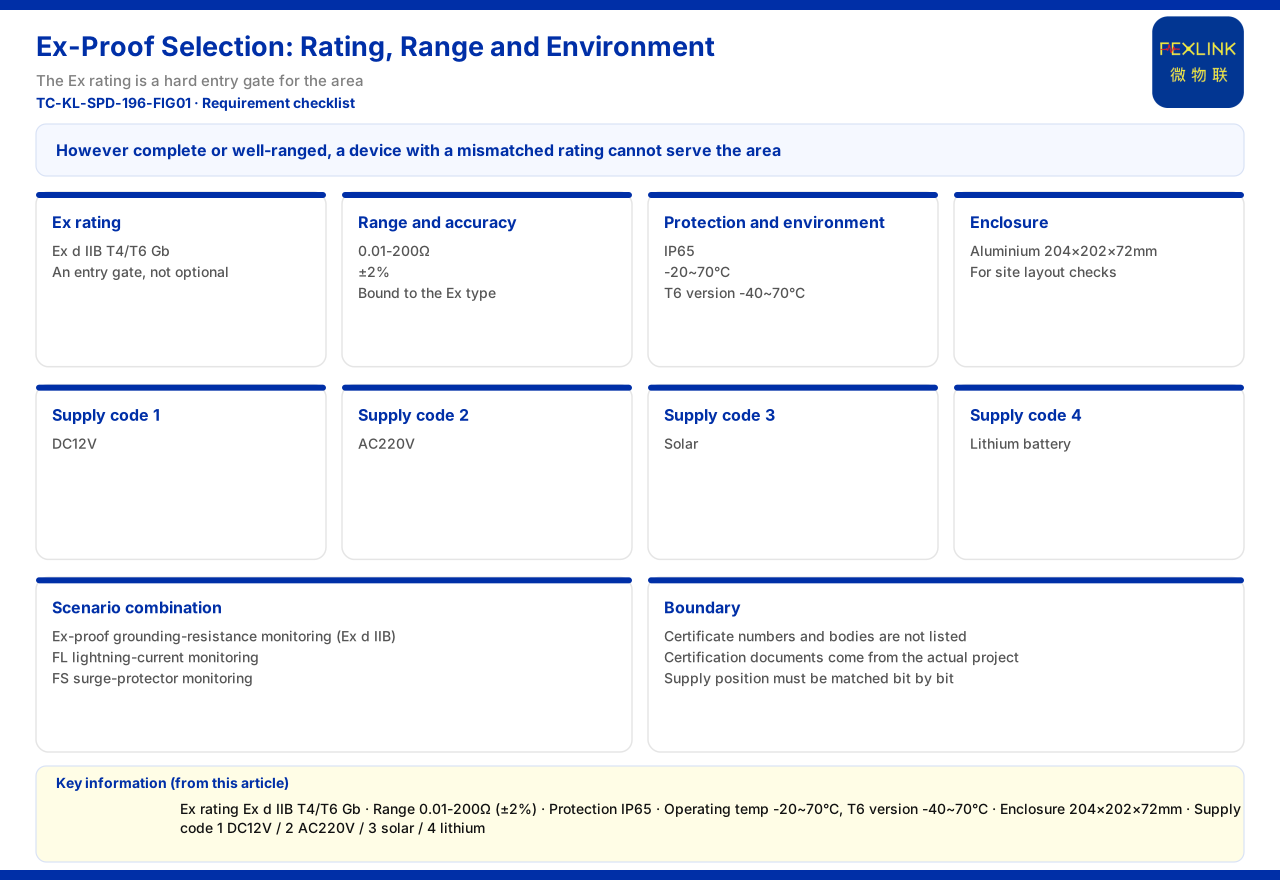
In explosion-proof scenarios the first constraint of selection is not how many functions a device has but whether it can be used safely in a flammable and explosive environment. The explosion-proof grounding-resistance monitoring capability given by the product material has an explosion-proof rating of Ex d IIB T4/T6 Gb, a range of 0.01 to 200Ω and an accuracy of ±2%, with the T6 version rated for an operating temperature of -40 to 70°C. An explosion-proof scenario should select a product with the corresponding explosion-proof rating and check its range, accuracy and environmental parameters item by item against the site conditions. It should be noted that the product material gives only the above rating and does not list certificate numbers, certification bodies or validity periods, so these must not be added by oneself.
1. Explosion-proof rating is a hard access threshold
For ordinary industrial equipment entering a flammable and explosive environment such as a petrochemical plant or an oil-tank area, the first question is whether the device itself could become an ignition source. The rating the product material gives for the explosion-proof monitoring unit is Ex d IIB T4/T6 Gb; this string simultaneously defines the protection type, gas group and temperature class. Selection should compare the site's hazardous-area classification with the device rating item by item and confirm that the rating is not lower than the area requirement. A particular caution: the explosion-proof rating is an access condition, not an option; however complete the functions and however suitable the range, if the rating does not match, the device cannot be used in that area. The product material provides no further protection types or ratings for extended choice, so selection should take the listed rating as its boundary.
2. Check range and accuracy against the explosion-proof parameters
The range given by the product material for the explosion-proof monitoring unit is 0.01 to 200Ω, with an accuracy of ±2%. This accuracy figure is bound to the explosion-proof type, and selection must not apply the parameters of a non-explosion-proof model to it. The check is: first confirm whether the expected range of the measured grounding resistance on site falls within 0.01 to 200Ω, then confirm whether the ±2% accuracy meets the project's requirement for confidence in the result. The product material also records that the grounding resistance monitor is distinguished by detection principle (loop method and three-point method) and gives an aluminium case outline dimension of 204×202×72mm for reference in on-site installation arrangement. Checking range, accuracy, principle and outline together avoids completing selection on the strength of the words explosion-proof alone.
3. Environmental parameters decide whether it can be installed
An explosion-proof site is often also outdoors, with a wide temperature swing, dust or damp, so environmental parameters form the second threshold. The product material gives a protection rating of IP65, an operating temperature of -20 to 70°C, and -40 to 70°C for the explosion-proof T6 version. Selection should place the site's minimum and maximum ambient temperatures inside this interval and confirm that the installation location can meet the IP65 protection requirement. If the winter temperature on site is below -20°C, the choice of the T6 version should be checked in particular; if the site has stronger corrosion or wash conditions, the product material gives no corresponding parameter and this should be confirmed separately from the site conditions rather than extrapolated from existing parameters.
4. Supply mode must be checked digit by digit
Supply conditions differ considerably between explosion-proof and outdoor scenarios, so the supply digit in the model name needs to be confirmed one by one. The supply mode codes the product material gives for lightning-protection products are: 1 for DC12V, 2 for AC220V, 3 for solar, and 4 for lithium battery. Selection should align the form of power available on site with the supply digit in the model, noting that different models in the same product family may differ in supply. For example, the product material records the FS surge protective device monitor (e.g. FS-00011-R) as powered at DC12V, while some FL models are AC220V. If the site has no stable mains, the available options should be checked among the listed supply codes rather than assuming an external connection is possible. A supply digit read incorrectly often only surfaces at commissioning, so it is advisable to check it together with the other model digits at the selection stage.
5. Combination selection: grounding, lightning current and SPD monitoring
The recommended combination the product material gives for the oil-tank-area and petrochemical lightning-protection and explosion-proof scenario is explosion-proof grounding-resistance monitoring (Ex d IIB), FL lightning current monitoring and FS surge-protective-device monitoring. This combination shows that an explosion-proof scenario is usually not a single-point measurement but a superposition of three capabilities: grounding, lightning current and surge-protective-device status. Selection can check the three lines separately: for the grounding line, confirm the use of the explosion-proof grounding resistance monitor and check its rating and range; for the lightning-current line, confirm that the installation form of the chosen FL lightning current / transient current monitor (e.g. FL-01212-R) matches the site; for the SPD line, confirm that the FS surge protective device monitor (e.g. FS-00011-R) carries the surge-protective-device status. The point of the combination is complete coverage, not piling up model quantities.
6. Interfacing explosion-proof selection with existing facilities
In a retrofit of an existing oil-tank area or petrochemical unit, explosion-proof selection is also constrained by existing conditions. The product material records that the FR and explosion-proof series have been applied to projects such as online grounding-grid monitoring for railway traction substations and the Jinzhou Port oil-tank area, which shows that explosion-proof grounding-resistance monitoring has an existing application form in similar scenarios. A retrofit usually reuses the original grounding test points and installation positions, so selection must check whether the existing test points support the chosen detection principle and whether the installation dimensions are compatible with the existing space. The aluminium case dimension of 204×202×72mm and the two installation methods (outdoor and indoor) given by the product material can serve as an initial check. If the existing supply is DC, the supply digit of the model should be confirmed as DC12V; if solar or lithium battery supply is considered on site, the listed supply codes should be compared item by item. Writing the existing conditions into the selection table reduces repeated on-site adjustment.
7. Certification information is limited to the listed rating
The boundary should be made clear: the explicit explosion-proof information in the product material consists only of the explosion-proof rating Ex d IIB T4/T6 Gb and the range, accuracy and temperature parameters of the explosion-proof type. The product material does not list explosion-proof certificate numbers, certification bodies, validity periods or other certification information. Therefore, if certification material is to be cited during selection or acceptance, it should be based on the documents actually obtained for the project; the certification status must not be inferred from the product material, nor must the explosion-proof rating be equated directly with a complete certification proof. Stating this boundary clearly is more reliable than a blanket promise of certified.
Scope and limitations
First, this article explains only the selection concerns of an explosion-proof scenario; the factual boundary is limited to the product material, and no parameter, certification or case conclusion not listed there is introduced.
Second, the explosion-proof rating, range, accuracy, temperature, protection rating and supply codes here are as recorded in the product material; this article does not infer the specifications of unlisted models from them, nor does it equate a rating marking with a complete certification proof.
Third, the product material does not give explosion-proof certificate information; this article does not judge whether a specific project meets a certification requirement, and the relevant documents are subject to those actually obtained for the project.
Fourth, the selection of a specific explosion-proof scenario must be determined in conjunction with the hazardous-area classification, on-site environment and installation conditions; this article provides no explosion-proof design or compliance conclusion.