Direct answer
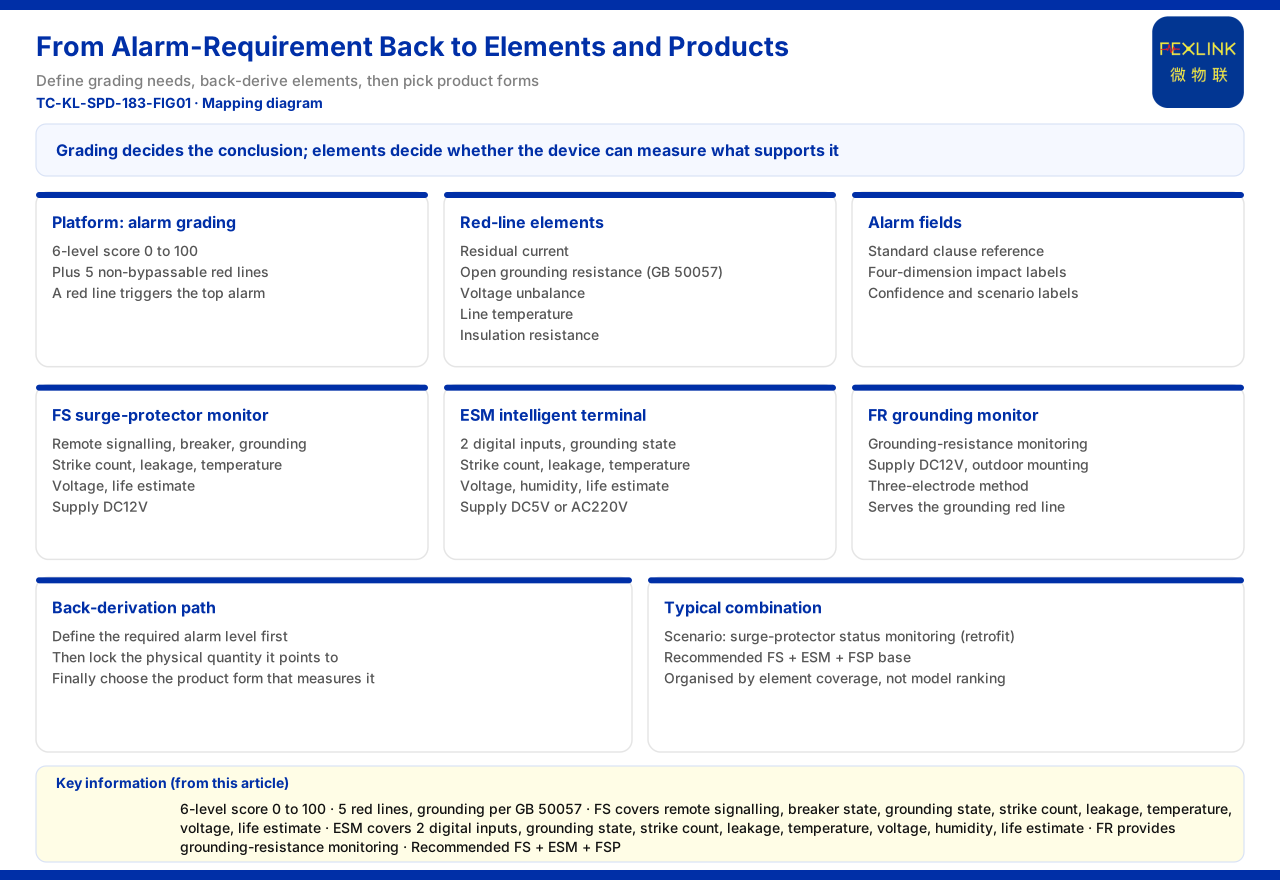
The relationship between monitoring elements and alarm grading can be summarised in one sentence: grading decides what conclusion you want, and elements decide whether the device can collect the quantities that support that conclusion. The product material gives a six-level alarm system graded by a composite score of 0 to 100, plus five non-bypassable safety red-lines. If a project needs safety red-line-level alarms, it must select products able to collect the corresponding elements; otherwise the safety red-line criterion cannot be triggered. The correct order of selection is therefore not to pick a model first, but to define the grading requirement first, work back to the elements, and only then settle on the product form. Putting this step first usually reduces rework compared with adding collection points during procurement or commissioning.
1. Grading and elements are two different layers
Alarm grading is a platform-side decision framework; it answers how serious the risk is and how it should be handled. A monitoring element is a device-side collection list; it answers what can be measured on site. The two cannot replace each other: with elements but no grading, data cannot become an executable alarm; with grading but no elements, grading loses its input. The product material lists the two layers separately precisely to signal that selection must align them. Many sites pick a model from the product manual first and only later discover that a key element is missing, so an upper-level safety red-line alarm simply cannot be established; such rework could have been avoided by fixing the grading requirement first.
2. The six-level alarm fixes score bands and disposition rhythm
The six-level system described by the product material is: normal 85 to 100, watch 70 to 84, level-1 pre-warning 55 to 69, level-2 pre-warning 40 to 54, level-1 alarm 20 to 39 requiring disposition within 48 hours, and level-2 alarm 0 to 19 requiring immediate shutdown. Each alarm also carries a standard-clause reference, four-dimension impact tags (safety, efficiency, lifetime and carbon, each scored 0 to 100), a confidence level and a scenario tag. These fields show that grading is not only a matter of a higher or lower score but also carries a basis, impact dimensions and explainability requirements; during selection it must be confirmed that the elements collected by the chosen product suffice to generate these fields.
3. Safety red-lines promote some elements to mandatory collection items
Beyond the six-level score, the product material lists five safety red-lines that, once triggered, output the highest-level alarm corresponding to the lowest score tier and cannot be bypassed. One of them, the grounding item, is abnormal open of grounding resistance, based on GB 50057. Its significance is to lift grounding-type elements from an optional observation item to a mandatory collection item: if a project requires a grounding abnormality to trigger the highest-level alarm, the front end must have grounding-resistance collection capability. By the same logic, the other safety red-lines point respectively to residual current, three-phase voltage unbalance, line temperature and insulation resistance, and their collection capability should be checked item by item during selection.
4. What elements the device side can collect
The product material gives element lists for three product categories. The FS surge protective device monitor (e.g. FS-00011-R) covers remote signalling, air-switch status, grounding status, lightning-strike counting, leakage current, temperature, voltage and lifetime estimation, is powered at DC12V, and can be combined into models by element channel count. The ESM intelligent lightning-protection monitoring terminal (SPD monitor, e.g. ESM-11312-R) covers two digital inputs, grounding status, lightning-strike counting, leakage current, temperature, voltage, humidity and lifetime estimation, with an optional DC5V or AC220V supply, in a basic four-element version and a flagship multi-element version. The FR grounding resistance monitor (e.g. FR-01311-R) provides grounding-resistance monitoring, is powered at DC12V, is installed outdoors, uses the three-electrode method, and corresponds to the grounding element among the safety red-lines. Different devices clearly cover different element sets, which is exactly why they must be checked against the grading requirement.
5. Deriving elements and form from grading requirements
Aligning the two layers yields an actionable backward path. First determine which alarm levels the project needs: if only routine grading is required, choose elements according to the quantities the site cares about; if safety red-line-level alarms are required, lock the physical quantity that the safety red-line points to first, then choose a product form able to collect that quantity. Taking grounding as an example, where a grounding-type safety red-line is needed, it should be confirmed whether the selection includes grounding-resistance monitoring capability. The recommended combination the product material gives for the surge protective device status monitoring (retrofit of existing SPDs) scenario is the FS surge protective device monitor, the ESM intelligent lightning-protection monitoring terminal and the SPD lightning-protection base (e.g. FSP-21100-R), which shows that the material organises combinations on the basis of element coverage rather than a simple stack by model rank.
6. Writing the element check into a selection checklist
To make the correspondence reviewable, the element check can be arranged as a checklist placed alongside the alarm requirements. Each row is an alarm requirement, and the columns include the physical quantity the requirement points to, whether the site has a collection point for that quantity, whether the candidate product covers the element, and whether the supply and installation conditions are satisfied. For a leakage-current requirement, for example, confirm first whether the product includes a leakage-current element, then whether its supply matches the site. For a grounding requirement, confirm whether grounding-resistance monitoring capability is configured. The element list, supply method and installation method in the product material can be used directly as the basis for filling in the table. Such a checklist does not change the product material; it merely reorganises information scattered across entries by alarm requirement, making item-by-item review easier and exposing the gap where an alarm is defined but the element is not collected.
7. The mapping not given in the material must not be filled in
A particular caution: the product material does not give a one-to-one mapping table from a monitoring element to an alarm level, nor does it give a selection decision rule. The six-level alarm and the safety red-lines belong to the platform-side system, while the product side only lists collectable elements. One must therefore not infer from the product material a conclusion such as collecting temperature will necessarily reach a certain level. What selection can do is confirm whether an element is collectable, not presuppose how an element converts to a level; the latter is platform decision logic and lies outside the product material boundary.
Scope and limitations
First, this article explains only the correspondence between grading requirements and element selection; the factual boundary is limited to the product material, and no standard clause, parameter or certification not listed there is introduced.
Second, the element lists, supply methods and model examples here are as recorded in the product material; this article does not infer the specifications of unlisted models from them.
Third, the product material does not give a mapping between elements and alarm levels; the backward path here is a method induction from the listed facts and does not represent the platform's actual decision rules.
Fourth, the element selection and product configuration of a specific project must be determined in conjunction with the site, standard applicability and platform requirements; this article provides no selection calculation.