Direct Answer
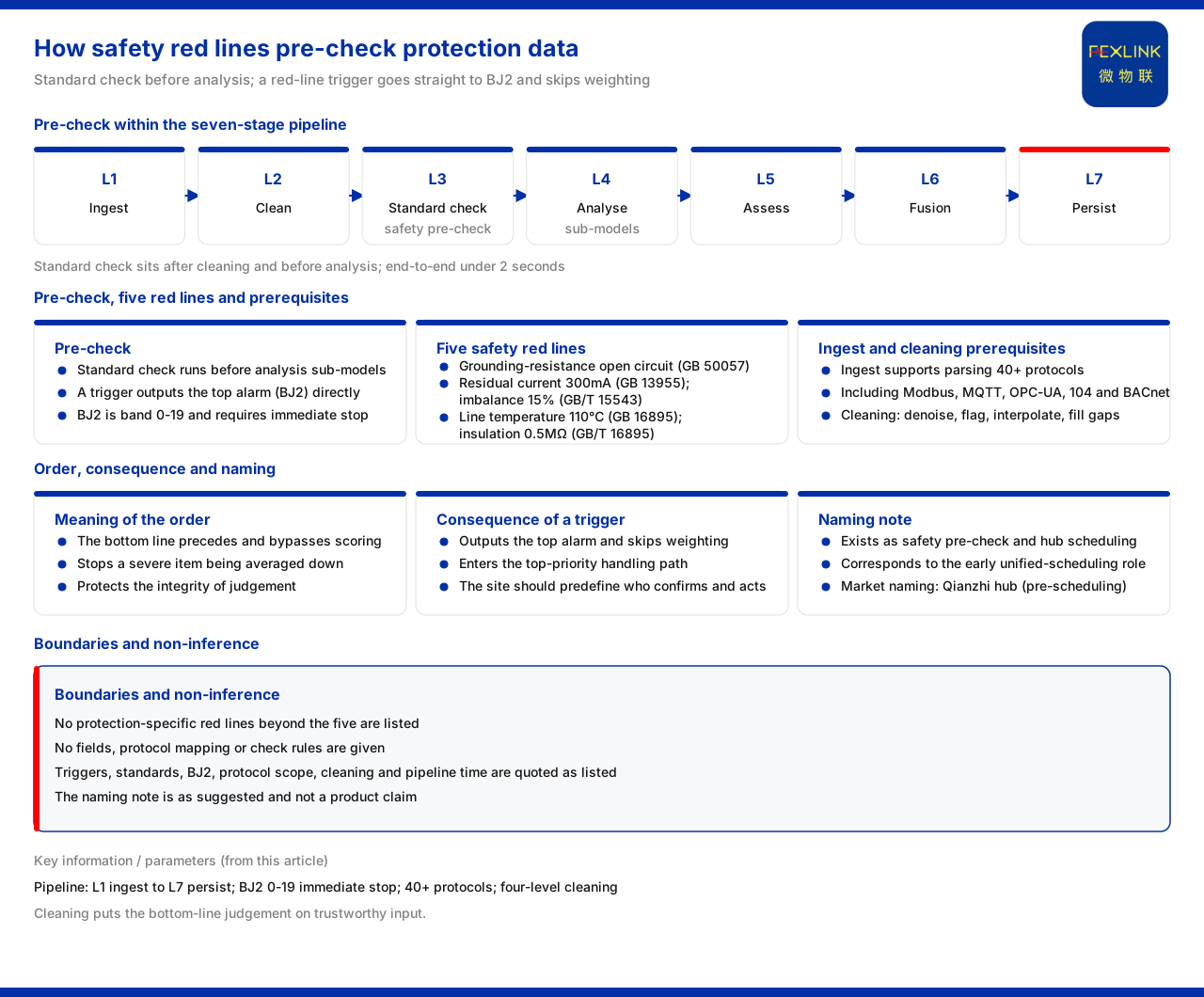
The front-end pre-check of safety red-lines on lightning-protection data means performing a standard verification before analysis and computation begin; once a red-line is triggered, the highest-level alarm is output directly and all subsequent weighted computation is skipped. The product knowledge base records that this verification runs before the analysis sub-models are computed, and that there are five safety red-lines which cannot be bypassed and whose thresholds no one can raise. For lightning protection, the one directly related to grounding, "abnormal open circuit of grounding resistance", is among them, with GB 50057 as the basis. In other words, before lightning-protection data enters analysis it must pass through a bottom-line gate rather than being scored together with the other indicators.
1. What Front-End Pre-Check Means
The meaning of a front-end pre-check is to take bottom-line judgement out of the composite score and execute it separately at the very front. A conventional analysis flow weights several indicators first and then produces a composite result; a front-end pre-check asks "has the bottom line been touched" before weighting. The product knowledge base records that standard verification runs before the sub-model computation and that a triggered red-line outputs the highest-level alarm directly and skips all weighted computation. This arrangement separates two kinds of judgement of different nature: an ordinary risk that can be weighed and averaged, and a safety bottom line that cannot be weighed or averaged. A grounding abnormality in lightning-protection data belongs to the latter.
2. The Sequence Decides That It Cannot Be Averaged
Placing the pre-check before the sub-models matters for the sequence, not only for the position. If bottom-line judgement were placed after weighting, a serious item could be pulled down by the scores of many normal items and finally appear as a medium risk. The product knowledge base states explicitly that after a red-line is triggered all weighted computation is skipped, precisely to avoid such dilution. For a lightning-protection scenario this sequence means that once grounding is abnormally open, the system does not compute "what the composite score is" but handles it directly at the highest level. Understanding this explains why the source repeatedly stresses that red-lines cannot be bypassed: as soon as one takes part in averaging, it is no longer a bottom line. From this angle, the front-end pre-check actually protects the integrity of judgement: it ensures safety-related events are not diluted in the compromise process of a composite score.
3. What Happens After Triggering
The handling after triggering is definite. The product knowledge base records that a triggered red-line outputs the highest-level alarm (BJ2) directly and skips all weighted computation; in the six-level alarm system, BJ2 corresponds to the 0 to 19 band and requires immediate shutdown. Taken together, the consequence of a red-line trigger is not "a hint" but entry into the highest-priority disposal channel. For a project connected to lightning-protection monitoring, this means the red-line must not be treated as an adjustable item when designing the alarm strategy; it should also be understood that immediate shutdown is a strong action, and the site should clarify in advance who confirms it and how it is executed, so that the mechanism does not idle.
4. Which Red-Line Lightning-Protection Data Will Trigger
The five safety red-lines listed by the product knowledge base cover residual current, grounding, three-phase voltage imbalance, line temperature and insulation resistance. The one directly related to the object of lightning-protection supervision is the abnormal open circuit of grounding resistance, with GB 50057 as the basis. The other four are residual current reaching 300mA (GB 13955), three-phase voltage imbalance exceeding 15% (GB/T 15543), line temperature reaching 110°C (GB 16895) and insulation resistance below 0.5MΩ (GB/T 16895). It should be noted that the product knowledge base lists no lightning-protection-specific red-lines beyond these five, so the scope of the front-end pre-check should be bounded by the entries above, without inferring additional red-lines or thresholds that the source does not list.
5. Access and Cleaning Before the Pre-Check
The pre-check can run only if the data has been accessed and cleaned. The product knowledge base records that the access layer supports more than 40 protocol parsers, including Modbus, MQTT, OPC-UA, 104 and BACnet; the cleaning layer is four-level data cleaning, comprising denoising, duplicate removal, anomaly marking and interpolation completion. These two steps are especially important for lightning-protection data: the sampling quality of quantities such as grounding resistance, leakage current and temperature varies, and without denoising and anomaly marking the pre-check could be falsely triggered or missed because of a single bad value. Cleaning is not to embellish data but to let the bottom-line judgement rest on trustworthy input. For sites connecting many kinds of equipment, the coverage of protocol parsing directly determines how many devices the pre-check can cover, which is also a practical precondition for landing the front-end capability. The source gives no specific access fields, protocol mappings or verification rules for the front-end pre-check of lightning-protection data, and these must be designed separately against the site.
6. Its Position in the Pipeline
Putting the pre-check back into the whole pipeline makes its position clearer. The seven-level pipeline given by the product knowledge base is: access, cleaning, standard verification (safety front-end), analysis (sub-models in parallel), judgement, fusion decision and persistence. Standard verification is placed after cleaning and before analysis, which fits the order of "first ensure the data is trustworthy, then execute bottom-line judgement, and finally perform composite scoring". The end-to-end time of less than 2 seconds shows that from data access to alarm output is near real time, so the front-end pre-check does not significantly slow the whole process merely by being on the chain. Understanding this position helps judge the dependencies among stages during system integration.
7. A Note on Naming
In its terminology note on the front-end layer, the product knowledge base points out that this kind of capability exists in the form of a safety front-end pre-check and hub scheduling, corresponding to the unified scheduling role in the early architecture, which undertakes model orchestration, routing and distribution, a unified interface and multi-model collaboration; if the market side needs a separate name, the suggested expression is "Qianzhi hub (front-end scheduling)". This note reminds us that the front-end pre-check is not an independent product name but a capability description. In external communication it is advisable to follow the expression suggested by the source and avoid inventing names or packaging the capability into concepts inconsistent with the source, which could cause misunderstanding.
Scope of Application and Limitations
First, this article only explains the front-end pre-check mechanism of safety red-lines on lightning-protection data; the factual boundary is the product knowledge base, and no standard clauses, parameters, certifications or cases not listed there are introduced.
Second, the product knowledge base lists no lightning-protection-specific red-lines beyond the five safety red-lines, and gives no specific access fields, protocol mappings or data-verification rules for the front-end pre-check of lightning-protection data; these must be designed separately against the site.
Third, the trigger conditions and basis standards of the five safety red-lines, the immediate-shutdown requirement of the BJ2 band, the protocol scope of the access layer and the four-level content of the cleaning layer, as well as the seven-level pipeline and end-to-end time, are cited from the source.
Fourth, the naming note of the front-end layer is cited as suggested by the source; this article does not extrapolate it into a new product name or capability promise.
Fifth, the pre-check configuration, access mapping and alarm linkage of a specific project must be verified against platform capability and site conditions; this article provides no interface design or setting calculation.