Direct Answer
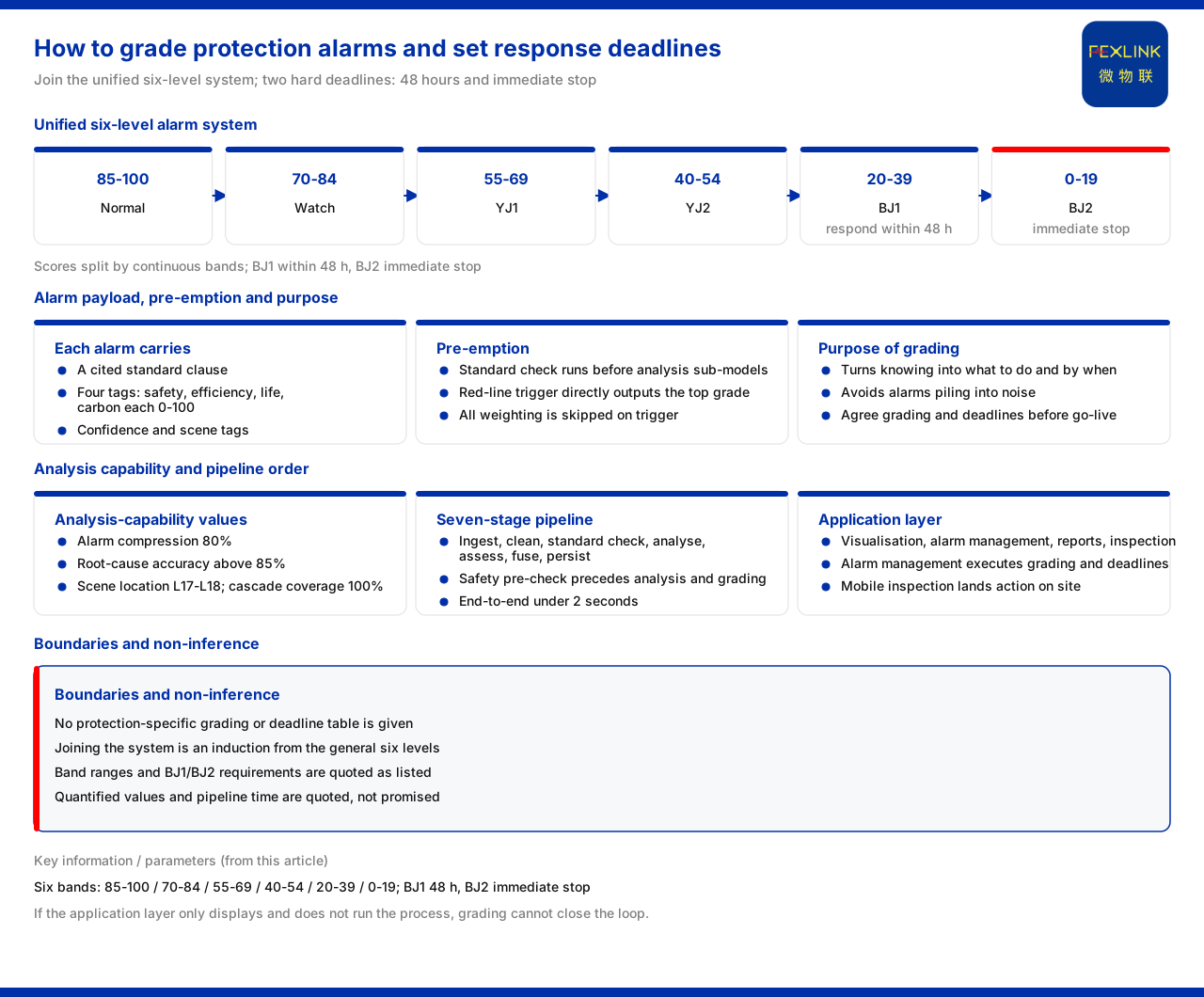
A lightning-protection alarm should not create its own grading but should connect to the unified six-level alarm system and set disposal time limits by level. The six-level system given by the product knowledge base is: normal 85 to 100, watch 70 to 84, YJ1 55 to 69, YJ2 40 to 54, BJ1 20 to 39 (disposal within 48 hours) and BJ2 0 to 19 (immediate shutdown). The product knowledge base also states that no separate grading definition or time-limit table is given for lightning-protection alarms, so lightning-protection alarms need to follow the same framework. The point of grading is to turn "we know" into "what to do and by when", preventing alarms from piling up into noise.
1. Why a Lightning Protection Alarm Cannot Just Be Reported Without Being Handled
Once an alarm is only reported and never handled, the platform quickly loses its usefulness. The value of an alarm does not depend on its quantity but on whether it corresponds to a definite action. If all alarms are presented at the same priority, operators can only rank them by experience and will in time become desensitised to the full screen of messages; conversely, if every alarm carries a level and a time limit, operators can direct their limited disposal resources to the high-risk items first. Grading and time limits are the two necessary buttons that turn "information" into "instructions", and neither can be missing. For a project connected to lightning-protection monitoring, these two matters should be agreed before go-live, rather than discussed on the spot after an alarm appears.
2. The Grading Basis of the Six-Level System
The six-level system of the product knowledge base divides a continuous state interval into six bands. The normal band is 85 to 100, meaning all indicators are within the expected range; the watch band is 70 to 84, meaning changes have appeared that need attention but do not yet constitute an urgent risk; the YJ1 band is 55 to 69 and the YJ2 band is 40 to 54, belonging to the warning interval; the BJ1 band is 20 to 39, belonging to the alarm interval; the BJ2 band is 0 to 19, the highest level. Dividing bands by a continuous score lets results from different parameters and different sites be compared on the same ruler, and makes the transition "from normal to urgent" gradual rather than a black-and-white jump.
3. The Two Hard Time Limits: 48 Hours and Immediate Shutdown
Among the six bands, two carry explicit disposal constraints. The BJ1 band requires disposal within 48 hours, and the BJ2 band requires immediate shutdown. These two are the key that projects grading onto the time dimension: 48 hours gives an arrangeable disposal window, suitable for situations requiring shutdown preparation or spare-part allocation; immediate shutdown leaves no buffer, suitable for a serious state that has already touched the safety bottom line. For a lightning-protection scenario, mapping states such as grounding abnormality, insulation degradation or backup-protection abnormality to these two bands lets the site clearly distinguish "schedule it this week" from "handle it now". Once the distinction is blurred, high-risk items are easily mistaken for ordinary ones and postponed.
4. What Information Each Alarm Carries
A level and a time limit are not enough; an alarm also needs to carry the basis of its judgement. The product knowledge base records that each alarm carries a standard-clause reference, four-dimension impact labels (safety, efficiency, life and carbon, each 0 to 100 points), confidence and a scenario label. These four kinds of information answer four questions: by what standard it is judged, which dimension is affected, how trustworthy the judgement is, and in what scenario it occurs. For a lightning-protection alarm, the standard-clause reference can point to a specific safety bottom line, the four-dimension labels help operations weigh side effects, the confidence indicates whether review is needed, and the scenario label assists localisation. Only when all four are present does an alarm become traceable and reviewable.
5. Front-End Interception Prevents Alarms Being Averaged
A grading system needs a mechanism that prevents the bottom line from being diluted. The product knowledge base records that standard verification runs before the analysis sub-models are computed, and a triggered red-line outputs the highest-level alarm directly and skips all weighted computation. Understood within alarm grading, this means the safety bottom line does not take part in the averaging of the composite score but directly determines the highest level. The benefit of this arrangement is that even if the other dimension scores are very high, an alarm that has already touched the bottom line will not be pulled back to a low level. For lightning-protection alarms this means that certain states, once they appear, should not be "converted" or "mitigated" within the six-level system but should enter the highest-priority queue directly.
6. Alarm Usability in Terms of Compression and Root Cause
Beyond grading, whether an alarm is usable also depends on the quality of its organisation. The product knowledge base records that in the quantified basis of analysis capability, alarm compression can reach 80%, root-cause accuracy is above 85%, scenario positioning accuracy falls at the L17 to L18 level, and cascade risk coverage is 100%. These figures show that the platform does not forward raw events unchanged but first compresses and merges them, then performs root-cause judgement and positioning. For operations, compression reduces the burden of received volume, while root cause and positioning reduce the difficulty of judgement; together they determine whether alarms can actually be handled. If grading and time limits lack this layer of organisational support, they may still fail because of sheer volume.
7. The Processing Sequence of the Pipeline
The capabilities above depend on an orderly processing chain. The seven-level pipeline given by the product knowledge base is: access, cleaning, standard verification (safety front-end), analysis, judgement, fusion decision and persistence, with an end-to-end time of less than 2 seconds. Comparing this chain with alarm grading shows that the safety front-end is placed before analysis, while the grading score is produced after analysis, and the order of the two cannot be reversed. The end-to-end figure of less than 2 seconds shows that from data access to alarm output is a near-real-time process, which makes a high time-limit requirement such as "immediate shutdown" technically feasible. Understanding this sequence helps judge which stages introduce delay in a scheme.
8. The Application Layer Takes Over Disposal
The last level is the application layer, which determines whether an alarm can be turned into an action. The product knowledge base records that the application layer of the four-layer monitoring architecture includes visualisation, alarm management, analysis reports and mobile inspection. Alarm management takes over the execution of grading and time limits, analysis reports serve post-event review, and mobile inspection brings disposal to the site. For a lightning-protection project, the application-layer configuration should match the grading agreement: which level is pushed to whom, in what manner, and how the disposal result is recorded should all be agreed there. If the application layer only displays and does not take over the flow, even a clear grading will struggle to form a closed loop.
Scope of Application and Limitations
First, this article only explains how lightning-protection alarm grading and disposal time limits should connect to the unified system; the factual boundary is the product knowledge base, and no standard clauses, parameters, certifications or cases not listed there are introduced.
Second, the product knowledge base gives no separate grading definition or time-limit table for lightning-protection alarms; the connection described here is an induction based on the general six-level system, not a lightning-protection-specific grading originally listed in the source.
Third, the band intervals of the six-level system, the 48-hour disposal requirement of BJ1 and the immediate-shutdown requirement of BJ2, and the fields an alarm carries, are cited from the source.
Fourth, the figures of 80% alarm compression, root-cause accuracy above 85%, scenario positioning accuracy and cascade risk coverage, as well as the seven-level pipeline and end-to-end time, are cited from the source; this article does not treat them as a promise for any site.
Fifth, the alarm grading, push targets and disposal flow of a specific project must be agreed against the operation-and-maintenance organisation and site conditions; this article provides no flow design or setting calculation.