Direct answer
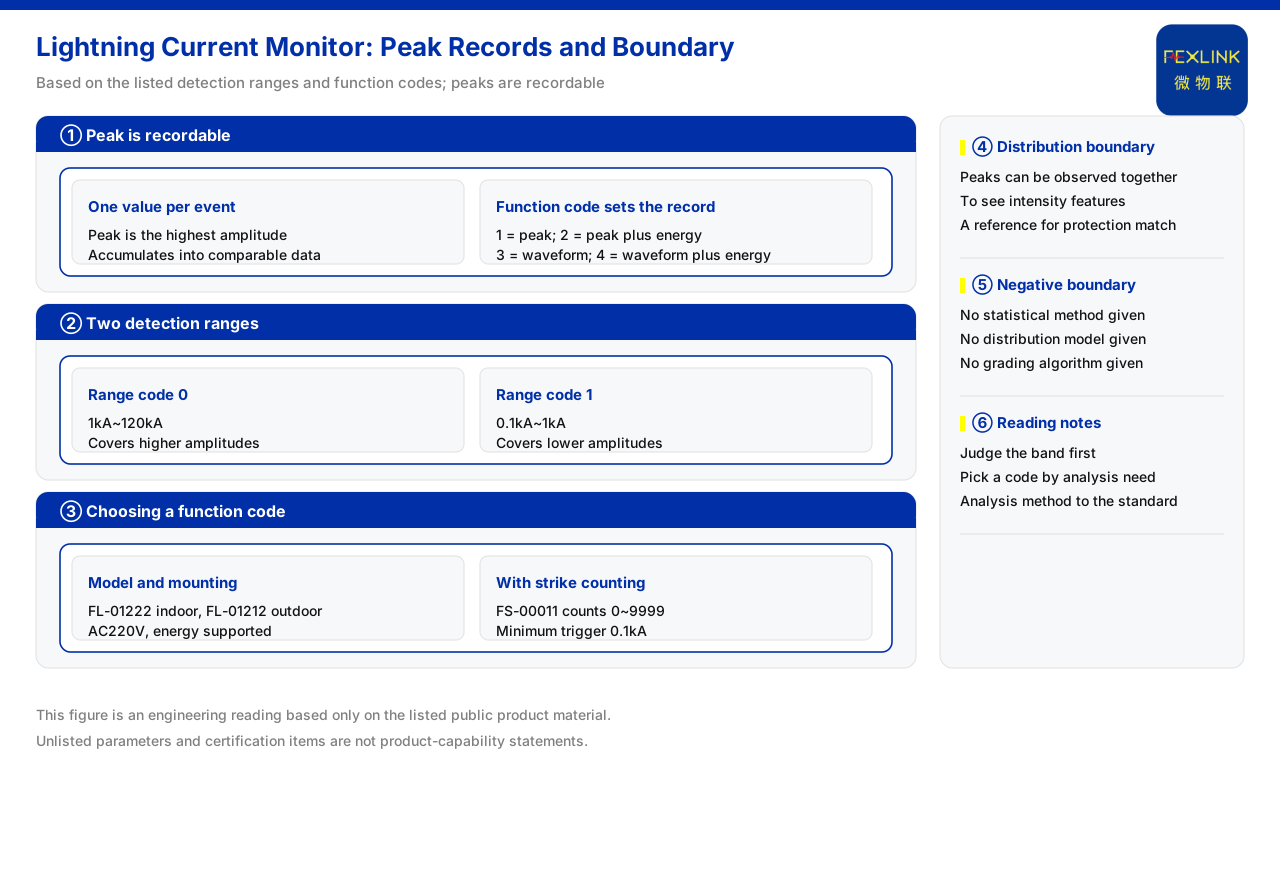
Analysing the peak distribution of multiple lightning events presupposes recording the peaks as comparable data. The current product documentation gives the lightning current / transient current monitor two detection-range codes: code 0 corresponds to 1 kA to 120 kA, and code 1 corresponds to 0.1 kA to 1 kA; among the function codes, 1 is peak, 2 is peak plus energy, 3 is waveform, and 4 is waveform plus energy. The peak is therefore a quantity that can be recorded and stored event by event. Collecting the peaks of multiple events for distribution observation helps to understand the intensity characteristics of regional lightning. It should be noted that the current product documentation gives neither a statistical analysis method, a distribution model, nor a grading algorithm for peak distribution; this article therefore states only that peaks can be recorded and observed collectively, and gives no specific fitting or grading conclusion.
1. The peak is a quantity recorded event by event
The first step in distribution analysis is to confirm that the object being analysed can be recorded repeatedly. The current product documentation defines one of the lightning current / transient current monitor function codes directly as peak, which shows that recording the peak is a basic capability of this kind of device. The peak describes the highest amplitude reached by the current in a single lightning event, so it is a quantity that yields one value per event. Precisely because it is produced event by event and can be accumulated, it is possible to line up the peaks of multiple events and observe at which magnitudes they cluster and at which magnitudes they are sparsely distributed. The documentation does not describe the sampling details of the waveform, so this article does not infer time characteristics beyond the peak.
2. Detection range is divided into two codes
Whether a peak can be recorded also depends on whether it falls within the detection range. In its model rules, the current product documentation divides the detection range into two codes: code 0 corresponds to 1 kA to 120 kA, and code 1 corresponds to 0.1 kA to 1 kA. The former covers higher current amplitudes, the latter lower current amplitudes. This division shows that selection must first judge roughly which interval the lightning intensity of the measured object falls into, and then choose a model with the corresponding range. Placing the two codes side by side also shows that the observation requirements for lightning peaks differ by orders of magnitude, which is why the equipment differentiates by range.
3. Function codes determine what is recorded
Even when the peak is recorded, different function codes provide different amounts of information. The current product documentation specifies that function code 1 is peak, 2 is peak plus energy, 3 is waveform, and 4 is waveform plus energy. This means that if only the amplitude matters, recording the peak is enough; if the energy released by the event also matters, a function code with energy should be chosen; and if the waveform must be seen, a code with waveform should be chosen. This set of codes shows that whether analysis beyond distribution is possible depends on which quantities the chosen model records. The documentation gives only the correspondence between codes and functions and does not describe the data format of each function, and this article does not extend it.
4. Indoor and outdoor models correspond
The lightning current / transient current monitors listed in the current product documentation are grouped by installation environment and detection range, with the higher range represented by FL-01222-R and the lower range by FL-11122-R; the remaining models and configurations are shown in the table below.
| Model | Installation environment | Power supply | Peak range | Energy | | --- | --- | --- | --- | --- | | FL-01222-R | Indoor | AC220V | 1 kA to 120 kA | Supported | | FL-01222-Z | Indoor | AC220V | 1 kA to 120 kA | Supported | | FL-01222-E | Indoor | AC220V | 1 kA to 120 kA | Supported | | FL-01212-R | Outdoor | AC220V | 1 kA to 120 kA | Supported | | FL-01212-Z | Outdoor | AC220V | 1 kA to 120 kA | Supported | | FL-01212-E | Outdoor | AC220V | 1 kA to 120 kA | Supported | | FL-11122-R | Indoor | AC220V | 0.1 kA to 1 kA | Not recorded | | FL-11122-Z | Indoor | AC220V | 0.1 kA to 1 kA | Not recorded | | FL-11122-E | Indoor | AC220V | 0.1 kA to 1 kA | Not recorded |
In form, the documentation gives the lightning monitoring housing in white and black, with the outdoor version using an aluminium housing measuring 204 × 202 × 72 mm. From this it follows that indoor versus outdoor, higher versus lower range, and whether energy is recorded are three dimensions that must be confirmed together during selection.
5. How the peak works with lightning counting
Beyond peak distribution, many scenarios need only to know how many events occurred. Among the key parameters of the surge protective device monitor (FS-00011-R) given in the current product documentation, the lightning count is 0 to 9999 events, with a minimum trigger of 0.1 kA. This capability works together with peak recording: the count answers how many times something happened, while the peak answers how strong each occurrence was. If only distribution analysis is performed, the peak is indispensable; if only event frequency matters, the count suffices. The documentation lists both in the lightning monitoring system.
6. What distribution analysis can and cannot do
Bringing these threads together, the conclusion that can be drawn is this: the peak can be recorded event by event, the detection range is divided into a higher and a lower code, and the function code determines whether energy or waveform is attached, so the peaks of multiple events can form a set of comparable data. Observing these data collectively can be used to understand the intensity characteristics of regional lightning and to provide a reference for matching protection level with equipment withstand. At the same time, the current product documentation gives no statistical analysis method, distribution model, or grading algorithm for peak distribution. This article therefore cannot say that a particular distribution should be fitted, nor can it give a rule for grading by peak. The documentation mentions in its typical-application section that tank farms and petrochemical lightning-protection and explosion-proof sites are recommended to use a combination of explosion-proof grounding resistance monitoring, lightning current monitoring, and surge protective device monitoring, which shows that peak monitoring has clear application settings but does not mean that the documentation provides a distribution-analysis method.
7. A verifiable check sequence
For ease of review, the check can be reduced to four steps. First, confirm that the monitored object is the peak of a lightning event and judge which detection-range code its magnitude falls into. Second, choose the function code according to the analysis need: choose peak for amplitude alone, and choose the corresponding function for energy or waveform. Third, confirm the installation environment and select an indoor or outdoor model, and check whether energy must be recorded. Fourth, if distribution analysis is involved, check whether there is a need to cite a statistical method, distribution model, or grading algorithm; if so, it should be marked explicitly as a matter not listed in the current documentation and left to analysis methods and standards. Following this order answers how the peak is recorded and what kind of observation it supports, rather than which distribution model should be used.
Scope and limitations
First, this article restates only what the current product documentation lists; its factual boundary is the detection-range codes, function codes, indoor and outdoor model configurations, and form description of the lightning current / transient current monitor, the lightning-count parameter of the surge protective device monitor, the listed application combination, and the fact that distribution-analysis methods and grading algorithms are not listed.
Second, the statistical analysis method, distribution model, and grading algorithm for peak distribution are matters not listed in the documentation, and this article makes no fitting or grading inference about them.
Third, the detection range and function codes are cited as listed, and this article draws no conclusion about which code or function a specific project should choose.
Fourth, the installation environment, power supply, and whether energy is recorded are cited as listed, and this article makes no judgement about field installation details.
Fifth, the lightning-count range and minimum trigger of the surge protective device monitor are cited as listed, and this article makes no inference about their conversion relation with peak recording.
Sixth, this article does not constitute a commitment regarding the selection result or field performance of any specific project; the latest product documentation and project scheme prevail.