Direct answer
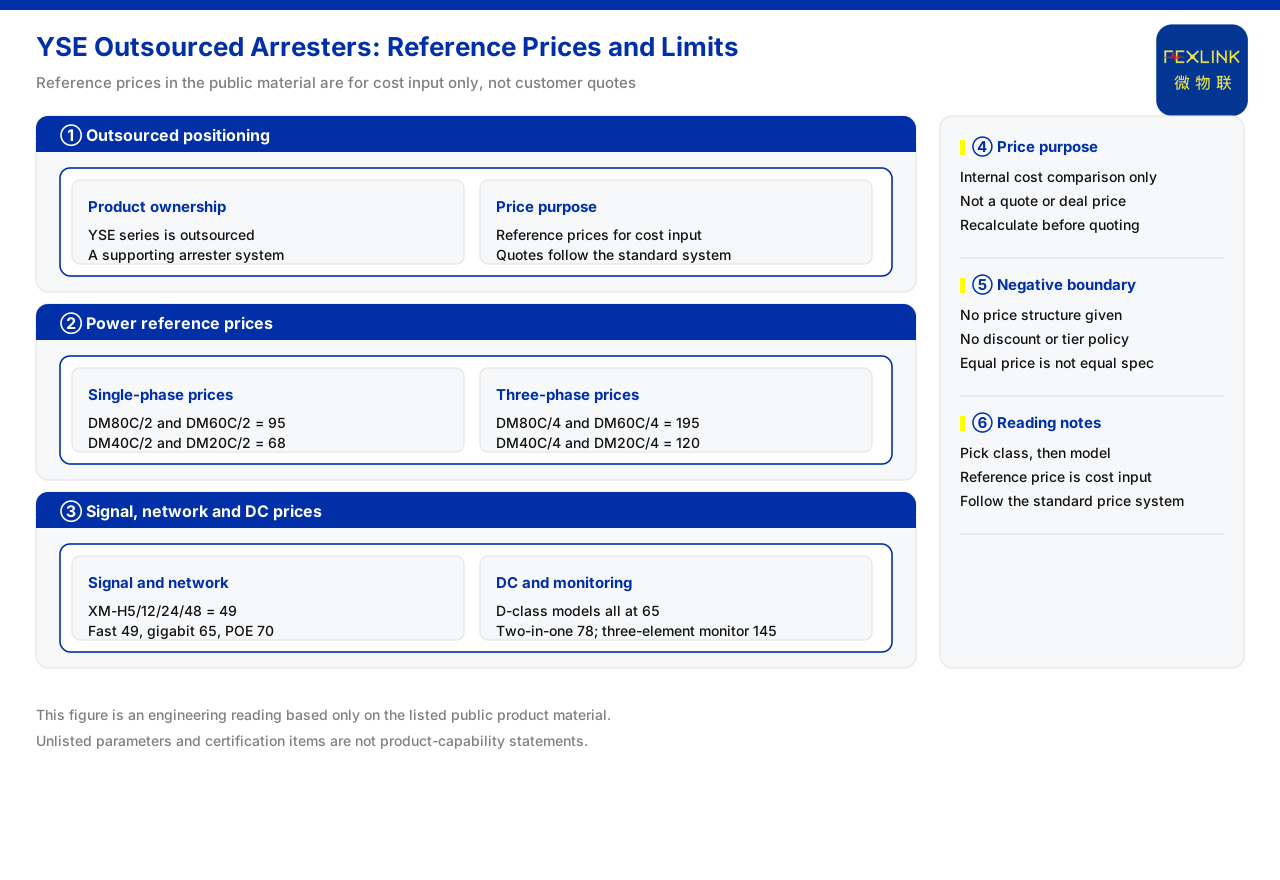
For the outsourced-support YSE series surge protective devices, selection must look at two layers of information: first, that they belong to a system-supported surge protective device family produced under outsourcing; second, that the reference prices given by the current product documentation can be used only as a cost reference, and that any external quotation must follow the company's standard price system. The reference prices listed in the documentation cover power, signal, network, and status-monitoring classes. For example, among single-phase power SPDs, YSE DM80C/2 is 95, DM60C/2 is 95, DM40C/2 is 68, and DM20C/2 is 68; among three-phase units, DM80C/4 is 195, DM60C/4 is 195, DM40C/4 is 120, and DM20C/4 is 120. These figures are not external quotations and cannot be used as a final transaction price.
Clarifying the outsourced-support positioning first
Before selection, the product ownership must be distinguished. The current product documentation lists the YSE series surge protective devices as a system-supported surge protective device family produced under outsourcing, whose prices come from internal quotation material, with the purpose explicitly written as a cost reference. This means two things: first, it is not the pricing of a self-manufactured product line but a cost wording for a supporting part; second, any external quotation must return to the company's standard price system, and the figures in the documentation cannot be cited directly. Only when this layer is clear does every price afterward have the correct boundary for use: they are a reference for internal estimation and scheme comparison, not a committed price to a customer.
Single-phase and three-phase reference prices for power SPDs
Power SPDs are divided into single-phase and three-phase groups by phase count. The single-phase reference prices given by the current product documentation are: YSE DM80C/2 at 95, YSE DM60C/2 at 95, YSE DM40C/2 at 68, and YSE DM20C/2 at 68. The three-phase reference prices are: YSE DM80C/4 at 195, YSE DM60C/4 at 195, YSE DM40C/4 at 120, and YSE DM20C/4 at 120. From this group of figures it can be seen that a three-phase unit in the same grade has a higher reference price than a single-phase unit, while the 80 and 60 grades, and the 40 and 20 grades, take the same reference value in single-phase and three-phase respectively. The documentation gives only these correspondences and does not explain their price composition, nor does it give discount or tiered policies, so the pricing logic of different capacity grades should not be inferred from them.
Reference prices for Class D power SPDs
Besides AC power SPDs, the documentation also lists Class D power SPDs, including DC and AC voltage levels. Their reference price is uniformly 65, covering four models: YSE DM-D220, YSE DM-D48, YSE DM-D24, and YSE DM-D12. The four products differ in line voltage level, yet the reference price given by the documentation is the same; this is a fact listed in the documentation and cannot be used to infer that they are also completely identical in other parameters. In selection, the voltage level and installation conditions of the protected line should govern, not the reference price level; the reference price is only a cost comparison, not a selection criterion.
Reference prices for signal and network SPDs
The reference prices of the signal and network classes are listed separately in the documentation. Among signal types, YSE XM-H5/12/24/48 is 49, and the YSE XM-AU broadcast signal SPD is 49, meaning the signal class takes the same reference price. Among network types, YSE X/RJ45-NET-POE is 70, the fast Ethernet SPD is 49, the gigabit Ethernet SPD is 65, and the network two-in-one SPD (such as YSE V2-D220/NET) is 78. It can be seen that the network class shows several price levels according to rate and function combination, with POE, gigabit, and two-in-one priced higher than fast Ethernet respectively. The documentation does not explain the specific composition of these price differences, so this article makes only the correspondence statement and no cost breakdown.
Reference prices for counting and status-monitoring accessories
Beyond passive protective parts, the documentation also lists accessories with monitoring capability. The ordinary lightning counter (no communication) has a reference price of 90; the three-element SPD monitor (count, switch status, and SPD status, with RS485 communication) has a reference price of 145. The meaning of this group of figures is that it distinguishes the "count only" and "count plus status monitoring" accessory classes: the latter adds switch and SPD status monitoring and carries communication, and its reference price rises accordingly. In selection, if only a lightning count is needed, the ordinary counter suffices; if switch and device status must also be known, a model with status monitoring should be chosen. The documentation gives only the price and function correspondence, not the data-reporting difference between the two, and this article does not extend it. Keeping the counting and status classes apart avoids paying extra for unwanted functions, and also avoids configuring only counting when status monitoring is needed.
Reference price and selection are two different things
A price can be referenced, but selection cannot look only at price. The current product documentation's description of the YSE series focuses on the fact that it is a system-supported surge protective device family produced under outsourcing and gives a set of cost-reference prices; the documentation does not give the complete electrical parameters, protection level, or applicable working conditions of each model. Therefore, when using these figures at the scheme stage, they should be placed in the position of cost estimation, not in the position of a selection criterion. What really decides which unit to choose is the class of the protected object, the voltage level, the phase count, the signal or network interface form, and whether status monitoring is needed; the reference price is used for internal comparison and budget estimation only after these conditions are fixed. If price is made the first screening condition, it is easy to overlook parameter differences the documentation does not describe, causing deviations later in external quotation or on-site adaptation. Keeping the two apart allows the reference price to be used well without crossing its boundary.
A checklist sequence for using reference prices correctly
To use the reference price correctly, the check can be gathered into four steps. First, confirm product ownership: the YSE series is outsourced support and is not the direct basis for an external quotation. Second, determine the class by the protected object: power, signal, network, or status monitoring. Third, within the corresponding class, choose a specific model by phase count, rate, or function grade, and record the reference price listed in the documentation as a cost comparison. Fourth, before an external quotation, return to the company's standard price system to recalculate; under no circumstances cite the figures in the documentation directly as a customer quotation. Following this order, the reference price serves internal comparison without crossing its boundary.
Scope and limitations
First, this article restates only what the current product documentation lists, with the factual boundary limited to the outsourced-support positioning of the YSE series, the source and purpose of the reference prices, the model types and their reference-price figures, and the documentation not listing price composition or external quotation policy.
Second, all price figures are cited as listed and serve only as a cost reference; they do not constitute an external quotation, transaction price, or discount commitment.
Third, the documentation does not explain the compositional differences among the price classes or the capacity pricing logic, and this article does not infer the causes of price formation.
Fourth, the identical reference price of the four Class D power SPDs is a fact listed in the documentation, and this article does not judge the consistency of their parameters.
Fifth, the prices of the network and signal classes of surge protective devices are cited as listed; this article does not conclude on their adaptability in a specific project.
Sixth, this article does not constitute a commitment about a specific project's selection result or transaction price; the actual quotation follows the company's standard price system and the latest product documentation.