Direct answer
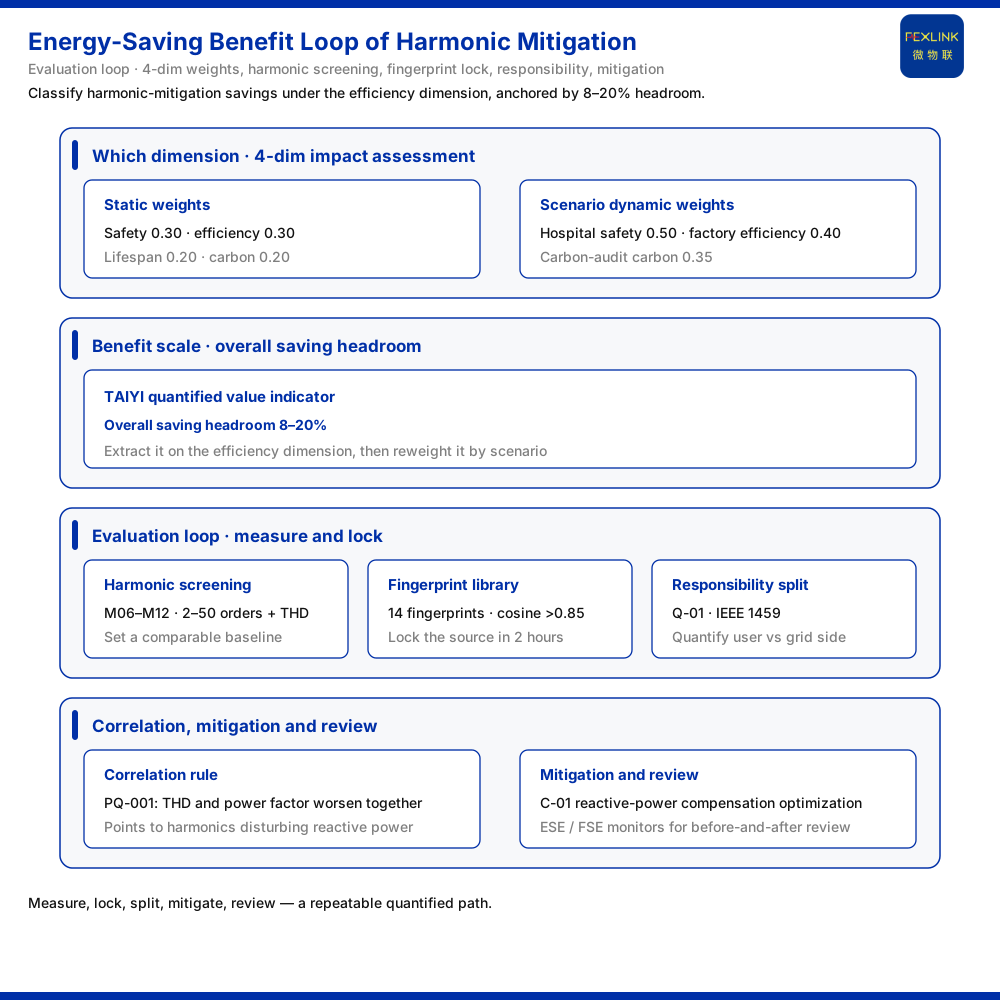
Harmonic mitigation is often treated as a power-quality compliance task, but it is also a quantifiable energy-saving account. The definition the product knowledge base gives is this: the four-dimension impact assessment already includes an efficiency dimension, with static weights of safety 0.30, efficiency 0.30, life 0.20 and carbon 0.20, plus scenario dynamic weights; and the quantitative value metric of the Taiyi intelligent control hub system gives an overall energy-saving space of 8-20%. Harmonic mitigation benefits can therefore be placed in the efficiency dimension and anchored at the 8-20% range. To assess the benefit, several steps are still needed: use the harmonic health check to confirm the source of additional losses, use the harmonic fingerprint library to lock the pollution source, use harmonic responsibility allocation to separate the user side from the grid side, and finally use monitoring devices for before-and-after review. This article explains the assessment method in that order and marks the material boundary.
1. Which dimension the energy-saving benefit belongs to: four-dimension impact assessment
The four-dimension impact assessment of the product knowledge base divides impact into safety, efficiency, life and carbon, with static weights of safety 0.30, efficiency 0.30, life 0.20 and carbon 0.20. It also provides scenario dynamic weights, for example safety 0.50 in a hospital scenario, efficiency 0.40 in a factory scenario, and carbon 0.35 in a carbon-assessment scenario.
The energy-saving benefit of harmonic mitigation corresponds by definition to the efficiency dimension. Additional losses caused by harmonics in equipment ultimately show as lower efficiency; after mitigation, efficiency recovers and the benefit falls in this dimension. In assessment, confirming which dimension it falls into before discussing weight and magnitude keeps the logic complete.
2. The definition of the benefit range: overall energy-saving space
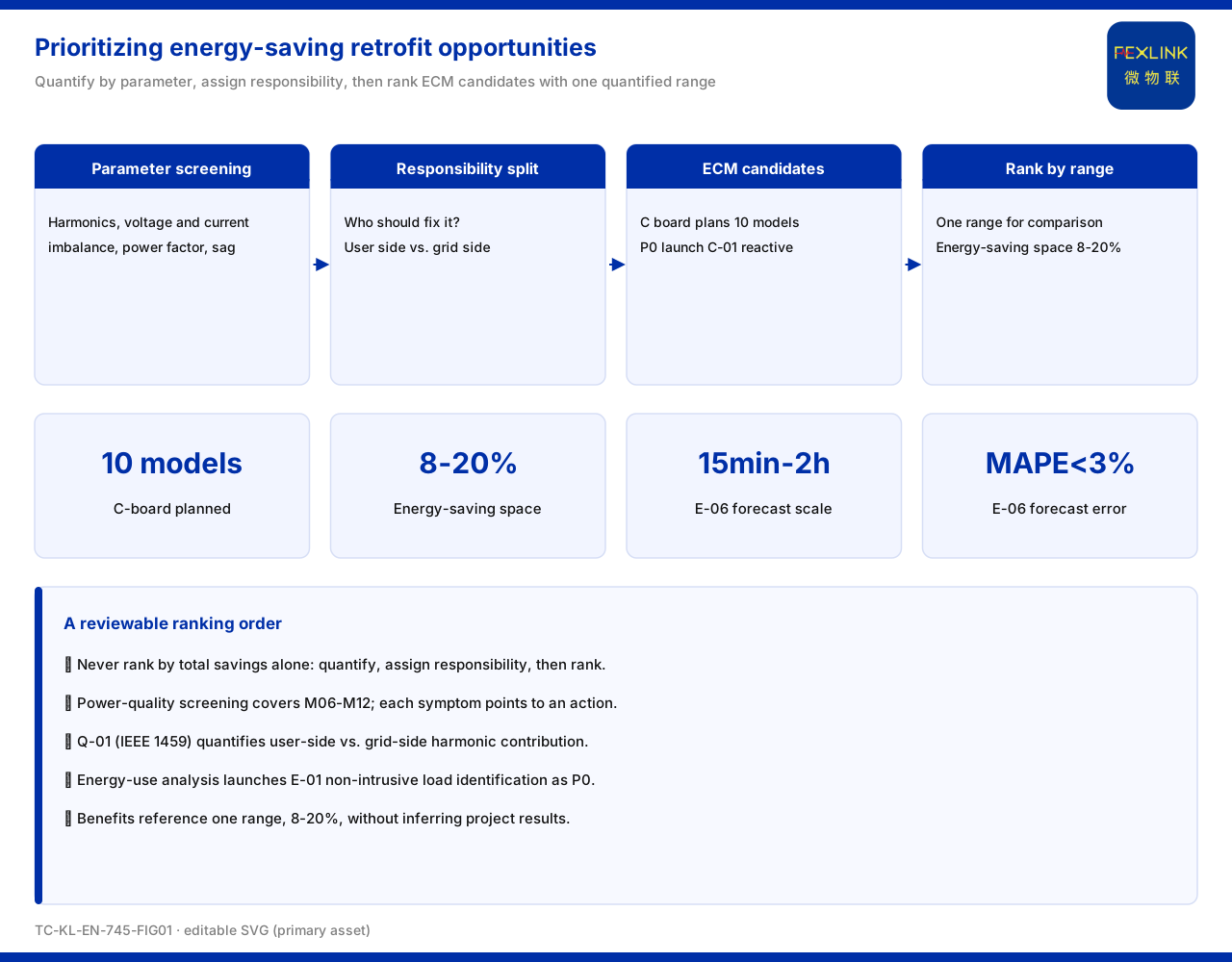
Where does the magnitude come from? The product knowledge base gives an overall energy-saving space of 8-20% in the quantitative value metrics of the Taiyi intelligent control hub system. This is a range definition rather than a fixed number. It should be understood as the overall space after mitigation and optimisation; where a specific project falls within the range must be judged in combination with load composition, harmonic level and mitigation scope.
Read together with the four-dimension weights, the assessment gains a skeleton: first extract the energy-saving space along the efficiency dimension, then adjust its weight in the composite decision with the scenario weights. What results is not a vague claim of saving money but a reproducible quantification path.
3. Where the benefit comes from: harmonic health check and additional losses
To argue the benefit, one must first explain where the losses come from. The power-quality health check of the Qianzhi engine includes M06 to M12, among which is a harmonic sub-model covering harmonics of order 2 to 50 and total harmonic distortion. This is the parameter-level perception source, responsible for measuring the harmonic level clearly.
Harmonics bring additional losses because they cause extra heating and eddy-current losses in transformers, lines and motors. The product knowledge base does not give a loss formula for each class of equipment one by one, but placing the harmonic sub-model in the check section shows its role is to quantify harmonics to the parameter level. Only when the parameters are measured accurately can efficiency benefit be discussed afterwards.
A health check before mitigation also serves another purpose: establishing a baseline. Doing the same health check once before and once after mitigation makes the change in efficiency comparable. If the definitions before and after differ, the benefit figure is hard to defend.
4. Locking the pollution source first: the harmonic fingerprint library
Once the harmonic level is clarified, the next step is to find who caused it. The harmonic fingerprint library of the Qianzhi engine contains 14 device fingerprints, covering three-phase rectifiers, six-pulse variable-frequency drives, UPS units, charging piles, photovoltaic inverters and others, with matching using a cosine similarity threshold above 0.85, and the product knowledge base states the pollution source can be locked in 2 hours where the traditional method needs weeks.
For benefit assessment, this step decides the mitigation target. If the pollution source is not located accurately, the mitigation investment may miss, and the energy-saving benefit cannot be discussed. Compressing the locking of the pollution source from weeks to 2 hours is itself part of the efficiency of the benefit assessment. The more definite the pollution source, the better the mitigation scheme can aim at the problem and the higher the certainty of the benefit.
5. Drawing the line of responsibility: harmonic responsibility allocation
Having found the pollution source, responsibility must still be drawn, because this directly affects the investment decision. The Tianyan engine of the product knowledge base has a Q-01 harmonic responsibility allocation, quantifying the harmonic contributions of the user side and the grid side under IEEE 1459. One practical result the product knowledge base gives is that the retrofit cost fell from CNY 800,000 to CNY 280,000.
This figure shows the value of responsibility allocation: if harmonics mainly come from the grid side, user-side mitigation investment is not necessarily reasonable. Without drawing the line, it is easy to count a cost that one should not bear into a project. In assessing energy-saving benefit, responsibility allocation is a precondition for getting the account right.
6. Linking harmonics with reactive power and energy use
Harmonics are not isolated. The Wanxiang engine of the product knowledge base contains 49 cross-dimension correlation rules, of which the PQ series has 3 and the EE series has 3, with an example rule PQ-001 being that total harmonic distortion and power factor worsen together, pointing to harmonic interference with reactive power. This shows a quantifiable link exists between harmonics and reactive power and energy use.
The significance of this link for assessment is that it shows energy-saving benefit cannot look at harmonics alone. Harmonic mitigation is often accompanied by improvements in reactive power and power factor, and several benefits stack. Placing them in one correlation map brings the assessment result closer to reality.
7. Data sources and selection
Assessment needs data for before-and-after comparison. In the selection comparison for power-quality and harmonic specialised mitigation, the product knowledge base gives two classes of devices: the power-quality monitor (ESE-22111-R), whose harmonic monitoring covers order 2 to 31 at an accuracy of ±1%; and the multi-parameter electrical intelligent controller (power-quality type), which can work with the Tianyan engine for harmonic analysis. They serve as the data sources before and after mitigation respectively.
At the same time, the first model C-01 reactive power compensation optimisation of the C energy-saving measures block of the Tianyan engine provides a landing point for mitigation. Read together with the monitoring data and the measure model, the energy-saving benefit assessment of harmonic mitigation forms a closed loop of measurement, locking, responsibility allocation, measures and review. Following this loop, the benefit assessment has both data support and a basis for measures.
Scope and limitations
First, this article restates only what the product knowledge base lists; the factual boundary is limited to the records of the four-dimension impact assessment, the Taiyi quantitative value metrics, the Qianzhi and Tianyan engines and the related devices.
Second, the four dimensions of the four-dimension impact assessment and the static and scenario dynamic weights are cited as listed in the product knowledge base; this article does not infer weight values for other scenarios.
Third, the overall energy-saving space of 8-20% is cited as listed in the product knowledge base; this article does not rewrite it as a fixed value, nor does it promise that an individual project must fall within the range.
Fourth, the 2 to 50 harmonics and total harmonic distortion of the harmonic health check, the 14 fingerprint classes and the cosine similarity above 0.85 of the harmonic fingerprint library, and the 2-hour locking of the pollution source, are cited as listed in the product knowledge base; this article does not extend their scope of application.
Fifth, the IEEE 1459 basis of harmonic responsibility allocation and the retrofit cost case are cited as listed in the product knowledge base; this article does not infer the costs of other projects on that basis.
Sixth, the 2 to 31 harmonics and ±1% accuracy of the power-quality monitor and the harmonic analysis capability of the power-quality type controller are cited as listed in the product knowledge base; this article does not provide specific engineering mitigation schemes or benefit calculations.