Class D Power SPDs at 220V, 48V, 24V, and 12V: Application Scenarios
Direct answer: the current product documentation lists the Class D power SPDs by voltage level in four models — YSE DM-D220, YSE DM-D48, YSE DM-D24, and YSE DM-D12 — corresponding to 220V, 48V, 24V, and 12V. It should be stated plainly that the documentation gives only the voltage level and reference price of these four models; it does not write a separate application-scenario description for each voltage band. The correct method for judging "what each is used for" is therefore to map the four models to the terminal supply voltage level and select by the site supply system, rather than expecting a scenario list keyed by voltage. Any specific scenario the documentation does not state should be decided by site supply conditions and must not be inferred from the model.
The Four Models and Their Voltage Levels
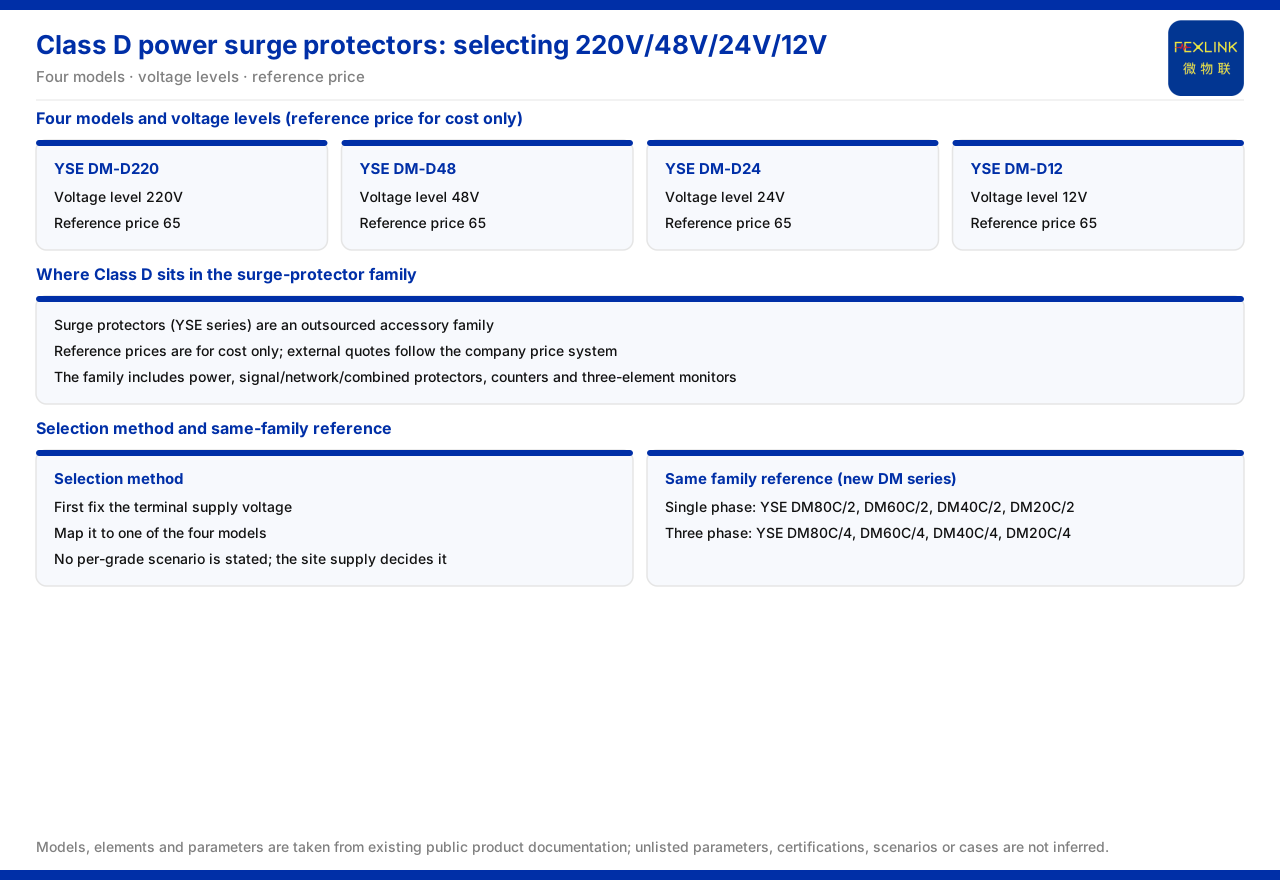
The Class D power SPDs belong to the power-protection part of the SPD product line and are distinguished by voltage level into four models:
| Model | Voltage level | | --- | --- | | YSE DM-D220 | 220V | | YSE DM-D48 | 48V | | YSE DM-D24 | 24V | | YSE DM-D12 | 12V |
All four share a reference price of 65, which is for cost reference only. The documentation also states that the surge protective devices (YSE series) belong to an outsourced companion system, so external quotations must follow the company's standard pricing system and must not use the cost reference price directly.
The model naming shows that the differences among the four center on voltage level: the suffixes D220, D48, D24, and D12 correspond to 220V, 48V, 24V, and 12V. For selection, this means the first criterion is the terminal supply voltage level, not another parameter. Aligning the voltage level is the main way to distinguish the four.
Why Selection Is Still Possible Without Listed Scenarios
In SPD selection, a scenario is usually decided by several factors together: whether the supply is AC or DC, what the voltage level is, where the installation sits, and how sensitive the protected equipment is to residual voltage. The documentation this time gives the voltage-level dimension and does not expand scenario descriptions per voltage band. This does not prevent selection, because the voltage level is itself one of the most basic and first-matched conditions.
Selection can be split into two steps. First, confirm the terminal supply voltage level and pick the model with the matching level from the four. Second, combine the other on-site requirements for power protection to confirm whether that model meets the installation and companion conditions. This uses the listed voltage levels without treating scenario information the documentation does not give as a settled conclusion. Conversely, skipping the voltage match and selecting by "it looks like this kind of scenario" makes it easy to err on the voltage level.
Where Class D Sits in the SPD Product Line
To understand the role of the Class D power SPDs, place them back in the overall structure of the SPD product line. Under this line the documentation lists power SPDs (the DM series, single-phase and three-phase), signal SPDs, network SPDs, two-in-one SPDs, plus lightning counters and three-element SPD monitors. The Class D power SPDs belong to the power-SPD branch, alongside the signal and network protection branches.
Within this structure, the new-generation power SPDs are the YSE DM series; the single-phase models include YSE DM80C/2, YSE DM60C/2, YSE DM40C/2, and YSE DM20C/2, and the three-phase models include YSE DM80C/4, YSE DM60C/4, YSE DM40C/4, and YSE DM20C/4. The DM series covers relatively common power protection levels, while the Class D power SPDs cover, beyond the DM series, the specific voltage levels of 220V, 48V, 24V, and 12V, especially the lower-voltage DC or low-voltage supplies.
Signal and network directions have corresponding products too, including 5V, 12V, 24V, and 48V signal surge protectors YSE XM-H5/12/24/48, broadcast-signal YSE XM-AU, and the POE network YSE X/RJ45-NET-POE. Together with the Class D power SPDs they form the outsourced companion protection system.
This structure shows that the Class D power SPDs are not an isolated category but one link cooperating with the DM-series power SPDs, signal SPDs, and network SPDs. The protected object differs, so the product branch differs: power protection corresponds to power SPDs, signal protection to signal SPDs, and network protection to network SPDs. Understanding this helps avoid mixing different protected objects during selection and gives the action "select Class D by voltage level" a clear scope — it handles power-side protection, not signal or network protection.
Understanding the Reference Price
The reference price of all four Class D power SPDs is 65. The word "reference" matters here: the documentation makes clear that this price is for cost reference, and that the SPDs belong to an outsourced companion system whose external quotation must follow the company's standard pricing system. That is, the number 65 cannot be used directly as an external quotation; it is only an internal cost reference.
In practice, mixing the reference price with the external quotation easily causes inconsistent quotation practice. The safer approach is to use only the voltage level and companion relationship as the selection basis at the selection stage, and to calculate separately at the quotation stage according to the company's standard pricing system, stating the nature of the reference price.
Selection Method: Voltage Level First, Then Companions
Putting the information together, Class D power SPD selection can proceed in the following order:
1. Confirm the terminal supply voltage level: 220V, 48V, 24V, or 12V. 2. Choose the model with the matching voltage level from the four: YSE DM-D220, YSE DM-D48, YSE DM-D24, or YSE DM-D12. 3. Confirm the installation location and companion relationship, and judge whether the point is power protection or needs to work with signal or network protection. 4. If a system has power protection as well as signal and network protection needs, select by protected object rather than covering all with one model. 5. At the quotation stage, follow the company's standard pricing system; the reference price is for cost reference only.
The key to this order is to put voltage-level matching first. Since the four are distinguished by voltage level, the first question of selection is whether the voltage matches; installation, companions, and quotation come only after this step.
Boundaries to State
The documentation's information boundary for the Class D power SPDs is fairly clear: it lists four models with their voltage levels and reference price, and places Class D under the power-SPD branch of the SPD product line. What it does not do is describe a scenario for each voltage band separately, or bind a voltage band directly to a type of equipment or a site.
So when asked "where are 220V, 48V, 24V, and 12V each used," what can be confirmed is that the four correspond to these four voltage levels; the specific equipment, cabinet, or site depends on the terminal supply conditions. Treating the voltage level as the certain part of the answer and the specific scenario as the part to be confirmed on site is the safest reading of this documentation.
Summary
The Class D power SPDs are divided by voltage level into 220V, 48V, 24V, and 12V models — YSE DM-D220, YSE DM-D48, YSE DM-D24, and YSE DM-D12 — with a reference price of 65 for cost reference only. The documentation does not give specific application scenarios per voltage, so "application scenario" should start from voltage-level matching: confirm the terminal supply voltage, choose the corresponding model, and handle quotation by the company's standard pricing system. This uses the information the documentation can confirm without overstepping its boundary to write scenarios.