Direct answer
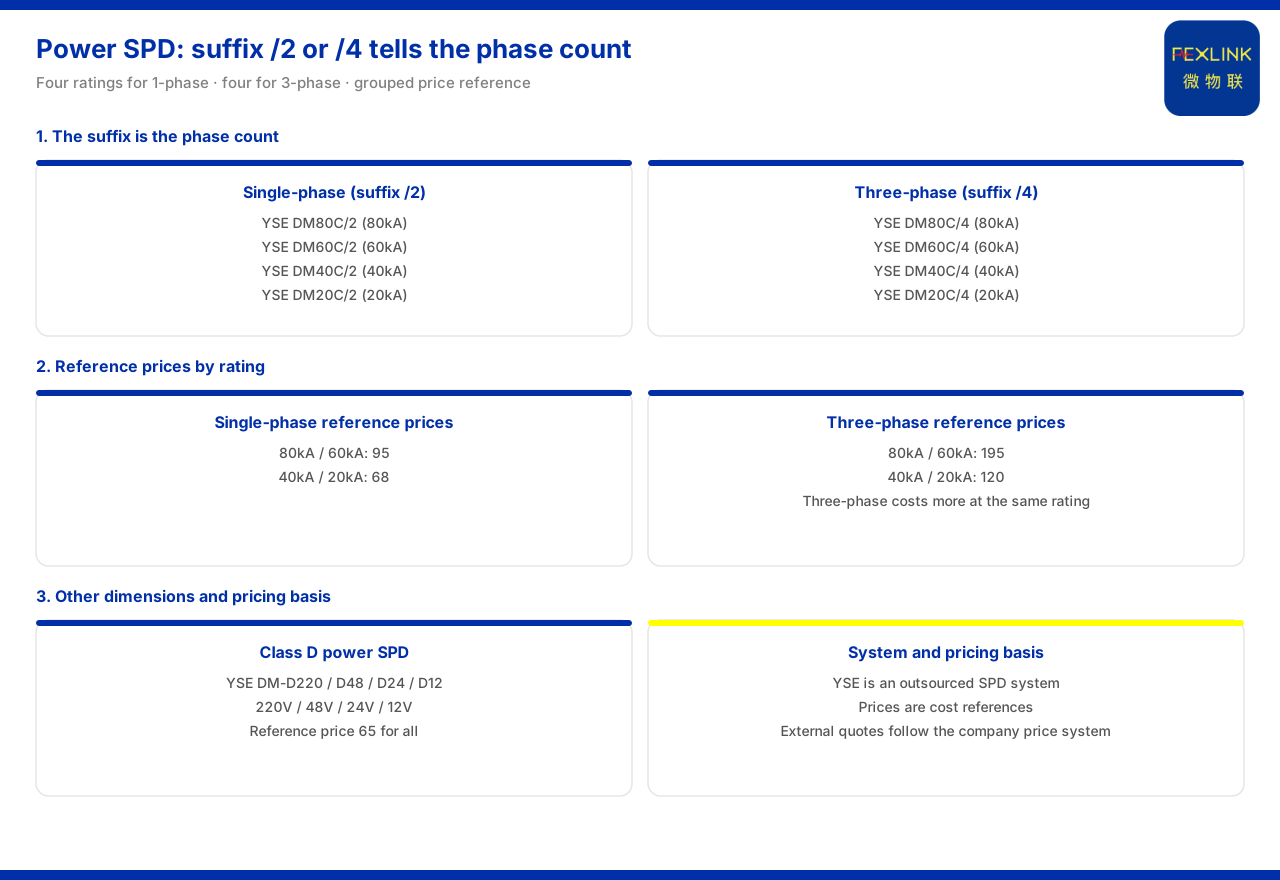
When choosing a power surge protective device, first establish whether the protected distribution system is single-phase or three-phase, then the current step required, and finally the price convention. The new-generation power surge protective devices in the product knowledge base distinguish phase count by model suffix: the single-phase suffix is /2 and the three-phase suffix is /4. Taking the 80-kiloampere step as an example, the single-phase model is YSE DM80C/2 and the three-phase model is YSE DM80C/4, the suffix corresponding directly to the phase count of the protected system. Single-phase and three-phase each have four steps of 80, 60, 40 and 20 kiloamperes: for single-phase, YSE DM80C/2, YSE DM60C/2, YSE DM40C/2 and YSE DM20C/2; for three-phase, YSE DM80C/4, YSE DM60C/4, YSE DM40C/4 and YSE DM20C/4. On reference prices, single-phase 80 and 60 kiloamperes are 95 and single-phase 40 and 20 kiloamperes are 68; three-phase 80 and 60 kiloamperes are 195 and three-phase 40 and 20 kiloamperes are 120, so at the same current step the three-phase reference price is higher than the single-phase one. Note in particular that this arrester belongs to an outsourced supporting system: the prices listed are for cost reference, and an external quotation must follow the company's standard price system. In addition, beyond phase count the power surge protective device has voltage specification as an independent selection dimension.
1. The suffix is the phase count: what /2 and /4 mean
The first thing to read in a model is the suffix. The product knowledge base records that in the new-generation power surge protective devices the single-phase suffix is /2 and the three-phase suffix is /4. For example, 80-kiloampere single-phase is YSE DM80C/2 and 80-kiloampere three-phase is YSE DM80C/4. The suffix corresponds directly to the phase count of the protected distribution system, so the first step in selection is not to pick a current step but to confirm whether the site is a single-phase or three-phase system; if the suffix is wrong, no matter how carefully the rest is chosen it will still be wrong. Once this rule is remembered, the rest of the model can be read by current step: under the same phase count, the number in the middle of the model indicates that step's discharge capability, decreasing from 80 to 20.
2. The four single-phase steps: from 80 to 20 kiloamperes
The single-phase power surge protective device has four steps. The product knowledge base lists the single-phase power surge protective device (YSE DM80C/2) for 80 kiloamperes, the single-phase power surge protective device (YSE DM60C/2) for 60 kiloamperes, the single-phase power surge protective device (YSE DM40C/2) for 40 kiloamperes and the single-phase power surge protective device (YSE DM20C/2) for 20 kiloamperes, all marked as single-phase by the /2 suffix. The single-phase product line is thus divided into four steps by discharge capability, with the number in the model corresponding one-to-one with the current step. In selection, first fix the step by the protection requirement of the single-phase system, then verify it against the corresponding model.
3. The four three-phase steps: corresponding models at the same current
The three-phase power surge protective device likewise has four steps. The product knowledge base lists the three-phase power surge protective device (YSE DM80C/4) for 80 kiloamperes, the three-phase power surge protective device (YSE DM60C/4) for 60 kiloamperes, the three-phase power surge protective device (YSE DM40C/4) for 40 kiloamperes and the three-phase power surge protective device (YSE DM20C/4) for 20 kiloamperes, all marked as three-phase by the /4 suffix. Compared with the single-phase line, the four three-phase current steps correspond one-to-one with the single-phase ones, the only difference being the suffix that expresses phase count. In selection, if the site is a three-phase system choose among the four three-phase steps by current requirement; if single-phase, choose among the four single-phase steps.
4. Reference price: three-phase higher than single-phase at the same step
On price, the product knowledge base gives four sets of reference prices. Single-phase 80 and 60 kiloamperes are 95, and single-phase 40 and 20 kiloamperes are 68; three-phase 80 and 60 kiloamperes are 195, and three-phase 40 and 20 kiloamperes are 120. Two patterns are visible: first, under the same phase count the high current steps (80 and 60 kiloamperes) and the low current steps (40 and 20 kiloamperes) fall into two price bands; second, at the same current step the three-phase reference price is higher than the single-phase one. By mapping reference prices to models, selection can show the relation among phase count, current step and price at the same time.
5. Outsourced supporting nature: price convention and quotation system
The price convention of this product line must be stressed. The arrester section of the product knowledge base states that the series to which the power surge protective device belongs is an outsourced supporting arrester system, produced by an outside party, and that the prices shown are for cost reference and an external quotation must follow the company's standard price system. The reference prices above are therefore for internal cost and selection comparison and cannot be used directly as an external transaction price. When quoting a project, first select the model by phase count and current step, then have the external price determined through the company's standard price system. Keeping this convention separate from selection avoids mistaking a reference price for an external quotation.
6. Another dimension: D-class voltage specifications
Beyond division by phase count, the power surge protective device also has D-class products distinguished by voltage specification. The product knowledge base lists the D-class power surge protective device (YSE DM-D220), the D-class power surge protective device (YSE DM-D48), the D-class power surge protective device (YSE DM-D24) and the D-class power surge protective device (YSE DM-D12), all with a reference price of 65. This shows that phase count (single-phase and three-phase) is only one selection dimension and that direct-current or different-voltage-level applications depend on the independent dimension of voltage specification. In selection, if the application voltage is not a conventional alternating-current system, it should be confirmed among the D-class voltage specifications rather than choosing only between single-phase and three-phase.
7. Selection check order
Bringing the above together gives a check order. First, confirm whether the protected system is single-phase or three-phase and fix the /2 or /4 suffix accordingly. Second, determine the 80, 60, 40 or 20 kiloampere current step by protection requirement. Third, combine phase count and current step into a specific model, for example single-phase 80 kiloamperes as YSE DM80C/2 and three-phase 80 kiloamperes as YSE DM80C/4. Fourth, check the reference price and make clear that it is for cost reference only and that the external quotation follows the company's standard price system. Fifth, if the system voltage is special, turn to the D-class voltage-specification models. By this order, selection of the power surge protective device moves from phase count to model, with a basis at each step.
8. Common misreadings
Several points are easily misread in selection. First, taking the reference price directly as an external quotation. This series is an outsourced supporting arrester system, and the prices listed are for cost reference while the external quotation must follow the company's standard price system; the two must not be mixed. Second, ignoring the suffix phase count. Single-phase is /2 and three-phase is /4; without first confirming the system phase count, choosing by current step alone easily goes wrong. Third, treating single-phase and three-phase as different specifications of the same model. They are independent product lines, and the same current step corresponds to different models and different reference prices. Fourth, equating D-class voltage specifications with single-phase and three-phase. D-class is another dimension divided by voltage specification, aimed at different voltage-level applications, and does not substitute for the phase-count choice. Keeping these points apart makes selection more reliable.
Scope and limitations
First, this article restates only what the product knowledge base records; the factual boundary is limited to the records of the single-phase and three-phase models, the four current steps and reference prices of the new-generation power surge protective devices, and the D-class voltage-specification models.
Second, the single-phase suffix /2, the three-phase suffix /4, and the specific models of the four single-phase and four three-phase steps are cited as the knowledge base lists them; this article does not infer models or steps not listed.
Third, the reference price figures are cited as listed, and their nature is a cost reference under the outsourced system; this article does not infer an external quotation from them, and external quotation must follow the company's standard price system.
Fourth, the four voltage-specification models and reference price of the D-class power surge protective device are cited as listed.
Fifth, this article only explains the selection method of phase count, current step and price convention for the power surge protective device; it provides no selection calculation, configuration quantity or setting scheme for a specific project, and related conclusions must be determined in conjunction with site conditions and the project scheme.