Direct answer
Energy-storage health has to be viewed through both safety and lifetime because, in the framework of the product knowledge base, it is neither a single capacity indicator nor a single fault indicator: the four-dimension impact assessment lists safety and lifetime as independent dimensions, while the special topics of the Tianyan engine place energy-storage SOH (State of Health) alongside high-voltage switchgear health, transformer lifetime and UPS assessment. The same energy-storage system's "health" therefore lands on both dimensions, sharing one entry point while answering different questions: safety asks whether something will go wrong, lifetime asks how much longer it can be used. Around this intersection, this article sets out the knowledge base's statements on these points.
Four-dimension impact assessment: why safety and lifetime are listed side by side
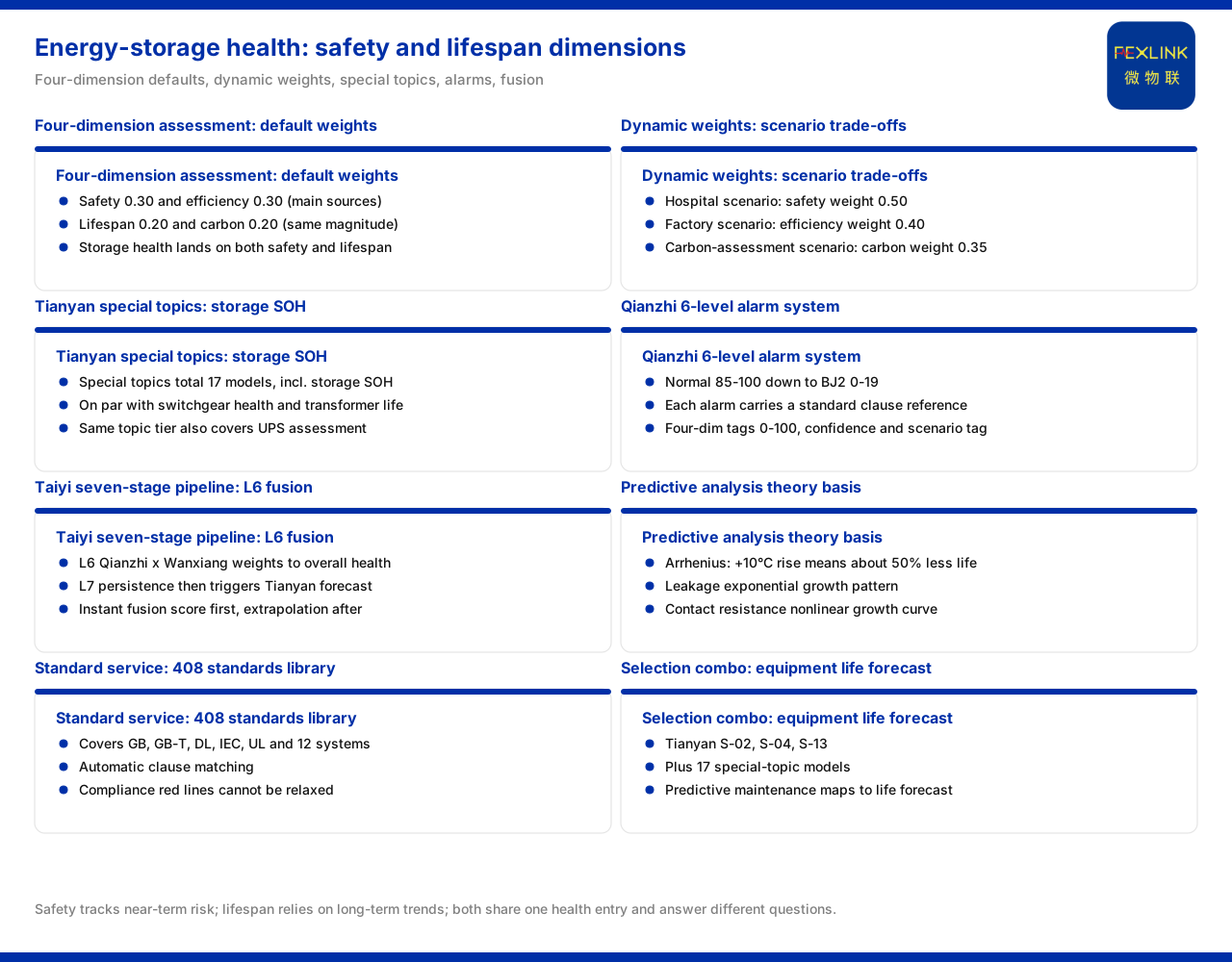
The product knowledge base divides the impact assessment of electrical and energy scenarios into four dimensions: safety, efficiency, lifetime and carbon. Under the default weights given by the knowledge base, safety is 0.30, efficiency 0.30, lifetime 0.20 and carbon 0.20. Two structural arrangements are worth noting. First, safety and efficiency carry equal default weight at three tenths each, which shows that in general scenarios the knowledge base does not simply let safety override efficiency but lets the two together form the main source of scoring. Second, lifetime sits at 0.20 alongside carbon, meaning that the usable life of equipment and its carbon-emission impact are considered on the same order of magnitude.
For energy storage, this structure determines where "health" lands. Changes in a system often have two classes of consequence at once: safety consequences such as thermal-runaway risk, insulation degradation and abnormal heating at connection points, and lifetime consequences such as cycle fading, capacity decline and rising internal resistance. A single dimension would mix them and blur "dangerous now" against "degrading in future"; treating safety and lifetime as independent dimensions lets energy-storage health be observed separately on one scoring sheet.
Dynamic weights: different scenarios, different trade-offs
Beyond the default weights, the knowledge base also gives a set of dynamic-weight values: in a hospital scenario the safety weight is 0.50, in a factory scenario the efficiency weight is 0.40, and in a carbon-assessment scenario the carbon weight is 0.35. These figures show that the weights are not fixed but adjusted with the scenario objective. A hospital raises safety to 0.50 because the cost of a power interruption or a safety incident is unacceptable in a medical setting; a factory raises efficiency to 0.40 because production continuity directly affects output; carbon assessment raises carbon to 0.35 because the accounting objective changes the focus of evaluation.
For energy-storage health, dynamic weights mean the same system's score may be explained differently in different scenarios. Energy storage is often used for peak shaving, backup power and renewable-energy consumption, and may sit near a hospital or factory or enter a carbon-assessment system; scenario weights let its health be re-proportioned to the deployment objective instead of one general set.
Special topics of the Tianyan engine: where energy-storage SOH belongs
The knowledge base lists the special topics of the Tianyan engine as 17 models in total, among which energy-storage SOH is explicitly included and placed alongside high-voltage switchgear health, transformer lifetime and UPS assessment. This side-by-side relation itself conveys two pieces of information. First, energy-storage SOH is not an isolated algorithm but sits at the same topic level as other asset-health models, showing that it is regarded as a concrete landing point of the "equipment health" matter on the energy-storage side. Second, the objects listed alongside it respectively cover switchgear, transformers and uninterruptible power supplies, all typical asset categories in an electrical power system; the presence of energy storage among them means it occupies an independent position in the knowledge base's asset-health view.
It should be noted that what the knowledge base gives here is the inventory convention of topic models: 17 models in total, of which energy-storage SOH is one. This article does not expand the internal algorithms of each model, nor does it extrapolate the number of topics into a commitment about detection capability for a specific project.
The Qianzhi engine alert system: a four-dimension tag on every alert
A change in energy-storage health ultimately lands on an alert. The knowledge base describes the Qianzhi engine as using a six-level alert system, with levels ranging from a normal band of 85 to 100 points down to BJ2 at 0 to 19 points. In this system, every alert carries a standard-clause reference, a four-dimension impact tag (safety, efficiency, lifetime and carbon, each scored from 0 to 100), a confidence level and a scenario tag.
This design moves the four-dimension assessment described above from "whole-machine scoring" down to "a single alert". For energy storage, this means that an alert about temperature rise or insulation does not merely tell operations staff that "there is an anomaly"; it also gives the impact scores on the safety and lifetime dimensions, together with the standard clause cited, the confidence level and the scenario tag. Health is therefore not just a number on a screen but a structured result that can be traced from alert to specific dimension and basis.
The Taiyi hub: fusion decision and persistence linkage
In the seven-level pipeline of the Taiyi intelligent control hub system, the sixth level is the fusion decision, in which the Qianzhi engine and the Wanxiang engine are weighted and combined to produce a composite health score; the seventh level is persistence, after which the prediction of the Tianyan engine is triggered. This chain links the three engines: Qianzhi handles perception and alerting, Wanxiang handles assessment and weight combination, and Tianyan handles prediction after the data is stored.
For energy-storage health, the order matters: the composite score is produced at the sixth level, while prediction is triggered only after persistence at the seventh. There is first the current fusion score, then the future-oriented prediction, so energy-storage "health" has both an immediate-judgement side and a time-extrapolated side. This echoes the safety/lifetime distinction: safety is closer to immediate risk, lifetime depends on long-term trends, and a trend needs persisted data to support prediction.
Theoretical basis of predictive analysis
The knowledge base lists three theoretical bases for the Tianyan engine's predictive analysis: the Arrhenius equation, the exponential growth of leakage current and the nonlinear growth curve of contact resistance. The Arrhenius equation gives the empirical relation that for every 10 degrees Celsius rise in temperature, insulation lifetime is shortened by about 50%, directly connecting temperature, a measurable present state, with lifetime, an inferable future result.
For energy storage, this pushes "health" from static scoring toward dynamic prediction: temperature rise affects insulation lifetime through Arrhenius, leakage grows exponentially, and contact resistance grows nonlinearly. The knowledge base uses these three as the theoretical explanation; this article cites them as they stand and infers no specific device's remaining lifetime.
Standard service and selection combination
The Taiyi standard service has a built-in library of 408 standards, covering 12 systems such as GB, GB-T, DL, IEC and UL, supports automatic clause matching, and its compliance red line cannot be relaxed. This means the clauses cited by an alert come from a fixed standard set, and the red-line part is not relaxed as weights are adjusted: dynamic weights can re-proportion safety and efficiency but cannot breach the compliance bottom line.
At the selection level, the twelfth part of the knowledge base lists the selection combination for "equipment lifetime prediction / predictive maintenance" as the Tianyan S-02, S-04 and S-13 models plus 17 special-topic models. This ties predictive maintenance and lifetime prediction to specific Tianyan selection items, giving asset scenarios such as energy storage a correspondence from objective to combination.
Applicability and limits
- This article is limited to the product knowledge base's existing statements on the four-dimension and dynamic weights, the Tianyan special topics, the Qianzhi six-level alert system, the Taiyi seven-level fusion decision, the theoretical basis of predictive analysis, and the standard service and selection combination; it does not extend to algorithm details, model counts or deployment conclusions not listed. - The weights in the text (safety 0.30, efficiency 0.30, lifetime 0.20 and carbon 0.20, as well as hospital safety 0.50, factory efficiency 0.40 and carbon assessment 0.35), the six-level alert bands, the 408-standard library, the 17 topic models and the selection combination are all conventions listed by the knowledge base and do not constitute a commitment to the result of any specific project. - The energy-storage SOH and the objects listed alongside it are given as they stand in the knowledge base; no further inference is made about each model's internal implementation. - That the compliance red line of the standard service cannot be relaxed is a knowledge-base convention; this article does not state it as a judgement on the compliance of any product. - This article does not constitute a commitment to any indicator not listed; actual capability is subject to the latest product documentation and project scheme.