Direct answer
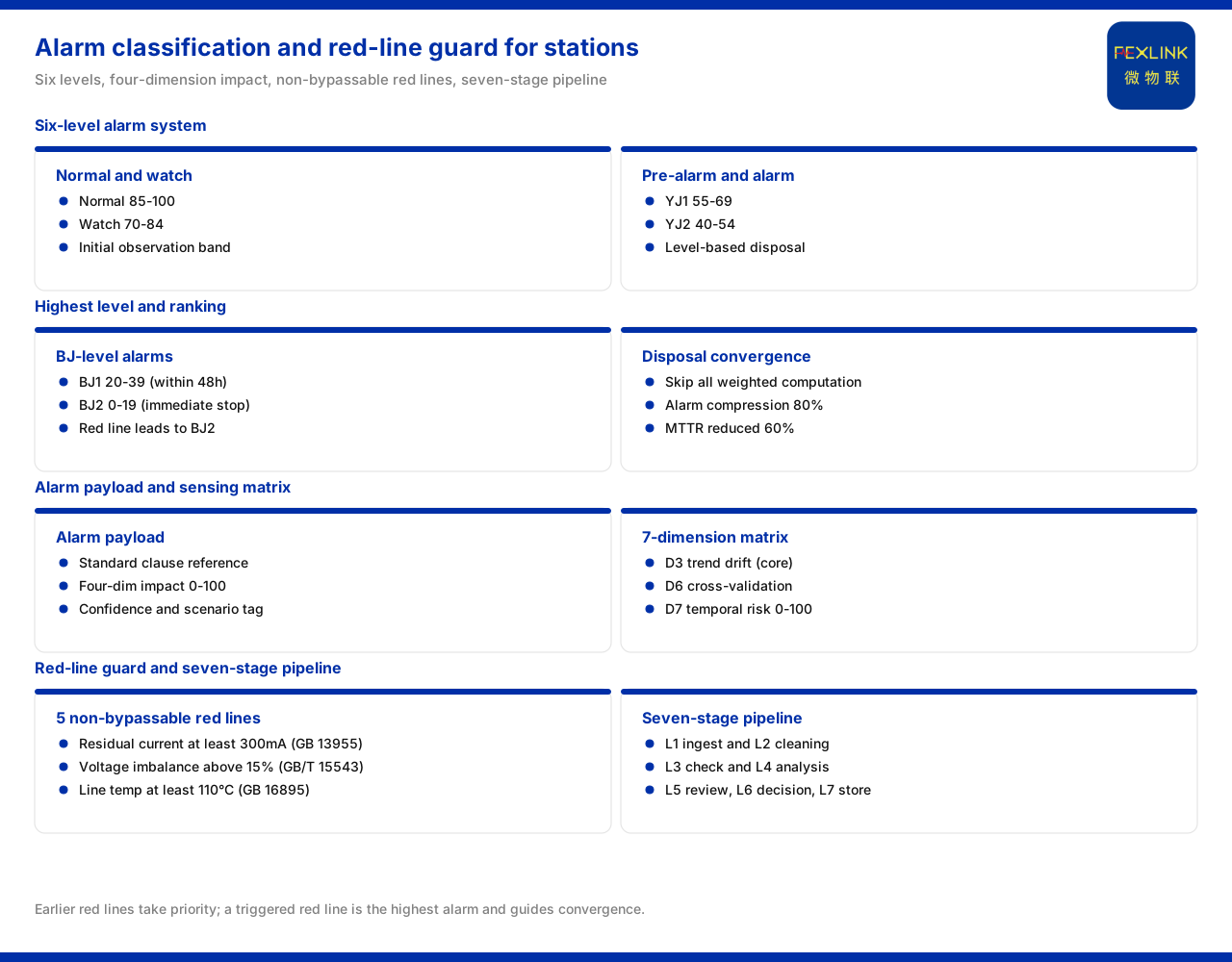
Alarm grading at a photovoltaic (PV) station maps onto the six-level system of the Qianzhi engine: normal is 85 to 100, Watch is 70 to 84, YJ1 is 55 to 69, YJ2 is 40 to 54, BJ1 is 20 to 39 with handling within 48 hours, and BJ2 is 0 to 19 with immediate shutdown. Each alarm additionally carries a standard-clause reference, a four-dimensional impact label, a confidence level and a scenario label, and these are what make handling order possible. One condition overrides the arithmetic: if the red-line pre-position check is triggered, the system emits the highest-level alarm directly and skips all weighted computation, so the outcome is no longer affected by grading. The product knowledge base records that the Taiyi intelligent control hub system counts new-energy stations among its applicable industries, and that its quantified value includes an alarm compression ratio of 80 percent, fault-location time shortened from days to 2 hours, and mean time to repair (MTTR) shortened by 60 percent. The sections below set out each element in turn.
1. The six levels and their handling deadlines
The product knowledge base records the six-level alarm system from high score to low as normal (85 to 100), Watch (70 to 84), YJ1 (55 to 69), YJ2 (40 to 54), BJ1 (20 to 39, handling within 48 hours) and BJ2 (0 to 19, immediate shutdown). The system maps a continuous score onto discrete levels and attaches handling deadlines to the two most severe levels: BJ1 must be handled within 48 hours, and BJ2 calls for immediate shutdown. For a station, the value of grading is that it turns "whether to respond" into "how urgent it is and how quickly it must be handled." This article quotes the score bands and deadlines exactly as the product knowledge base states them, and does not infer how many alarms each level will contain.
2. What each alarm carries
The product knowledge base records that every alarm carries a standard-clause reference, a four-dimensional impact label (safety, efficiency, life and carbon emission, each scored 0 to 100), a confidence level and a scenario label. This metadata supports grading and the ordering of handling: the clause reference shows the basis for the judgement, the impact label shows which aspect is affected, the confidence level shows how firm the conclusion is, and the scenario label shows the operating condition in which the alarm arose. Reading the metadata together with the level is what allows an operator to decide which alarm to handle first, rather than ranking on score alone. For a PV station, the difference between daytime generation and nighttime shutdown is pronounced, and the scenario label helps distinguish the operating state in which an alarm appeared, avoiding a judgement made out of context. This article restates only the classes of metadata carried and does not expand on how they are computed.
3. Why the red-line pre-position skips the weighting
The product knowledge base records that the standard check in the front-end layer runs before the Qianzhi sub-models are computed, as a red-line pre-position check; once a red line is triggered, the highest-level alarm is emitted directly and all weighted computation is skipped. The meaning of this design is that a red-line judgement takes priority over a composite score. When certain conditions have already reached an unacceptable state, the system does not wait for the dimensions to be weighted into an intermediate score but immediately assigns the highest level. For station alarm grading this amounts to a direct-to-top channel that sits outside the grading, preventing a severe condition from being diluted by an average.
4. The five red lines that cannot be bypassed
The product knowledge base records five red-line guard rules whose thresholds no one may raise. The first safety red-line is residual current of 300mA or more (based on GB 13955); the second is abnormal open circuit of grounding resistance (based on GB 50057); the third is three-phase voltage unbalance greater than 15 percent (based on GB/T 15543); the fourth is line temperature of 110 degrees Celsius or more (based on GB 16895); and the fifth is insulation resistance below 0.5 megohm (based on GB/T 16895). Together these cover five classes of risk: residual current, grounding, voltage unbalance, temperature and insulation, each with its corresponding standard. What they share is that they cannot be bypassed: unlike application-side thresholds that can be adjusted, red-line thresholds are fixed, and a trigger emits the highest-level alarm. This article quotes the thresholds and standard numbers exactly as recorded, does not reproduce the text of any standard clause, and does not present unverified limits in the name of a standard.
5. Where grading sits in the seven-stage pipeline
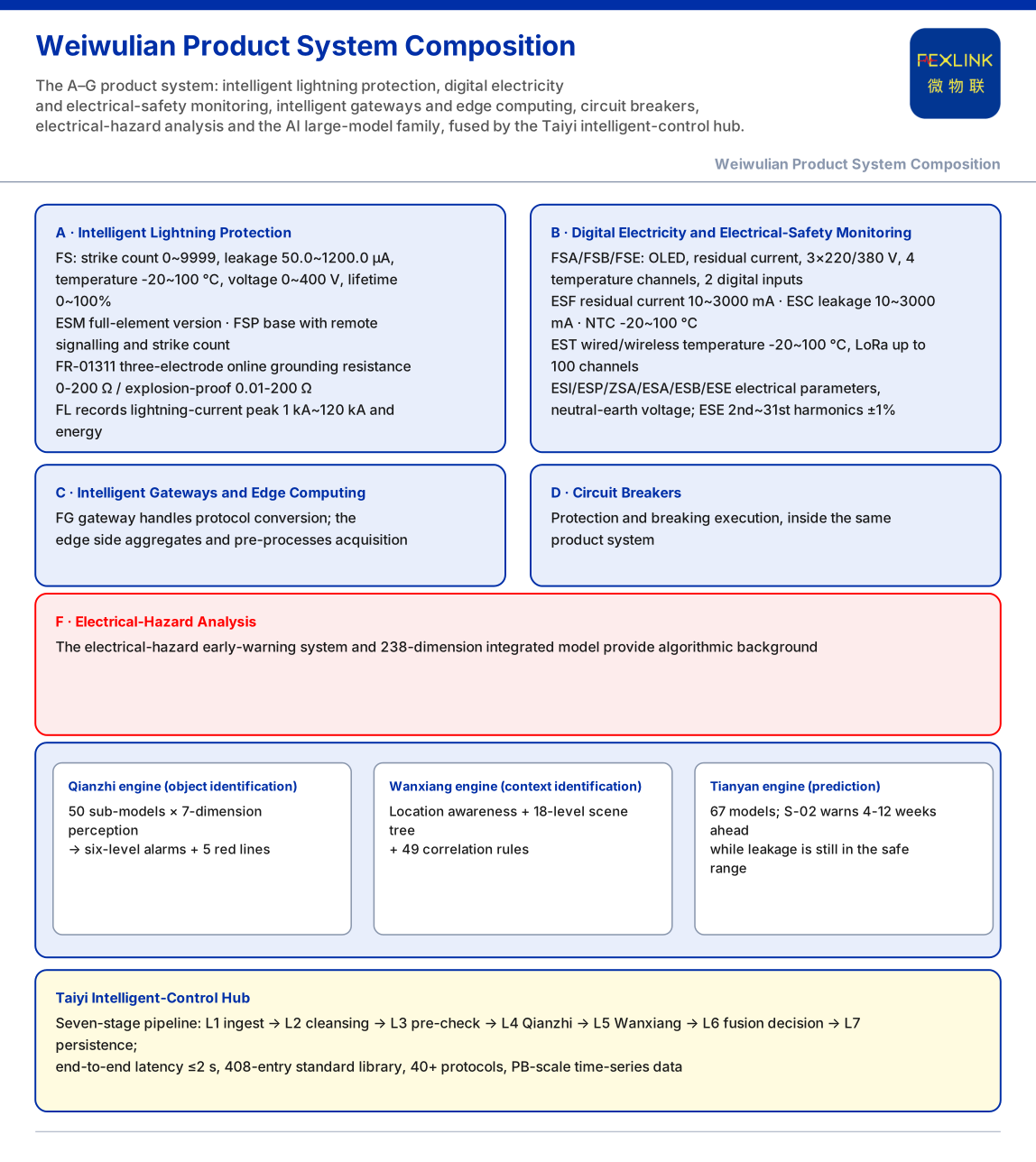
The product knowledge base records that the Taiyi intelligent control hub system is a seven-stage pipeline: access, cleaning, standard check, Qianzhi analysis, Wanxiang assessment, fusion decision and persistence, end to end in less than 2 seconds. Putting grading back into the pipeline: the standard check comes first, where the red-line pre-position intercepts; the Qianzhi analysis outputs the seven-dimensional perception and a composite score, of which the seventh dimension is a 0 to 100 composite decision; the Wanxiang assessment supplies correlation conclusions; and the fusion decision maps the result onto a level. The "less than 2 seconds" figure means that from data entry to conclusion output the process completes at the second scale, which matters to the timeliness a station requires.
The seven-dimensional perception matrix is D1 amplitude, D2 rate of change, D3 trend drift (the core), D4 anomaly density, D5 fluctuation amplitude, D6 correlation verification and D7 time-series risk score. The composite score on which grading rests is aggregated from this matrix. This article restates the names of the dimensions and the scoring band exactly as recorded.
6. The value figures: compression and response
The product knowledge base records that the quantified value of the Taiyi intelligent control hub system includes an alarm compression ratio of 80 percent, fault-location time shortened from days to 2 hours, and MTTR shortened by 60 percent. These three figures relate to graded response: the compression ratio shows that a large volume of raw alarms is condensed into a small number of effective ones, reducing noise; the location time shows the interval from alarm to location shrinking; and MTTR reflects handling efficiency. For station operations, the compression ratio lowers the screening burden while location time and MTTR lower the handling time; together they point at the overall efficiency from alarm generation to closure. This article restates only the figures given by the product knowledge base and does not read them as a guarantee for any particular PV station.
7. Deployment order at a station
First, confirm that on-site data can enter the access layer of the seven-stage pipeline and complete cleaning. Second, enable the red-line pre-position check of the standard check, ensuring the five red-line thresholds are fixed and cannot be raised. Third, enable the seven-dimensional perception of the Qianzhi analysis to obtain the 0 to 100 composite score. Fourth, map the score onto the six-level system and implement the 48-hour handling for BJ1 and the immediate shutdown for BJ2. Fifth, use the standard-clause reference, four-dimensional impact label, confidence level and scenario label carried by each alarm to order handling, and evaluate the effect against the compression ratio and response-time figures. This order breaks "grading" into executable actions: secure data entry, then red-line interception, then score computation, then level mapping, and finally ordering by metadata. If any link is missing, grading fails.
Scope and limitations
- This article is bounded by the product knowledge base's existing statements on the Qianzhi engine's six-level alarm system, alarm metadata, seven-dimensional perception matrix, standard-check red-line pre-position, red-line guard entries, and the Taiyi intelligent control hub system's seven-stage pipeline and quantified value. - The six-level score bands and handling deadlines, the four-dimensional impact label convention, the composite-score band, the five red-line thresholds and their standard numbers, and the pipeline end-to-end latency and three value figures are all as given by the product knowledge base. - This article quotes standard numbers as recorded and does not reproduce the text of any standard clause. - The product knowledge base records that the Taiyi intelligent control hub system counts new-energy stations among its applicable industries; this article does not infer from that any deployment scale or effect at a specific PV station. - This article does not constitute a commitment regarding alarm accuracy or response effect for any project; actual capability is subject to the latest product material and the project scheme.