Direct answer
Selecting the tier of a power SPD is essentially a matter of separating two things—pole count and discharge-current tier—and then trading them off against a cost reference. The YSE DM series power SPDs listed in the product knowledge base share one set of tiers across two forms: on the AC side the single-phase models run from 20 kA, 40 kA and 60 kA to 80 kA in four tiers, and the three-phase models reuse the same four tiers, distinguished only by the pole-count suffix. The selection order is therefore to fix the pole count first, then the kA tier. Besides AC power SPDs, the system also provides D-class power SPDs for 220V, 48V, 24V and 12V, and SPDs for signal and network links; the three address different supply systems and links and cannot substitute for one another. It should be noted in particular that the YSE series is an outsourced supporting system whose prices come from quotation material and serve only as a cost reference; external quotations must follow the company's standard price system.
First fix the pole count: how single-phase and three-phase are distinguished
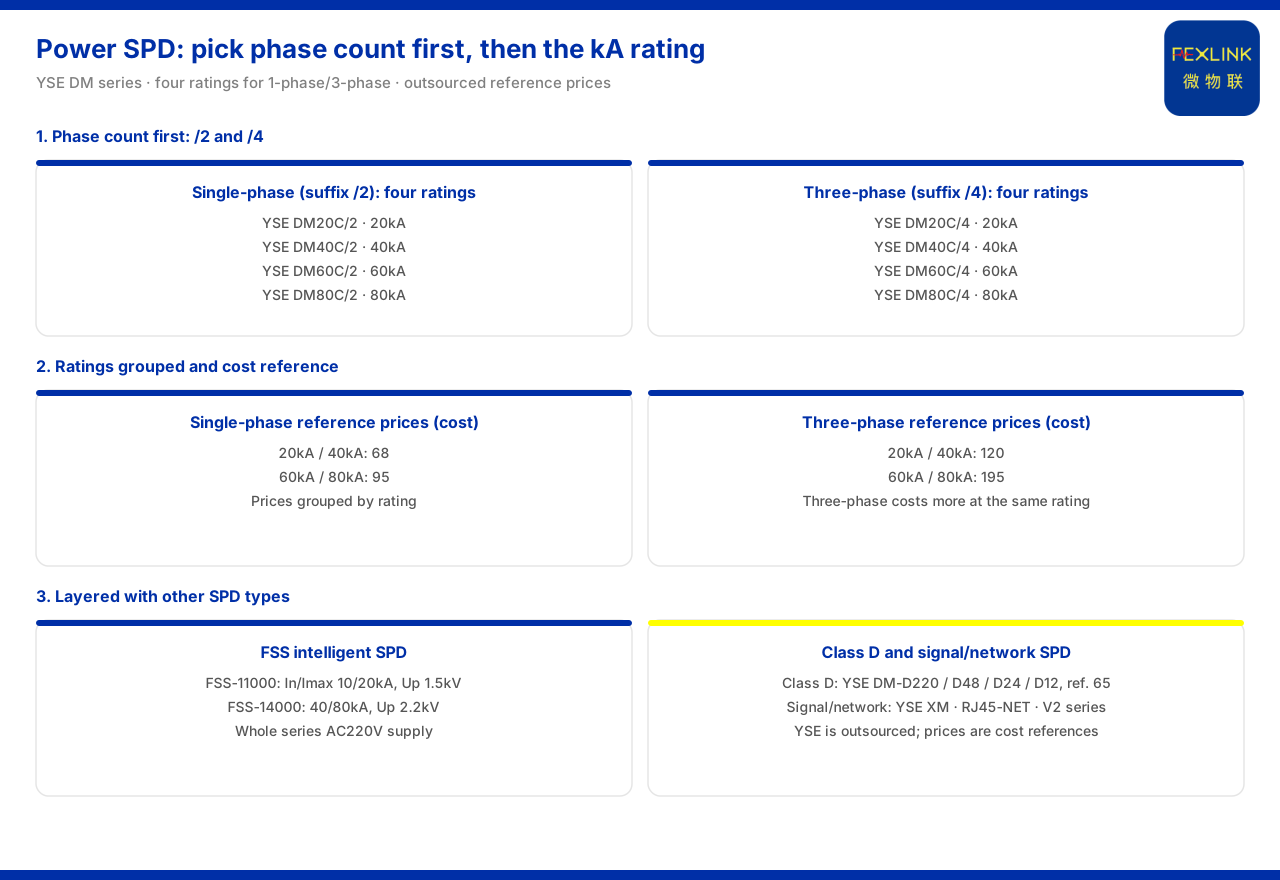
In the product knowledge base, the single-phase models of the YSE DM series power SPDs are YSE DM20C/2, DM40C/2, DM60C/2 and DM80C/2, and the three-phase models are YSE DM20C/4, DM40C/4, DM60C/4 and DM80C/4. The two groups share the same 20, 40, 60 and 80 kA tiers; the only difference is the pole-count marker at the end: /2 denotes single-phase and /4 denotes three-phase. The first step in selection is therefore not to compare kA figures but to confirm whether the protected circuit is single-phase or three-phase; after the pole count is confirmed, the kA tiers are compared within that same pole count, which avoids mixing models of different pole counts into one comparison table.
Then fix the kA tier: how the four steps are arranged
Once the pole count is fixed, the tier is chosen only among the four values 20 kA, 40 kA, 60 kA and 80 kA. The product knowledge base treats these four as a grading shared by single-phase and three-phase, showing that the system uses one and the same scale: 20 and 40 kA form the first two tiers, and 60 and 80 kA the last two. What matters in selection is the discharge-current magnitude the protected circuit is expected to withstand, not the assumption that a larger tier number is safer. Combining pole count with tier, the eight models cover exactly the full "two pole counts by four tiers" matrix, which is why the product knowledge base describes it as a single-phase four-tier selection placed alongside a three-phase four-tier one. A more robust practice is to fix the pole count and tier first, then compare prices within the same pole count and tier, avoiding a cross-pole-count choice driven by price difference that leads to a model-circuit mismatch and rework.
Prices grouped by tier: how to use them as a cost reference
The reference prices marked in the product knowledge base show that pricing is grouped by tier rather than given model by model: on the single-phase side 20 kA and 40 kA are both 68, and 60 kA and 80 kA are both 95; on the three-phase side 20 kA and 40 kA are both 120, and 60 kA and 80 kA are both 195. This grouping yields a direct conclusion: within one pole count, the price changes only where the tier grouping is crossed. Overlaying the price grouping on the tier grouping makes it possible, while meeting the magnitude requirement, to judge which segment carries the cost increment from stepping up a tier, rather than staring at a single model's list price.
Aligning the kA tier with the protection level
Beyond the tier, one more dimension—the protection level—needs to be understood. The FSS intelligent surge protective device (e.g. FSS-11000) listed in the product knowledge base is graded by nominal discharge current and maximum discharge current: FSS-11000 is 10 kA and 20 kA, FSS-12000 is 20 kA and 40 kA, FSS-13000 is 30 kA and 60 kA, and FSS-14000 is 40 kA and 80 kA, with corresponding protection levels of 1.5 kV, 1.8 kV, 2.0 kV and 2.2 kV respectively. This set of data serves as a reference for aligning the power SPD's kA tier with its protection level: as the tier rises, the protection level changes as well, so discharge current alone must not be read in isolation—it should be checked together with the protection level. In other words, the kA tier describes withstand capability and the protection level describes the residual-voltage suppression result; together they determine the protection effect, and lacking either is not enough to judge whether a configuration is suitable.
Beyond AC: D-class power SPDs tiered by voltage
The YSE DM series addresses AC power; beyond AC, the product knowledge base also lists the D-class power SPDs YSE DM-D220, DM-D48, DM-D24 and DM-D12, used respectively for 220V, 48V, 24V and 12V supplies, with a reference price of 65. This shows that the choice of a power SPD depends not only on the discharge-current tier but also on the supply system: AC circuits and DC circuits fall under different series in selection. Only by handling D-class models separately from the AC series can a DC circuit be prevented from being covered by an AC SPD, or vice versa.
Signal and network links need separate matching
Beyond power, the product knowledge base lists a whole set of signal and network SPDs, including YSE XM-H5/12/24/48, YSE XM-AU, and YSE X/RJ45-NET-POE/100/1000 and YSE V2-D220/NET. Their presence marks a boundary: power SPDs solve protection of the supply circuit, whereas protection of signal and network links must be matched separately with the corresponding models. Signal lines, network lines and power lines are not the same on the lightning-coupling path, so signal and network SPDs need to correspond by link type rather than being replaced by a single power SPD. When configuring the YSE DM series, therefore, it should be confirmed at the same time whether any signal or network link needs protection, so as not to cover only the power side and leave a link blind spot.
A checking sequence for implementation
Gathering the clues above into a sequence, four steps can be followed. First, confirm whether the protected circuit is single-phase or three-phase and select /2 or /4 accordingly. Second, choose the tier among the four values 20, 40, 60 and 80 kA by magnitude requirement. Third, use the price grouping to judge the cost increment of stepping up a tier, and check it against the protection level. Fourth, check whether any D-class DC circuit and any signal or network link still exist, and match the corresponding series if needed. In this order, tier selection answers "how pole count, tier and matching align", not merely a comparison of the price of one tier.
Applicability and limits
First, this article only restates content listed in the product knowledge base; its factual boundary is limited to the single-phase and three-phase models and tiers of the YSE DM series power SPDs, the reference-price grouping, the grading and protection levels of the FSS intelligent surge protective device, the D-class power SPD and signal/network SPD systems, and the outsourced supporting attribute of the YSE series, and it introduces no unlisted parameters, certifications or cases.
Second, the single-phase and three-phase models, kA tiers and reference prices of the YSE DM series are cited on the terms listed in the product knowledge base; this article draws no conclusion on the discharge-current value of a specific project.
Third, the nominal discharge current, maximum discharge current and protection level of the FSS intelligent surge protective device are cited on the terms listed in the product knowledge base and serve only as a reference for aligning tier with protection level.
Fourth, the voltage grading of the D-class power SPDs and the series composition of the signal/network SPDs are cited on the terms listed in the product knowledge base; this article does not infer unlisted specifications from them.
Fifth, the YSE series is an outsourced supporting system; its prices are for cost reference, and external quotations must follow the company's standard price system—this article does not constitute a quotation basis.
Sixth, this article does not commit to any specific project's selection result or on-site performance, which remain subject to the latest product documentation and project scheme.