Direct answer
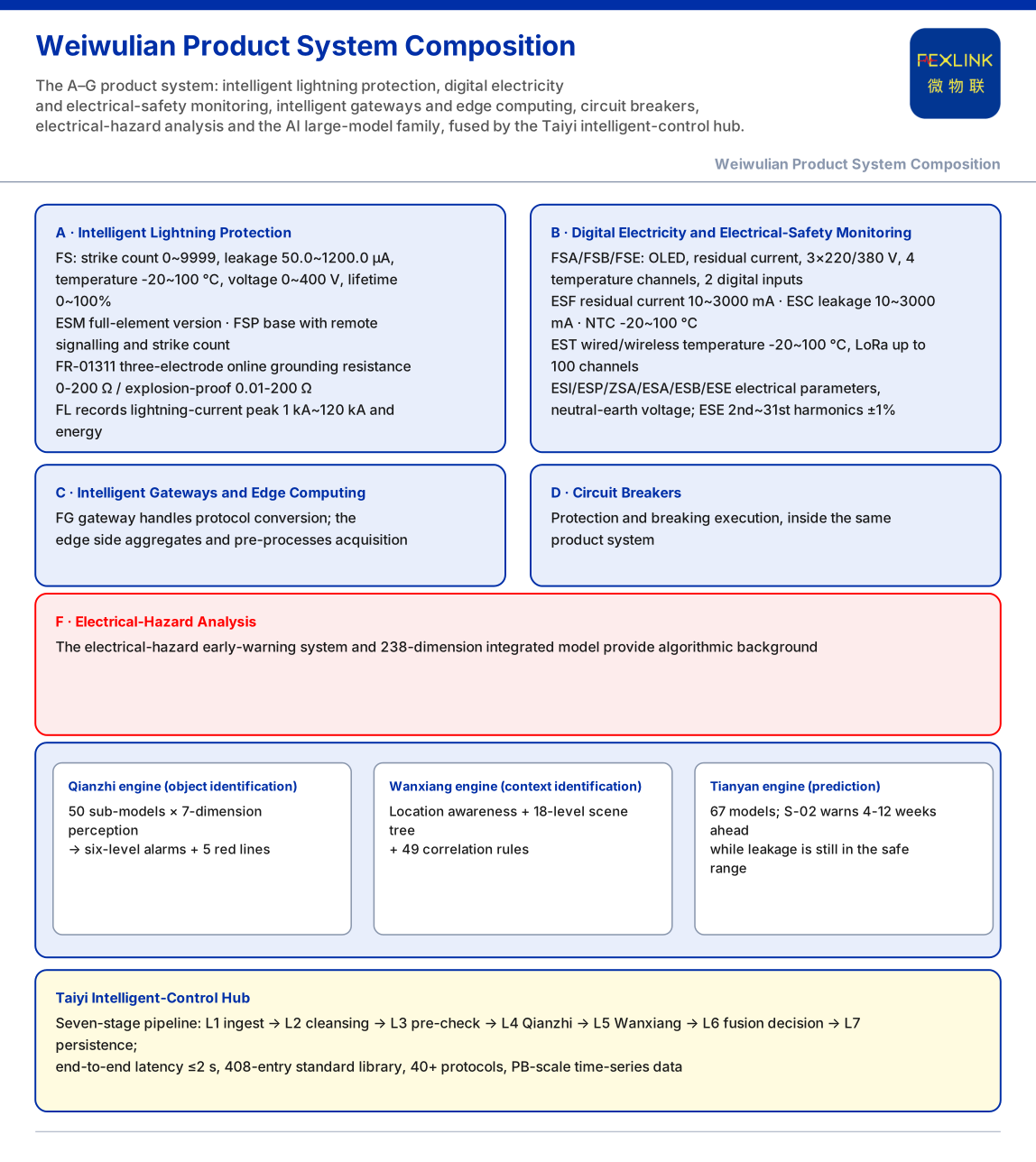
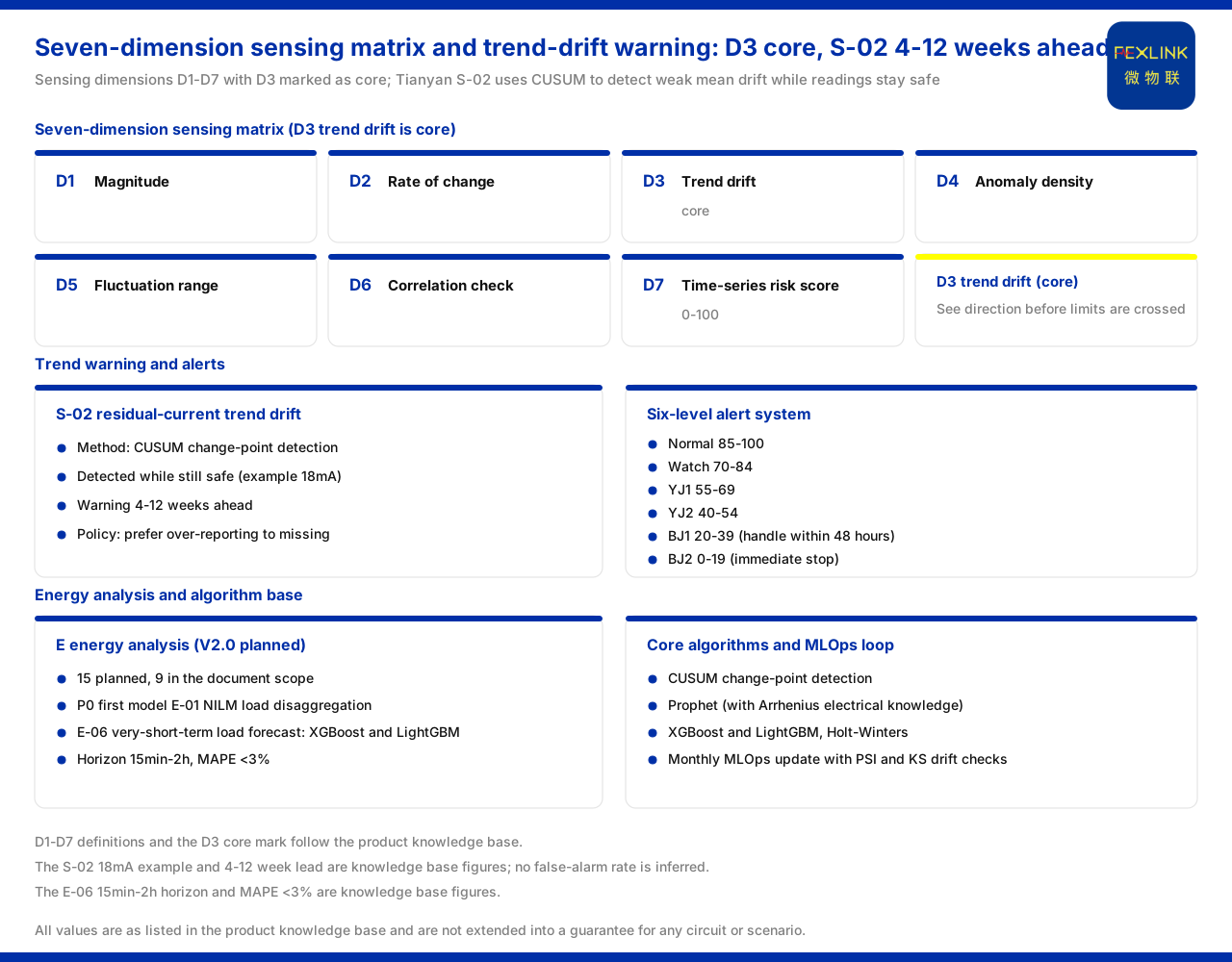
If equipment is still within the "normal range," is there no risk? The answer given by the product knowledge base lands on the dimension of "trend drift." The 7-dimensional perception matrix of the Qianzhi engine (large model) splits perception into D1 amplitude, D2 rate of change, D3 trend drift (core), D4 anomaly density, D5 fluctuation amplitude, D6 association verification and D7 time-series risk score (0 to 100 composite decision). D3 trend drift is marked as the core dimension. The product knowledge base also records that the S-02 residual-current trend-drift model of the Tianyan engine (large model) uses CUSUM, detecting a weak mean drift while leakage is still in the safe range (e.g. 18mA) and giving warning 4 to 12 weeks ahead, with a parameter strategy of "rather over-report than miss." This article restates only the items listed by the product knowledge base and infers no site's early-warning accuracy or false-alarm level.
1. From "measured" to "trend": the 7-dimensional perception matrix
Traditional monitoring answers "whether the current value is out of limit," and an out-of-limit alarm often means the problem has already happened. The product knowledge base records the Qianzhi engine's perception as a 7-dimensional perception matrix, precisely to provide more criteria before the limit is exceeded. D1 amplitude is the size of the instantaneous quantity, D2 rate of change is how fast it changes, D3 trend drift is a slow but continuous directional deviation, D4 anomaly density is how densely anomalies occur over a period, D5 fluctuation amplitude is the rise and fall around the mean, D6 association verification is the mutual corroboration among several related quantities, and D7 time-series risk score aggregates the above into a composite decision value of 0 to 100. Placing the seven side by side shows the design emphasis: both instantaneous and time-dimension judgement, and both single parameters and their relations. For problems that are "not yet out of limit but worsening," looking at amplitude alone is powerless; information in the time dimension is required. This also explains why the knowledge base marks D3 trend drift as the core dimension.
2. Why D3 trend drift is core
Trend drift differs from instantaneous fluctuation. An instantaneous fluctuation may be caused by a disturbance and then fall back; trend drift is the mean moving slowly in one direction over a longer time, invisible in a single sample and showing direction only when time is stretched. The knowledge base makes it the core dimension, showing that one focus of the system is identifying this "boiling-frog" kind of change. Recognizing trend drift needs not only a threshold but change-point detection. The product knowledge base records that the Tianyan engine's core algorithms include CUSUM change-point detection. CUSUM accumulates the deviation from the target and judges that a change has occurred when the cumulative amount exceeds a certain level. It is sensitive to slow, weak mean shifts and well suited to interpreting trend drift. D3 and CUSUM correspond in method and purpose: D3 raises "we must look at the trend," CUSUM provides "how to look at the trend."
3. S-02: weak drift within the safe range
The product knowledge base records that the S-02 residual-current trend-drift model of the Tianyan engine uses CUSUM, detecting a weak mean drift while leakage is still in the safe range (e.g. 18mA) and giving warning 4 to 12 weeks ahead. The key lies in the words "still in the safe range." 18mA itself may not be out of limit, and judging by threshold alone the system would give no prompt; but if the residual current drifts upward continuously over several weeks, it may later cross the limit. What S-02 captures is exactly this trend before the limit is exceeded. The knowledge base also records that the model's parameter strategy is "rather over-report than miss." This orientation matches the nature of trend warning: when the signal is weak and the conclusion uncertain, it tends to give more prompts to leave time for investigation, rather than waiting for sufficient evidence after the handling window has passed. This article cites only the model name, detection method, warning lead time and parameter-strategy orientation listed by the knowledge base, and infers neither its false-alarm rate nor its applicability to a specific circuit.
4. 6-level alarm and four-dimensional impact tags
Once a trend or anomaly forms a conclusion, it is output through the alarm system. The product knowledge base records that the Qianzhi engine uses a 6-level alarm system: normal (85 to 100 points), Watch (70 to 84 points), YJ1 (55 to 69 points), YJ2 (40 to 54 points), BJ1 (20 to 39 points, handled within 48 hours), BJ2 (0 to 19 points, immediate shutdown). The levels give a continuous range from "normal" to "immediate shutdown," with handling urgency rising as the score falls. The knowledge base also records that each alarm carries a standard clause reference, four-dimensional impact tags (safety, efficiency, lifetime and carbon, each scored 0 to 100), confidence and a scenario tag. For trend warning, confidence is especially important: when the signal is weak, the alarm should truthfully reflect its credibility for the user to judge with the scenario. The scenario tag states in what operating condition the alarm occurred, avoiding interpretation out of context. With these metadata alongside the level, an alarm is not just "whether it sounds" but can state its basis and certainty.
5. Energy analysis and ultra-short-term load forecasting
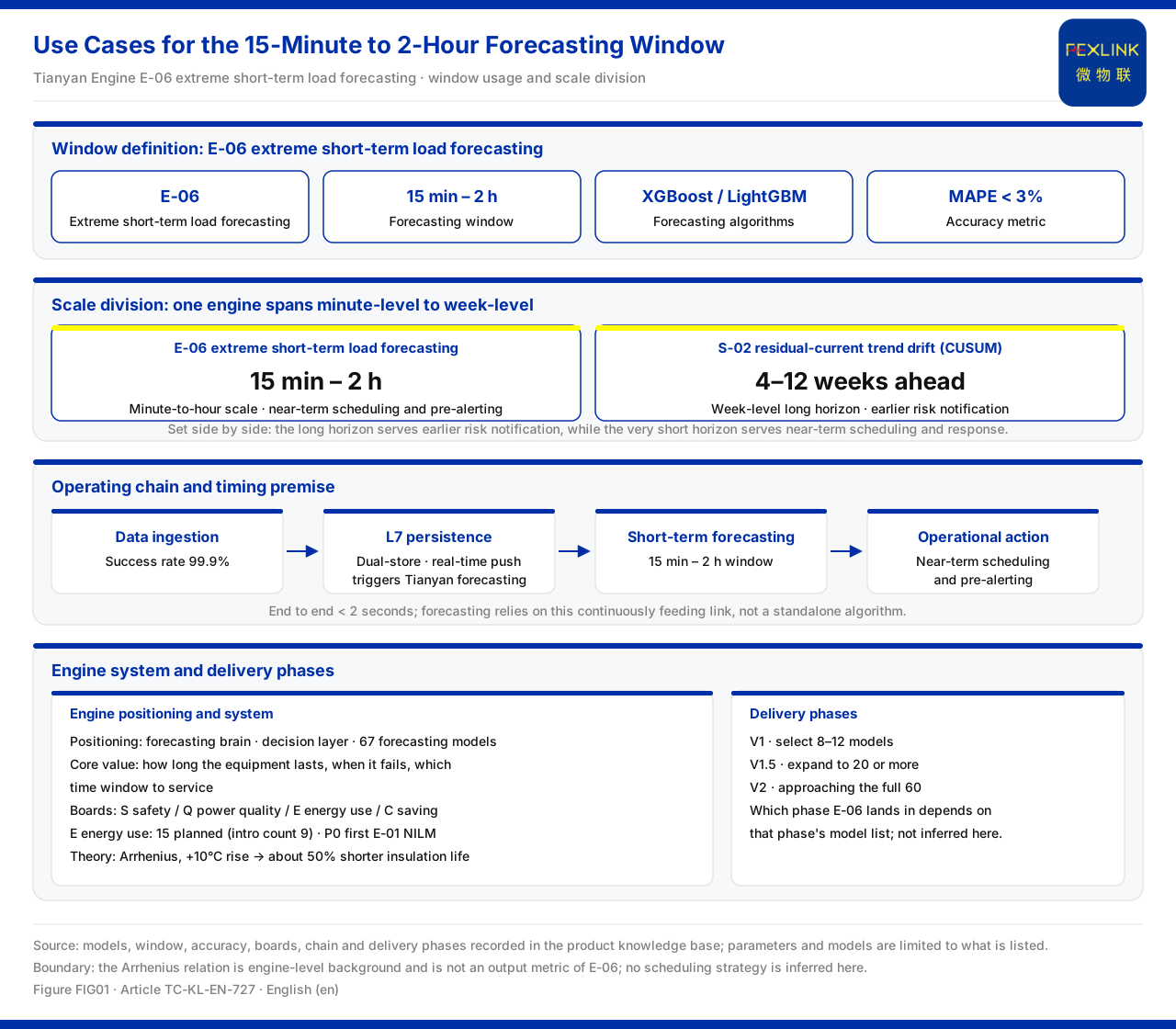
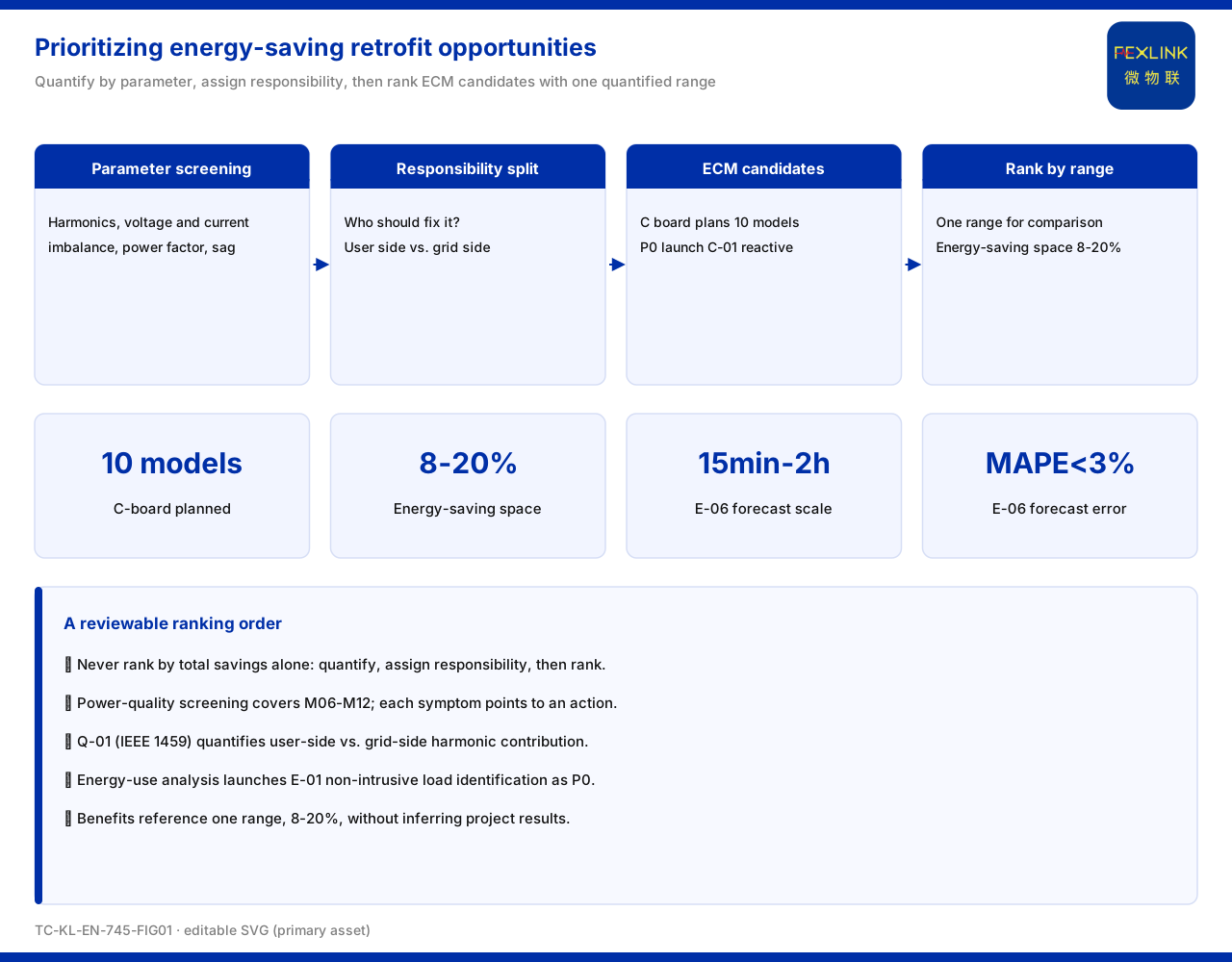
Beyond safety-related trend warning, the knowledge base also records the Tianyan engine's capability in the energy direction. Its E energy-analysis section plans 15 models in V2.0, with a documented count of 9; the P0 first-release model is E-01, using NILM non-intrusive load decomposition. NILM's role is to decompose the consumption composition of each device from the total electricity data without additionally installing sub-metering devices. The knowledge base records that E-06 ultra-short-term load forecasting uses XGBoost and LightGBM, with a forecasting time scale of 15 minutes to 2 hours and a mean absolute percentage error (MAPE) of less than 3%. Fixing the time scale at minutes to hours shows the model targets short-cycle scheduling and real-time energy management, not medium- and long-term planning. These values are product knowledge base specifications; this article does not infer their performance in other scenarios.
6. Algorithm base and model update loop
The above capabilities rest on a set of algorithms. The product knowledge base records that the Tianyan engine's core algorithms include CUSUM change-point detection, Prophet (with Arrhenius electrical knowledge injected), XGBoost and LightGBM, and Holt-Winters triple exponential smoothing. The four methods have different emphases: CUSUM for change-point detection, Prophet for trend and period modeling with electrical knowledge, XGBoost and LightGBM for load forecasting, and Holt-Winters for time series with trend and seasonality. The knowledge base also records that the Tianyan engine updates models monthly in an MLOps loop that includes PSI and KS drift detection. This loop means the model is not fixed after one training but iterated monthly while monitoring changes in the data distribution. PSI and KS detect whether the data distribution has shifted and belong to the model-maintenance stage. For trend warning and load forecasting, distribution changes directly affect judgement, so periodic updating is a necessary step to maintain usability. This article cites only the algorithms and update mechanism listed by the knowledge base and does not unfold their implementation details or effect evaluation.
Scope and limitations
First, this article restates only what the product knowledge base lists, with the factual boundary limited to the Qianzhi engine's 7-dimensional perception matrix D1 to D7 definitions and the D3 core marking, the 6-level alarm system, the standard clause reference and four-dimensional impact tags with confidence and scenario tag carried by alarms, the Tianyan engine's S-02 CUSUM detection and 4 to 12 week warning with the "rather over-report than miss" strategy, E energy-analysis V2.0's 15 items and documented 9 with E-01 NILM, E-06's 15 minutes to 2 hours and MAPE less than 3%, and the core algorithm list with monthly MLOps update and PSI and KS drift detection.
Second, this article does not excerpt the clause text of the relevant standards, nor give unverified limits in the name of a standard; standard content is subject to the officially published text.
Third, the S-02 safe-range example (18mA), warning lead time (4 to 12 weeks) and parameter-strategy orientation, and E-06's time scale and MAPE, are product knowledge base specifications; this article does not extend them to a guarantee for any site or circuit, nor infer false-alarm rates and applicability conditions.
Fourth, the specific calculation methods and weights of each dimension of the 7-dimensional perception matrix are not unfolded here; the scoring specification of the four-dimensional impact tags is limited to the range listed by the product knowledge base.
Fifth, this article constitutes no commitment to the early-warning accuracy, model performance or remediation effect of a specific project; actual capability is subject to the latest product material and project solution.